


For the storage space, 2025 proved to be a year of dramatic shifts and seismic realignments, with AI workloads forcing a fundamental rethinking of digital infrastructure.
The year saw VMware face unprecedented pressure from all sides following Broadcom's aggressive licensing overhaul, creating opportunities for nimble competitors to seize market share. Against this backdrop, upstarts like Vast Data emerged from relative obscurity to sign billion-dollar deals with hyperscalers, while established players like Dell Technologies rode surging AI demand to record revenues.
But perhaps most telling was how AI itself became both savior and disruptor for storage vendors, driving explosive growth for those who adapted quickly, while breaking traditional architectures that couldn't keep pace with the relentless data demands of large-scale inference workloads.
Here are the top themes from around the wonderful world of storage for 2025.
VMware under assault from all sides

It’s been quite a year for VMware, to say the least. The likes of Nutanix, Lenovo, Proxmox, Red Hat, and even hyperscalers are circling the Broadcom-owned firm with disgruntled customers looking for alternatives to its VMware Cloud Foundation (VCF) platform.
On the storage front, VMware did tout in late November that cloud environments powered by its virtual storage area network (vSAN) offering are set to get cheaper, having lowered the hardware configurations – or ReadyNodes – for its vSAN storage clusters and vSAN hyper-converged infrastructure (HCI) clusters.
But lowering costs hasn’t stopped it from becoming the market’s proverbial whipping boy, with rivals constantly nipping at its heels.
A Gartner report published this year, however, noted that despite the increase in rival offerings of late, there is “no parity replacement for VMware," with many alternatives either incomplete, maturing, or both.
Add to that Broadcom CEO Hock Tan’s proud proclamation that more than 90% of VMware’s 10,000 largest customers signed onto VCF. And its latest earnings revealed its division continues to be a business driver, with Broadcom’s infrastructure software business, where VMware sits, seeing revenues rise by 26% in fiscal 2025 to $27 billion for the full year.
Market leaders are always likely to face criticism from those below, but the sheer magnitude of rivalry VMware has faced in the past 12 months shows its position might not be as sure as it once was.
Read more on VMware
VMware exalts cloud savings, as market tide flows from Broadcom
Broadcom bulges with Anthropic, AI orders
How one company left VMware over Broadcom license changes
Vast Data becomes one to watch
The storage space is ripe for disruption, and Vast Data has quickly risen to the task. The New York-based firm may have only been founded in 2016, but has ridden the AI wave to firmly find its footing – and shows no signs of making way.
For those unfamiliar with Vast, it provides an operating system for AI, essentially unifying compute, data management, and storage infrastructure to create a high-performance foundation to power AI training and inference workloads.
It was Vast’s year in 2025, with the vendor securing several major deals, including a $1.17 billion tie-up with neocloud leader CoreWeave, wherein Vast's AI OS will serve as CoreWeave's primary data storage and management platform.
But it’s not just the industry newcomers Vast has signed up with. In November, it unveiled a milestone partnership with Google Cloud Platform (GCP) – its first hyperscale deal – to allow GCP users to connect clusters running in the platform with other forms of distributed infrastructure.
And yet, just days later, a second hyperscale deal, this time with Microsoft, providing Azure users with access to Vast’s suite of services.
“We're definitely architecting for this new AI era of training and inference,” Vast CEO Renen Hallak told SDxCentral in November. The firm is now valued at around $9 billion, a number that could well soar even higher in 2026. So one might say the future for Hallak and team is … Vast?
Read more on Vast Data
Google Cloud enlists Vast Data to support AI multi-environment deployments
Vast Data teams up with Microsoft for more agentic AI
Vast Data lands $1.17B CoreWeave deal for AI storage platform
Datadog has its day
Datadog was one of the breakout names of 2025, highlighted by a figurative and literal surge in its stock: the vendor joined the S&P 500 at the expense of the Hewlett Packard Enterprise-bound Juniper Networks, while its stock price has risen more than 16% in the past six months.
Founded by CEO Olivier Pomel and CTO Alexis Lê-Quôc in 2010, Datadog has since soared to such an extent that its market cap stands at nearly $50 billion – that’s considerably more than the $14 billion HPE paid for its S&P predecessor.
In late November, Datadog unveiled its pièce de résistance for the year: its Storage Management platform. The offering is designed to augment storage needs, chiefly assisting enterprises in building AI to catch anomalies in storage growth. It also comes with automated recommendations to help reduce cloud storage spend faster.
Yrieix Garnier, VP of product at Datadog, said at the time of the release that the platform would help companies building AI products better manage one of the consistent cost contributors or AI model training and inferencing.
The launch capped off a stellar year for the firm, which has firmly ridden the wave of robust demand for its cloud-security products from firms building out their AI stack.
The firm raised its fourth-quarter earnings forecast well above Wall Street estimates, a move only a dog with profound confidence that its day has come would do.
More on Datadog:
Datadog storage management solution targets rising AI storage costs
New tricks as Datadog replaces old Juniper Networks on S&P 500
Dell rides the AI wave well
If Vast and Datadog had good years, then Dell Technologies had a very good year. The vendor has seen intense demand for its storage lines, riding the AI wave to record-setting revenues.
Demand for its AI-optimized PowerEdge servers has been so substantial that it finds itself with a multibillion-dollar backlog. Joining forces with Nvidia on so-called AI factories has proved a major boon for the firm and its storage solutions – with Dell even claiming its Nvidia Blackwell-powered PowerEdge servers (like the liquid-cooled rack-scale XE9780L and XE9785L) are capable of delivering four-times faster large language model (LLM) training capabilities. It’s even looking beyond the data center, with PowerEdge lines targeting telecom and edge deployments released in September.
Amidst the upheaval at VMware, Dell inked a deal with Nutanix in April for a joint solution aimed at attracting customers dissatisfied with the Broadcom-VMware situation.
In fact, the upheaval at VMware even saw CEO Michael Dell suggest that its hyperconverged infrastructure (HCI) platform with VMware, VxRail, is “no longer a thing.”
While it’s still supporting VxRail, the Nutanix tie-up, combined with the surge in demand for its own storage solutions, sees Dell standing tall atop the storage market. IDC’s "Enterprise Storage Systems Tracker" placed the storage market crown atop Dell’s head with a 22.7% revenue share – though it did see a single-digit drop in growth during the third quarter as enterprises prioritize compute servers over storage solutions.
Read more on Dell
Dell, Nutanix launch their first external storage package
Dell targets telecom & edge deployments with new PowerEdge server
AI is making (and breaking) storage
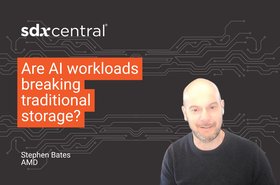
SDx Interviews: Are AI workloads breaking traditional storage?
AI workloads are changing how storage systems operate, requiring high-performance computing and better data management.
Sticking with AI, then, the sheer volume of data is completely changing how storage systems operate, leading to a rise in both storage servers with embedded GPUs and ever-augmented software solutions.
The rise of large-scale inference and disaggregated inference processing has seen the traditional storage stack flipped on its head, with the need for smarter ways of processing and moving information around. Such changes have seen AI-powered tools and applications aimed at ensuring the flow of AI-enthused traffic to provide peak capacity and hardware optimization.
Read more
Storage is transforming AI
AI traffic is flipping network architecture on its head: Here's what you need to know
Watch: Are AI workloads breaking traditional storage?
AMD's Steven Bates assesses the current state of the industry, AI-ready storage hype versus reality, and common misconceptions around storage.








Comments