


Enterprises are continuing to pour money into AI compute infrastructures but appear to be a lot more selective about their storage investments, according to data from IDC.
The research firm’s Worldwide Quarterly Server Tracker revealed that server vendor revenue soared 61% year-over-year (YoY) during the third quarter, hitting $112.4 billion. But on the storage side, Q3 revenue growth stood at just 2.1%.
IDC’s "Quarterly Enterprise Storage Systems Tracker"even acknowledged the disparity, labelling the storage market’s growth as “solid” despite being “eclipsed by the high double-digit growth in the server market, which is driven by investments in accelerated server infrastructure.”
The modest but growing flash storage demand could point to a clear compute-first strategy, with enterprises and hyperscalers building out their AI stack, opting for compute over storage.
IDC’s report suggests that revenue for servers with embedded GPUs alone grew 49.4% YoY, accounting for more than half of the server market revenue. In fact, demand from hyperscalers and cloud service providers picking up embedded systems fueled the server market growth to such an extent that it has almost doubled in size compared to 2024.
But while server demand is on the rise, firms may just be hedging their bets amid the ongoing memory frenzy, waiting to see where prices end up.
Recent price spikes and subsequent panic buying stemmed from the soaring demand from AI builders for memory hardware.
The memory market uncertainty is at such a level that SK Hynix is racing to set up a low-power wafer factory to try and alleviate supply chain issues, while Samsung raised prices of its DRAM wares by 60% as it’s looking to usurp its fellow South Korean contemporary as the world’s leading DRAM provider.
The memory market, which the storage space naturally relies on heavily, is in such dire straits that Micron moved to close shop on its consumer division in a bid to focus solely on enterprise AI demand.
A tale of two markets for Dell; HPE languishes
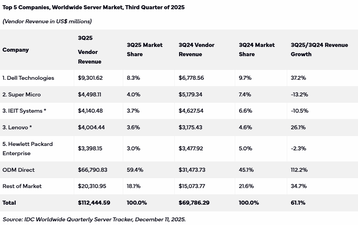
Both reports had Dell Technologies leading the server and storage markets, but with opposite trajectories.
On the server front, IDC had Dell with a clear market lead with 8.3% revenue share, with what the research firm described as “outstanding growth on accelerated servers,” a 37.2% jump.
But storage looks a little more precarious, with Dell seeing a single-digit drop in growth for Q3 – though it still holds 22.7% revenue share.
That hasn’t stopped demand for its PowerEdge line outstripping the need for its hyperconverged with VMware, which CEO Michael Dell recently claimed VxRail was “no longer a thing.”
In storage, Dell looks to be facing a resurgent Huawei, which saw a 9.5% growth in Q3 due to “very strong performance” in the Chinese market. Meanwhile, NetApp and Pure Storage are nipping at the pair’s heels in third and fourth place, respectively.
It’s a much different situation for Hewlett Packard Enterprise (HPE), with IDC having the now Juniper Networks-infused vendor languishing on both its respective storage and server market reports.
On the server front, HPE finished in the fifth position in the market with a 3% share, with a 2.3% drop in Q3 growth. The likes of Supermicro, IEIT Systems, and Lenovo found themselves above the Texas-based vendor.
On the storage side, HPE again finished fifth with a 5.6% market share – surpassed by Pure Storage after that firm saw double-digit growth. During its recent earnings report, Pure Storage cited increased spending on AI and neocloud projects as a major growth driver, with the vendor even increasing its full-year revenue and operating profit guidance.
On the more fruitful server side, not all vendors thrived, with Supermicro declining by 13.2% in Q3 despite holding the No. 2 position.
“IDC expects AI adoption [to] keep growing at an outstanding pace as major vendors continue reporting record orders and showing strong backlogs,” Juan Seminara, research director for IDC’s Worldwide Enterprise Infrastructure Trackers, explained. “Hyperscalers and cloud providers are still ahead with new, large deployments that require much higher compute density. Additionally, we started to see major AI-based research and education projects that will help fuel further growth path in the market.”
The death of the server middleman?

IDC’s "rest of market" category, which includes ODM direct sales where hyperscalers bypass traditional vendors to order directly from manufacturers, has some even more striking numbers.
The segment soared 112.2% YoY on the server side, representing 59.4% of the server market, suggesting that the biggest AI infrastructure buyers are increasingly cutting out the middleman for their compute needs.
In storage, meanwhile, the rest of the market grew a more modest 3.4% to capture 43.5% of the market, yet again showing storage investments remain measured and selective for now.
Geographically, the compute-first approach is particularly stark in the U.S., where server revenue surged 79.1%, but storage declined 9.9%. Canada followed a similar pattern with 69.8% server growth, while China showed more balanced growth at 37.6% for servers and 9.5% for storage.
Even traditionally strong storage markets like EMEA and Japan posted double-digit server growth (31% and 28.1% respectively), far outpacing their storage performance (10.5% and 14.4%).
“The penetration of AI-infused applications and AI models into corporate data centers will increase the need for more dedicated and efficient enterprise storage systems,” Seminara added. “IDC expects growing demand for flash storage to support projects related to AI, both for training and inferencing.”





Comments