


Agentic AI is coming, but approach with caution. By 2028, Gartner expects a third of enterprise software applications to include some form of agentic AI, with roughly 15% of day-to-day business decisions made autonomously. In 2024, that figure was less than 1%, a reminder that we’re still at the very start of a new chapter in automation.
But that hasn’t stopped the agentic AI hype machine from going into overdrive. For network managers, this is both a blessing and curse because while the excitement is forcing long-overdue conversations about automation, it has also complicated matters.
Almost every vendor now claims an agentic strategy, yet most of the tangible progress so far lies in quiet, practical steps, such as reasoning agents embedded in management tools, early experiments at the network edge, or cautious pilots designed to prove the concept without breaking anything.
The prize, according to Capgemini, could be worth as much as $450 billion in productivity and cost savings by 2028.
What is agentic AI?
Agentic AI refers to systems that can make decisions and take actions toward a defined goal. Rather than waiting for a command or running a fixed script, these systems can assess what’s happening, decide what needs doing, and get on with it.
In a networking context, that could mean software that spots a fault, applies a fix, checks the result, and logs the change, all without waiting for human approval.
How agentic AI works
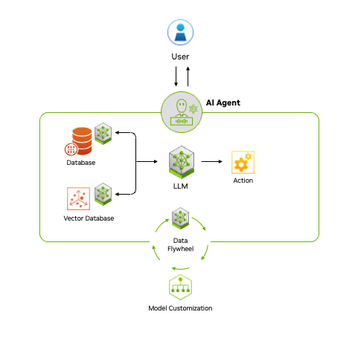
According to Ericsson, agentic AI builds on automation by introducing a continuous feedback loop – observe, reason, act, verify – allowing systems to adapt and refine their actions as conditions change, rather than waiting for human intervention. This, the company argues, represents the pathway to fully autonomous networks that can manage, optimise, and heal themselves. Nvidia makes a similar point, suggesting that agentic systems can “ingest vast amounts of data, independently analyse challenges, develop strategies, and execute tasks,” effectively shifting networks from rule-based operation to dynamic, goal-driven performance.
As Nvidia’s accompanying diagram below illustrates, this loop links perception and planning with action and feedback, creating an iterative process that enables networks to learn from outcomes and continually improve their decisions over time.
Why it matters
Gartner predicts that more than 40% of current agentic projects will be cancelled by 2027 because the economics don’t yet add up.
“Most agentic AI projects right now are early-stage experiments or proof of concepts that are mostly driven by hype and are often misapplied,” said Anushree Verma, senior director analyst at Gartner. “This can blind organisations to the real cost and complexity of deploying AI agents at scale.”
And yet, agentic AI does matter. Agentic AI is already being talked about as having a major impact on network design and management. Lawrence Huang, senior vice president and general manager of network platform and wireless at Cisco, said recently that enterprises are starting to see how agentic AI might reshape the network, claiming it is evolving toward a model that can allow enterprises to structure more relevant workflows for building specific outcomes.
“And what that means for the campus and branch, and the enterprise infrastructure ultimately, is it's less about pre-defined types of data and users that we historically have seen,” said Huang, “but it becomes much more, call it fragmented if you will, [about an] increase in the number and types of people and services and agents that actually need to access the network infrastructure.”
According to McKinsey, the shift to agentic AI is less about the models themselves and more about embedding them into the business. McKinsey argues that success depends on four pillars – choosing the right use cases, redesigning workflows, building the right infrastructure and skills, and securing executive leadership.
How agentic AI changes network operations
Agentic AI is beginning to change how networks are observed, managed, and tuned. Instead of reacting to alerts or following fixed scripts, agents can interpret telemetry in real time, reason about what’s happening, and act within defined guardrails. They can isolate a failing link, reroute traffic to maintain service quality, or adjust power use across edge nodes. It doesn’t need a human network manager's approval to do so either.
Cisco argues that “AI not only reinforces the importance of collaboration, it also puts huge demands on networks.”
Meeting those demands requires low-latency connectivity, richer telemetry, and adaptive policy enforcement that can respond instantly to context.
McKinsey describes agentic AI as a step beyond generative models, systems that can “understand goals, break them into subtasks, interact with both humans and systems, execute actions and adapt in real time – all with minimal human intervention.”
In network operations, that shift means moving from static, rule-based automation to dynamic decision-making, where agents coordinate traffic, optimise performance, and apply fixes autonomously within defined limits.
For network teams, this means moving from managing devices to managing outcomes, such as performance, reliability, and energy use, in near real time.
The agentic AI network stack
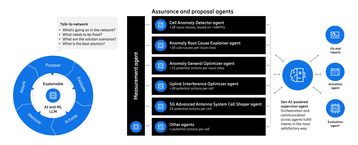
Agentic AI is woven through a network. As Ericsson notes in its Autonomous Network Level 5 model, and Cisco echoes in its Agentic AI era demands a new network blog, the shift to autonomous systems depends on four interacting layers:
- Data and observability – Continuous telemetry from devices, sensors, and endpoints feeding real-time context into the system.
- Reasoning and inference – AI agents interpret that context, assess intent, and prioritise actions based on defined goals.
- Execution and orchestration – Automated control and policy engines implement verified actions across domains — from campus to cloud.
- Feedback and learning – Results are logged, validated, and used to refine future responses, closing the loop.
Together, these layers turn the network from a static transport layer into a continuously learning system that adapts to conditions and intent.
Different from AIOps and intent-based networking
Agentic AI builds on earlier automation models but extends them in scope and autonomy. Where AIOps correlates data across systems to flag anomalies and suggest fixes, agentic AI can decide which actions to take and verify the results. And while intent-based networking focuses on enforcing predefined policies, agentic systems can interpret intent dynamically, reasoning about context, trade-offs, and goals as conditions change.
McKinsey calls this shift “a fundamental architectural change, from static, LLM-centric infrastructure to a dynamic, modular, and governed environment built specifically for agent-based intelligence.” It’s an evolution that moves from monitoring to active decision-making, and from closed loops to networks capable of self-direction within defined limits.
Microsoft echoes this view, noting that “we’ve entered the era of AI agents,” where systems can work across applications “to help us all solve problems in new ways.” The company’s use of declarative, API-driven agents in Microsoft 365 Copilot illustrates how shared compute and unified orchestration are already beginning to reshape enterprise infrastructure.
For network teams, that combination of autonomy and accountability will be critical. Agents will be capable of independent reasoning but operating within transparent, governed boundaries.
Agentic AI in the real world
For all the noise, agentic AI is already finding practical use where the technology has something tangible to fix.
IBM’s Network Intelligence platform combines reasoning agents with specialised time-series foundation models to spot issues that typical monitoring tools miss.
“We believe this approach is critical to addressing the complexity of modern networks where network teams struggle to manage through tools and manual processes,” said Benjamin Hickey from IBM Software Networking.
Google DeepMind’s CodeMender offers another glimpse of what autonomous agents could mean in practice. The AI system automatically patches vulnerabilities in open-source code and validates the fixes before submission.
“The AI agent helps developers and maintainers focus on what they do best – building good software,” said researchers Raluca-Ada Popa and John “Four” Flynn. DeepMind says the system has already submitted dozens of security fixes, each reviewed by humans before release, in what the researchers describe as a “cautious approach” to autonomy.
Then there’s the infrastructure end of the spectrum. Fujitsu and Nvidia are developing an AI agent platform designed for sector-specific use, pairing Fujitsu’s Monaka CPUs with Nvidia GPUs to create full-stack computing for healthcare, manufacturing, and robotics.
“The AI industrial revolution has begun, and we must build the infrastructure to power it, in Japan and across the globe,” said Jensen Huang, Nvidia’s founder and CEO. Takahito Tokita, CEO of Fujitsu, added that the collaboration “will accelerate AI-driven business transformation in enterprise and government sectors,” with early deployments already planned in Japan.
Each of these examples shows agentic AI in a controlled environment, highly specific, and still (importantly) under human supervision. What’s emerging is a slow evolution, one where reasoning agents extend human capability without removing the safety net.
A need for rules. Get your house in order
As with any system that promises independence, agentic AI will only earn trust once it can be audited, verified, and, when necessary, reined in.
The Model Context Protocol (MCP), an open standard from Anthropic, is one of several efforts to bring order to this new layer of communication. MCP aims to standardise how AI agents interact with external tools and data sources, providing a single set of rules for context, permissions, and traceability. It has already been integrated into Google Cloud’s Security Command Center, Cisco’s Data Fabric, and Cloudflare’s zero-trust platform, where it creates a common checkpoint for monitoring prompt traffic and tool access.

What is the Model Context Protocol (MCP)? The definitive guide to AI’s new integration standard
MCP explained: Why it matters for network security and AI infrastructure
Security specialists warn that without proper guardrails, MCP itself could become an attack surface. Dominic Wellington, AI and data expert at SnapLogic, says the risk lies in “shadow AI” adoption by end users bypassing corporate IT. Ian Quackenbos of SUSE adds that network teams need governance “so agents can’t take actions that disrupt production.” Conor Sherman, CISO in Residence at Sysdig, describes the “safety catch” as issuing agents short-lived credentials tied to specific tasks and requiring policy checks before high-impact commands touch production.
As Sherman notes, AI agents are “a new class of networked users: fast, privileged, and often invisible to legacy tools.” Just as APIs standardised how applications communicate, MCP may yet do the same for AI agents integrating with corporate systems.
Agentic ambition: Friend not foe
Researchers and vendors are already experimenting with multi-agent systems that coordinate tasks, negotiate priorities, and even critique one another’s decisions. In networking, that could mean agents managing different layers – radio, transport, security, and applications – and collaborating to balance performance and risk in real time. The concept sounds ambitious, but the underlying technology already exists in the form of software-defined networking, telemetry frameworks, and cloud-native orchestration.
What’s missing is consistency. Vendors tend to define agents differently, which is where the standards bodies and alliances come in. As well as Anthropic’s Model Context Protocol, ETSI’s work on experiential networked intelligence and Google’s Agent2Agent protocol are pointing towards a future where agents can exchange intent and context as easily as packets. It’s an untidy process, but so was the early internet, and if history repeats, interoperability will win out, even if it takes time and a few strong nudges from the standards community.
Practical takeaways for network professionals
- Start small - Pilot reasoning agents in clearly scoped, low-risk workflows such as anomaly detection or energy optimisation.
- Get your data house in order - Reliable telemetry, policy data, and observability are prerequisites for any autonomy.
- Governance first - Define rules, guardrails, and audit trails before scaling.
- Build for collaboration - The most effective networks will combine human oversight with machine initiative, not replace it.





Sept. 15, 2026, 12:28 p.m. - Dr Max Johnson
What is the attraction to recalcitrant psychopathic employees?