


For the third consecutive year, AI has, without a doubt, been the most talked about thing in the digital infrastructure space yet – a trend that shows no signs of slowing going into 2026.
The year saw unprecedented government commitment to projects like the Genesis Mission, while the DeepSeek debacle challenged the hardware-first approach of Western tech giants.
Against this backdrop, the rapid rise of agentic AI brought both immense promise and real-world pain, as evidenced by major network outages caused by automation tools – along with a myriad of marketing hyperbole.
Here are the top themes around the industry’s hottest topic from 2025.
The genesis of the Genesis Mission

Among the biggest AI-related announcements this year – alongside the myriad multi-gigawatt behemoth data center plans – was news that the Trump administration is spearheading a project ostentatiously labelled as “Manhattan Project 2.0.”
At its core, the so-called Genesis Mission will create an “integrated platform” based on high-fidelity training data sourced from years of historical scientific research, long locked away in old tapes. This trove will be modernized and ingested for the good of humanity, providing swathes of scientific data for U.S. researchers to tinker with via AI tools made accessible on a national cloud platform.
There’s some pretty big names attached to this too – three of the big four hyperscalers, Nvidia, OpenAI, AMD, HPE, Anthropic, and even Cisco.
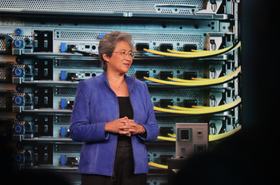
Lisa Spelman, CEO of Cornelis Networks, which is providing networking technologies for the project, sat down with SDxCentral toward the end of the year, and explained that while no new contracts have been signed off to support the Genesis Mission, the project is far from finalized.
“This is not something where all the work has been done, and then it's being announced as a finalized product,” Spelman said in late November. “The public and the world are being brought in at the genesis of the definition and the concept, and that is where the reach out happened ahead of the announcement about our willingness to participate.”
In a more grandiose explanation, U.S. undersecretary for science Darío Gil said the goal of the Genesis Mission was to make “all knowledge computable” to drive advancements in AI and quantum computing.
But at its core, the effort is a modernization initiative, taking decades' worth of data and making it usable – and suitable – for tackling contemporary problems that AI might just be able to help solve.
Read the full story:
Trump's AI Genesis Mission: The unglamorous reality of ‘Manhattan Project 2.0'
DeepSeek debacle dents the big boys
Arguably, the firmest pin prick in the apparent AI bubble going on at the time of writing occurred in January when a relatively unknown research lab from China published two AI models that sent shockwaves across the tech world.
DeepSeek’s R1 and V3 AI models performed as well as or better than leading models from OpenAI and Google on key benchmarks, but it was how they were built that really rattled the big boys.
The Chinese lab claimed they built R1 for less than $6 million, a mere fraction of the billions invested by Western firms. Further rubbing salt in the wounds was that its model was allegedly trained using Nvidia hardware that, by foundation-level standards, is practically archaic.
Investors went on to punish tech stocks across the industry, with a mass sell-off plunging Nvidia's market value by nearly $600 billion. The panic was, of course, short-lived – Nvidia, for example, largely recovered just a month later – but the shockwaves showed the fragile foundations the industry finds itself precariously perched upon.
While the industry moved on, DeepSeek soldiered on, finishing the year as it started: with a powerful model built not with high-end hardware, but with intricate architectural designs enabling it to get around heavily hobbled hardware.
Published in early December, DeepSeek V3.2 was largely designed using Nvidia’s H800, a China-specific chip with just 400 Gb/s chip-to-chip bandwidth – a paltry figure compared to the outdated H100’s 900 Gb/s.
But through its DeepSeek Sparse Attention (DSA), the Chinese lab was able to create a model that “performs comparably” with OpenAI’s GPT-5.
While the jury is still out on the actual hardware DeepSeek has at its disposal, DeepSeek is compensating for apparent limited access to GPUs with algorithmic efficiency to ultimately keep up with the larger Western rivals whom its first model so thoroughly dented at the turn of the year.
Read the full story:
DeepSeek defies US chip restrictions with new V3.2 model that may just close the AI gap
What actually is agentic AI? No, really?

Since AI became the top topic in tech, each subsequent year has focused on a specific related aspect. The initial 2022 and early 2023 wave focused generally on generative AI. Last year was the emergence of foundational AI - or "frontier" to some of the top-end labs and vendors. This year was no different with the rise of agentic AI.
So what is agentic AI? Well, simply put, it’s an AI-powered tool or system capable of acting autonomously to perform a task or achieve a designated goal with minimal to no human intervention. For a more detailed explanation, you can refer to our definitive guide to understanding agentic AI and its role within the networking stack.
Google search trends can easily showcase the rise of agentic AI. In 2024, little to no searches for "agentic AI" occurred until late October. Just a year later, searches for "what is agentic AI" went up 30%, AI agent rose by 70%, and "best agentic AI" went up a whopping 450%.
Vendors from across the industry have rushed to take advantage of the opportunity. The likes of Gluware, Arista, Google Cloud, Cisco, Palo Alto Networks, AT&T, and SUSE were just some of the names to have dropped agentic offerings in 2025.
But a Gartner report published in June poured some ice on the glowing hot agentic area, suggesting that more than 40% of related projects will be canceled by the end of 2027.
More striking from that report was the apparent rise of “agent washing” with some firms potentially guilty of taking existing products like AI assistants, RPA, and chatbots and simply slapping the agentic label on them in a bid to take advantage of the hype. The research giant estimated that only about 130 of the thousands of agentic AI vendors out there are actually real.
In the networking world, the agentic hot streak doesn’t show any signs of going away, but that doesn’t mean you can view these products and services with one eyebrow raised and a hint of natural skepticism.
Read the full story:
According to Gartner, the future isn't actually agentic
For more on agentic AI:
What is agentic AI and what impact will it have on networks?
AI tools are already causing headaches …
Toward the end of the year, a worrying trend began to emerge: big-name network operators and content-delivery firms suffered outages to such an extent that large swathes of the internet went down.
Cloudflare saw two outages in late 2025 – a large incident in mid-November and a much smaller, but still impactful occurrence in early December. In mid-October, Amazon Web Services (AWS) suffered a major outage that largely impacted users in North America.
Other instances this year saw SentinelOne experience a global service disruption in May, while Google Cloud suffered a blip in June.
But the latest of these outages were of note for the reason behind why they went down: automation tools. Specifically, tools and services designed to make network operations that bit more succinct ended up falling over and taking down entire networks.
Looking at Cloudflare’s November incident in detail, for example, at fault was a machine learning-powered bot tasked with generating scores for every request traversing Cloudflare’s network to help react to traffic flow variations.
An issue with permission changes in ClickHouse, one of Cloudflare’s database systems, caused it to output multiple entries used by the firm’s Bot Management system, causing it to double in size, and the automation tool ultimately panicked in response.
AWS went one step further – launching a tool capable of identifying incidents and conducting investigations into customer apps and resources in minutes, only days after its mass October outage.
The irony is strong here. As each year passes, AI tools are getting increasingly more intuitive and already helping to automate parts of the networking stack. But cases like these show that automation isn’t quite at the level where some might claim it is, and that human oversight is still massively needed to stop systems falling over.
Read the full story:
Cloudflare post-mortem highlights AI agent networking pitfalls
… but they’re also getting more nifty

Despite the dower entry above, there’s some potential light in the dark in terms of AI systems getting more intuitive – not smarter, as that would imply some form of potential intelligence.
Examples of some nifty launches that occurred in 2025 include Google DeepMind’s CodeMender, another agentic solution, this time, one that’s capable of automatically fixing critical software vulnerabilities.
Designed to patch new vulnerabilities in software updates and secure existing code, CodeMender is still in development, but so far has pushed some 72 security fixes for open source projects this year.
It’s a concept with a lot of potential, considering botched code can provide threat attackers with a potential entry point into a network device, or, in the case of Cloudflare’s September dashboard refresh, inadvertently take down services.
Another Google update from this year was that of VaultGemma, a small-scale AI model designed to prevent potential leakage of specific training data.
Businesses use their own data to train or fine-tune models for specific use cases, which could expose potentially sensitive information – with threat actors potentially then able to extract underlying training information through carefully crafted prompts.
VaultGemma is designed to protect training data, with carefully calibrated mathematical noise input during the training process itself to prevent the model from memorizing specific data points. Essentially, it can still learn general patterns, but no potentially vital business data would be exposed to the model.
Then there’s CUDA Tile, an Nvidia-developed tool aimed at simplifying GPU programming to enable developers of any experience to more easily write programs for high-end hardware across large sets of data like arrays, vectors, and tensors.
These are just a few examples, but for all the gloom, marketing spiel, and natural skepticism, there are some genuine innovations in the world of AI being slowly published that could well augment digital infrastructure operations for the better.
For every Manhattan Project 2.0 and agentic application, genuine enlightening research and development is going on that’ll improve network operations in the near future. Just wait and see.




Comments