


Arista Networks is bringing data center networking principles to help solve campus network problems for enterprises.
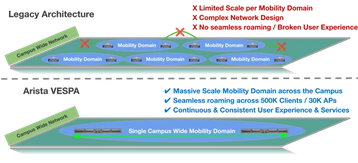
The networking vendor's Virtual Ethernet Segment with Proxy ARP (VESPA) aims to support seamless roaming across sites for universities, manufacturers, and health care. The architecture was built using standards typically used in data centers to enable single roaming domains supporting more than 500,000 clients with sub-second failover.
“We took the same EOS operating system, the same protocols, and standards, and kind of brought it into campus,” Sriram Venkiteswaran, director of product management for Arista's campus portfolio, told SDxCentral. “We are not creating a fork in terms of operating system, in terms of standard, in terms of protocols.”
Traditional controller-based systems force IT teams to break networks into smaller mobility domains, which results in users' connections dropping as they move between buildings.
Arista’s offering, instead, distributes the control plane across access points rather than relying on centralized controllers. Meanwhile, wireless LAN gateways centrally aggregate traffic.
“In mission-critical environments, very specifically manufacturing health care, like in manufacturing, we could be sending control traffic from really critical equipment, and a downtime, losing those packets for minutes can be disastrous,” Venkiteswaran explained. “VESPA brings our data center DNA of resiliency into campus across all the layers.”
Arista argues its controller-less Wi-Fi reduces complexity and supports connectivity across everything from vast factory floors to convention centers and stadiums.
Arizona State University (ASU), one of the largest public universities in the U.S., helped validate the architecture. Jorge De Cossio, ASU’s senior director for digital infrastructure, said Arista's controller-less Wi-Fi provides “a seamless wireless roaming domain that improves connectivity across the university.”
“Customers don't have to be at the scale to take advantage of VESPA, because what VESPA does is it creates a uniform architecture no matter what the customer size is,” De Cossio added.
Arista goes agentic AI
In addition to bringing VESPA to campuses, Arista also expanded its Autonomous Virtual Assist (AVA) platform with agentic AI capabilities designed to automate network operations tasks.
The framework aims to handle routine work like vulnerability management, where AI agents can detect security issues, identify affected network segments, download patches, and prepare change management windows, leaving engineers to review and approve rather than execute manually.
“Our goal is, how do we enable them to become experts?” Venkiteswaran said, referring to entry-level network engineers. “Think of this as an assistant that will do a lot of the mundane tasks, automate things.”
A host of Arista’s competitors have also dipped their toes into the proverbial pool that is agentic AI. When asked what sets Arista's offering apart, Venkiteswaran pointed to the vendor’s data lake.
AVA is built on Arista's network data lake, which streams granular telemetry from network devices. The exec positioned this data-led foundation as Arista’s key differentiator, noting that the unified operating model across data center, AI, campus, and WAN environments allows the company to train models on a broader dataset.

“One of the investments we made is getting very granular telemetry using what we call the streaming telemetry from our network infrastructure devices into this network data lake that sits in Cloud Vision,” Venkiteswaran explained. “We have a massive amount of data, which we can train [large language models] to deliver better outcomes.”
Beyond the simple adage of "our data is more sophisticated than yours," Venkiteswaran highlighted a more sophisticated play in that Arista’s EOS unified operating framework now connects across data center, cloud, AI, WAN, and now campus, to essentially “cross-pollinate” learnings from across these domains.
“You have a single model that stretches across your entire enterprise. It's going to make our AI model much better, because you're learning a lot of data and use cases,” Venkiteswaran added. “We use the exact same data center principles and standards to solve a very specific problem in campus without creating these forks. This consistent approach is going to help us build a model that's going to be more accurate.”
New rugged switches
The networking vendor also introduced two ruggedized switch platforms, the 710HXP-28TXH and 710HXP-20TNH, targeting industrial and outdoor deployments.
The switches include IP50-rated DIN rail and IP30-rated 1RU form factors, with multigigabit ports and 90W PoE to support Wi-Fi 7 access points and outdoor security cameras in harsh environments.
The platforms run the same EOS operating system as Arista's data center and campus switches, allowing enterprises to standardize on a single platform across all deployments.
“All our enterprise customers, whether it's manufacturing, utilities, universities, or gas stations, have these very specific use cases for needing a ruggedized platform,” Venkiteswaran said. “Without these two platforms, unfortunately, our customers have to deploy a third-party solution for these very specific use cases. They ask us, 'can I just manage my entire infrastructure on a single platform?' and that’s what we enable.”
The switches are expected to be generally available early next year.






Comments