


When Nvidia designed its H800 chip for export to China, reducing its chip-to-chip bandwidth from 900Gb/s to just 400Gb/s, there was a likely assumption that it would appease U.S. lawmakers’ desire to hinder large-scale AI training in China.
But DeepSeek’s new AI model suggests otherwise. The Chinese AI lab, whose earlier models sparked a market reckoning for Western AI stalwarts, is back with its latest offering: DeepSeek V3.2.
According to a paper outlining the model, DeepSeek V3.2 “performs comparably” with OpenAI’s GPT-5 – with the higher-spec V3.2-Speciale reportedly surpassing the OpenAI model and even exhibiting “reasoning proficiency on par” with Google’s flagship Gemini 3.0 Pro.
Unlike the initial paper that sent shockwaves earlier this year by detailing DeepSeek's efficient use of H800s, this latest report omits any concrete mention of training hardware.
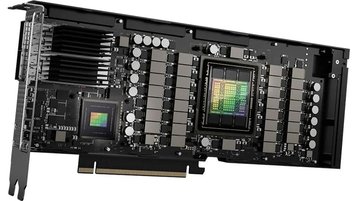
There is a casual reference to the H800 in the inference benchmark section, in which the lab said inference costs were at a rental price of $2 per GPU hour.
DeepSeek’s claim that it trains its AI models on the hobbled hardware has raised eyebrows and attracted skeptics, too.
The House Select Committee on the CCP claims DeepSeek has got its hands on “tens of thousands of chips” subject to export restrictions to power its development efforts, including an estimated 10,000 H100s.
The Committee’s April figures put DeepSeek’s total H800 count at around the same number, while also reportedly having access to around 30,000 H20s – another China-specific unit which local officials have ordered production pauses on in favor of sourcing hardware from domestic producers.
Limited hardware? No problem as DeepSeek opts for design nous
Despite the V3.2 paper’s omission of hardware training details, DeepSeek sought to get over hardware limitations again by doubling down on architectural design.
The key innovation in the new V3.2 model is DeepSeek Sparse Attention (DSA), an “efficient attention mechanism” that reads like it was purpose-built for bandwidth-constrained clusters.
Using a “lightning indexer,” DSA essentially identifies which tokens actually matter for each query – instead of sifting through all input tokens. Instead, DeepSeek V3.2 uses DSA to pick out the most relevant ones, which in turn slashes core attention complexity. Think of it like skim reading an article like this one, only picking out what actually matters.
Such a process could not only speed up token processing time, but also require much less data to be moved between chips, thereby requiring “much less computation,” even for a model with a context length (the amount of data it can handle at input) of 128,000 tokens.
DeepSeek’s researchers contend their latest innovation ultimately provides “significant end-to-end speedup in long-context scenarios.”
“Using DSA, we addressed critical computation complexity without sacrificing long-context performance,” the paper reads. “By increasing computational budget, DeepSeek-V3.2 achieves comparable performance with GPT-5 on reasoning benchmarks.”
It wouldn’t be a DeepSeek model without a catch, however, and this one brings it full circle to the question of hardware.
The Chinese lab’s researchers wrote that in order to achieve comparable performance with some of the top-of-the-line models for its base V3.2, it would require increasing the computational budget, with post-training compute repeatedly exceeding 10% of pre-training costs.
In other words, DeepSeek is compensating for limited access to hardware with longer, far more intensive training runs, giving the model more inference time. Despite its potential algorithmic efficiency, then, the enduring challenge for the Chinese lab remains the substantial cost and time required to run these models on hardware with ever-tightening constraints.






Comments