


A quick look back at the wonderful world of networking in 2025.
Nvidia still wears the crown
Unless you’ve been living under a rock, Nvidia dominated the year yet again in 2025, and for good reason: its highly coveted hardware is powering some of the most intense AI workloads in the world … as well as your god-awful ChatGPT queries.
But in the world of networking, Nvidia has quickly and quietly built itself a multi-billion-dollar side hustle. The launch of its Ethernet-based Spectrum-X in 2024 saw the once great champion of InfiniBand spread its bets, offering the best of both worlds. The result? In a little over year after Spectrum-X was revealed, demand for its Ethernet offerings are at such a level that CFO Colette Kress told investors in November its tech was now “roughly on par with InfiniBand.”

Revenues for its networking segment in Q3 2025 alone soared by 67.7% year-over-year (YoY) to reach $1 billion, and the firm has now taken an 11.6% share of the Ethernet data center switch market from what was essentially a standing start, according to IDC data.
The data center space is, of course, well known to Nvidia, and it’s looking to take on the likes of Cisco, which, while an established leader with deep enterprise relationships, has found itself losing ground in the market. For example, its data center segment grew by just 16.9% YoY in Q3.
Add to that its move to augment both Spectrum-X and the InfiniBand-based Quantum-X with co-packaged optics (CPO) set to drop in 2026, and Nvidia looks to have another string to its bow – one that may find itself losing out for attention to its more glamorous GPU sibling, but will still rake in the cash nonetheless.
Ethernet finds a way
Staying with the world of Ethernet, cast your mind back to 2023: InfiniBand ruled the roost back then, holding an 80% share of the data center switch market. Fast forward a little over two years, and Ethernet finds itself with the market crown.
On the supercomputing side, Ethernet (specifically the mid-tier 100G Ethernet) was the most populous interconnect protocol on both of the Top500 lists published in 2025. Meanwhile, Slingshot, the Ethernet-based solution from HPE, commanded 48.1% of performance for the Top500 list in June and 46.3% in November. On both of the lists, it provided interconnectivity for six of the top 10 – including the top three: El Capitan, Frontier, and Aurora.
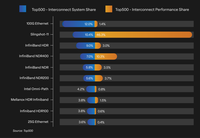
That resurgence extends to the data center-focused scale, with IDC suggesting the Ethernet switch market is exploding due to continued AI infrastructure buildouts.
The demand for Ethernet-based technologies shows no signs of slowing, with Dell’Oro Group research published in July projecting it to dominate the data center-scale fabric space in the coming years, driving a staggering ~$80 billion in data center switch sales over the next five years. Add to that Nvidia’s explosive emergence, and you can expect more sales and even more switches to drop in 2026 … and beyond.
Big breakthroughs and budding systems
There’s real momentum among areas like quantum and coherents, concepts that just a few years ago seemed like decades away. But we’re at a stage where Nvidia
is showcasing a way for quantum computers to interconnect with classical systems, or Broadcom is touting its CPOs, having powered one million cumulative 400 Gb/s (400G) equivalent port device hours without a single link flap in tests with Meta.
Just like AI, these nascent areas have their hyperbole, but we’ve seen some genuine breakthroughs, like the “universal translator” to allow disparate quantum systems to communicate over a network with virtually no noise, or a material developed by New York University scientists capable of alleviating light dissipation in photonic chips.
Wins like these show that these emerging technologies will ‘become a thing.’ But AI has unfortunately created a culture of faster = better, what with everyone and their dog seemingly developing some form of agent or tool. Quantum will become a thing. Photonic chips will help push the networks of the future beyond what’s capable with traditional systems.
Genuine breakthroughs, like NTT creating a chip that rewrites itself using light patterns, show that things are taking shape. But patience is a virtue. Just because, as an industry, we’ve been talking about these technologies for a while, and nothing truly tangible has taken shape yet, doesn’t mean these won’t have an impact down the line.
AI has made storage sexy
The meteoric rise and subsequent proliferation AI has seen some unlikely winners, and none more so than vendors in the storage space. While many jump straight to look at the fancy GPUs powering AI workloads, it’s the often overlooked part of the digital infrastructure stack that has quickly become one of its most important assets – evident from OpenAI’s mammoth purchase of around 40% of the world’s memory capacity.
The insatiable data demand from AI training and inference has meant demand for not only storage, but systems capable of providing the requisite complexities needed to cater to AI.
Established folks like Pure Storage, Dell Technologies, and Seagate, to emerging players like Vast Data and Eon, have come out on top courtesy of the AI boom. And with an anticipatory imbalance set to emerge in the form of a potential memory component shortage (price spikes are already impacting the consumer market), storage vendors can come out of 2025 with both their heads and their stock prices high, knowing full well that
2026 will be a year that can make even more money.
Network automation tools aren’t as smart as you think?
Towards the end of the year, several big-name network operators and content-delivery firms were subject to outages that resulted in large swathes of the internet going down.
Cloudflare saw two outages in late 2025 – a large incident in mid-November and a much smaller, but still impactful occurrence in early December. While in mid-October, Amazon Web Services (AWS) suffered a major outage that largely impacted users in North America. There were instances earlier in the year too, with SentinelOne experiencing a global service disruption in May, while Google Cloud suffered a sizable blip to its services in June.

But the latter of these outages are of note for the reason behind them: automation tools. More specifically, tools designed to make network operations that bit more succinct ended up falling over and taking down entire networks.
Take Cloudflare’s November. At fault was a machine-learning-powered bot tasked with generating scores for every request traversing Cloudflare’s network to help react to traffic flow variations. An issue with permission changes in ClickHouse, one of Cloudflare’s database systems, caused it to output multiple entries used by the firm’s Bot Management system, causing it to double in size, and the automation tool ultimately panicked in response.
AWS went one step further – launching a tool capable of identifying incidents and conducting investigations into customer apps and resources in minutes, only days after its mass October outage.
Ironic? You bet. Now, with each passing year, AI tools are supposedly becoming increasingly more intuitive. And yet, incidents like these just highlight the need for humans in the loop, and that AI-augmented network automation tools might not quite be at the level some might claim they are.
Broadcom’s gonna Broadcom
The networking world’s uneviable whipping boy award for 2025 goes to Broadcom. For all the wins around its growing Tomhawk switch line and custom chip contracts with OpenAI and Meta, there’s the industry-upending fallout from its VMware takeover.
To cut a rather long and incredibly far-reaching story fairly short: Since Broadcom took over VMware in late 2023, it’s introduced VCF (VMware Cloud Foundation), which is essentially a congealing of its entire software stack, which is available for a single subscription fee. Sounds simple enough. But suddenly, some of its customers found themselves with the prospect of having to pay for a bundled offering, one that was far more expensive than what they were paying previously, with offerings added that they had no interest in using. And on top of that? Broadcom halted perpetual licenses for VMware products and ended support for existing offerings, basically forcing customers to take on a subscription or find an alternative.
CEO Hock Tan proudly proclaimed that more than 90% of VMware’s 10,000 largest customers have signed up to VCF. But that hasn’t stopped the likes of Nutanix, Red Hat, and even some hyperscalers from racing to take advantage of the discontent.

The move has been a success for Broadcom, of course, with its infrastructure software business, where VMware sits, witnessing a revenue rise of 26% in fiscal 2025 to $27 billion for the full year.
But that hasn’t stopped a wave of confusion and moves. It’s a win for folks like Nutanix, who have repeatedly seen triple-digit logos added to its wall of customers throughout the year. But engineers trying to justify to the board the need to spend out on their stack in the wake of potential price rises when, for a long time, their systems have just worked is a tall order that’s dominated discourse this past 12 months.
The new home of SDxCentral
One of the most important updates – at least in our world – was the relaunch of SDxCentral under the InfraXmedia banner.
Brought together with our brothers and sisters at DCD, SDx 2.0, as we call it in-house, is slowly but surely taking shape. With a focus on genuine human reporting, technical depth, and a bit of humor, we’ve sought to take what made DCD great and build on it for the wonderful world of networking, while honoring the legacy of what made SDxCentral great. It’s a long road, and DCD wasn’t built overnight, but we’ve made some stellar progress, and have got some plaudits from industry folks – or at least we like to think so.
There’s plenty more to come: watch this space...



Comments