

New York University (NYU) scientists uncovered a material that could help bring photonic computing a little closer to reality.
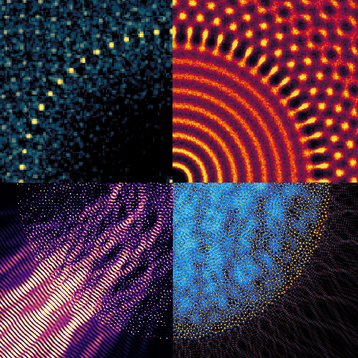
Dubbed "gyromorphs," the material performs better than any other known structure at blocking light from incoming angles – meaning it could potentially control optical properties.
Stefano Martiniani, an assistant professor of physics, chemistry, mathematics, and neural science, and the senior author behind the research paper detailing gyromorphs, said the materials “are unlike any known structure in that their unique makeup gives rise to better isotropic bandgap materials than is possible with current approaches.”
Simply put, gyromorphs could reroute light signals on a chip or in a computer with minimal loss in signal strength.
Fruits of the forest (of light)
Photonics is a nascent but growing computing technology. Instead of using electrons, the idea is to employ light to transmit data, with photons being potentially limitless in how fast it can be transmitted.
There have been several breakthroughs in light-based computing of late, including a chip from NTT that rewrites itself using light patterns and laser-chip integrations that could streamline photonic chip manufacturing.
But one challenge still remains: ensuring the light being used to transmit data doesn’t dissipate.
Traditional chip materials like silicon can cause photonic signal losses. When light interacts with mobile charge carriers (the electrons in the conduction band and holes within the silicon's structure), it can absorb photons in a concept known as free-carrier absorption (FCA).
The NYU researchers sought to break this bottleneck by unearthing a material that would provide greater control of light to avoid it dissipating during transmission.
They focused on developing what they described as “metamaterials” – engineered materials with properties that stem from their structure rather than their chemical nature.
Using an algorithm to help design functional disordered structures, the researchers uncovered a novel material – or a gyromorph – that was neither fully disordered nor fully ordered.
“Think of trees in a forest, they grow at random positions, but not completely random because they’re usually a certain distance from one another,” Martiniani explained. “This new pattern, gyromorphs, combines properties that we believed to be incompatible and displays a function that outperforms all ordered alternatives, including quasicrystals.”
Quasicrystals, conceived by physicists Paul Steinhardt and Dov Levine in the 1980s, have a mathematical order to their structure. Traditional semiconductor materials, including silicon can be used to form artificial quasicrystals on a glass substrate – meaning they could be used in photonic hardware. However, as the NYU researchers note in their paper, quasicrystals either block out light from a few directions, or entirely – there’s no in between.
“Gyromorphs don’t have a fixed, repeating structure like a crystal, which gives them a liquid-like disorder, but, at the same time, if you look at them from a distance, they form regular patterns,” Mathias Casiulis, a postdoctoral fellow in NYU’s Department of Physics and the paper’s lead author, explained. “These properties work together to create band gaps that lightwaves can’t penetrate from any direction.”

Comments