

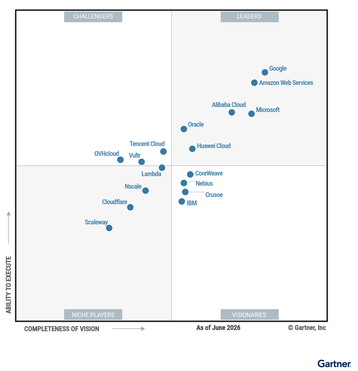
The Gartner Magic Quadrant. To some, it’s another example of analyst firm hyperbole. But to others, it’s a lens into broad market trends and a vital guardrail for corporate buyers.
The analyst firm debuted its first-ever Magic Quadrant for cloud AI infrastructure in mid-July, with a few familiar and not-so-familiar names finding themselves in one of the four categories. For every Amazon Web Services (AWS), there was a Cloudflare.
One of those emerging players who found themselves on the rankings was CoreWeave, which came out as the top-ranking "visionary" player in a quadrant that also included IBM. CoreWeave actually pushes against the neocloud label, with EVP Chen Goldberg leaning toward a term used by none other than Nvidia CEO Jensen Huang: a “new generation AI-native cloud.”
Market naming conventions aside, though, CoreWeave was one of several such players that pushed to the fore on Gartner's AI infra Magic Quadrant, with the "AI native cloud" crop including rivals like Nebius, Crusoe, and Vultr.
Corey Sanders, CoreWeave’s SVP for product management, said his team’s Magic Quadrant positioning stemmed from building a vertically integrated stack from the ground up, rather than “retrofitting environments and clouds and experiences for AI.”
“It takes its shape in sort of down-to-the-metal optimizations and innovation, offering innovation in the way of liquid cooling [or] rack management work, but also innovation higher in the stack like AI-specific storage solutions such as our LOTA (Local Object Transport Accelerator) cache … and inference platform,” Sanders explained. “This full stack, metal-to-job or metal-to-mode workload-dependent approach is a key component of our vision and actually our execution.”
When asked about whether customers actually care about quadrant positions and the like, Sanders likened the idea to being just another independent validation of its offerings.
“There’s a lot out there in the market … independent evaluation helps end customers understand the differences, understand sort of the providers out there, and that includes MLPerf or ClusterMAX benchmark results," Sanders explained. "I think it all adds up to help customers make the right decision and think through their choices for the requirements they have.”
Beyond benchmarks and analyst reports, Sanders stressed that CoreWeave’s AI-first design is framed in total cost of ownership (TCO) terms through features like its Mission Control observability suite and hands-on support, which is pitched as a way to squeeze more useful work out of each graphic processing unit (GPU)-hour than on general-purpose clouds.
In a way then, CoreWeave’s contention over naming conventions ties in with how it got its Magic Quadrant place, through being seen as an AI-specialist cloud.
The analyst giant singled out the vendor for what it described as a “purpose-built” platform, also lauding its native container orchestration offerings, like SUNK, which marries the high-performance computing (HPC) workload management system Slurm with Kubernetes.
While hyperscale rivals are all building comparable AI-native stacks, Sanders, a Microsoft veteran, argued it was difficult for those players to copy such offerings without redesign or redeployment of existing cloud infrastructure or cloud solutions.
“It’s a little bit trickier to deliver a very specific AI solution focused on storage, caching, and throughput if you need to support a wide range of different services and solutions,” Sanders said.
In the exec’s view, then, the big boys are held back by their own success; a general‑purpose estate built to host “everything” leaves less room to optimize ruthlessly for AI. And that may just help CoreWeave and other AI-native clouds to potentially squeeze their way into the coveted right-hand quadrant spot, where "leaders" sit.
“[Hyperscalers] will give us room to be able to innovate in specific AI ways because all we're delivering is AI capabilities, and focused data center design capabilities, or innovative liquid cooling approaches – these are dedicated solutions that we have built to support those AI workloads because we don't need to worry about any of the other workloads running in our environments,” Sanders said. “It allows us to bring focus. It allows us to bring dedicated innovation, and I believe our customers are quite enthusiastic about those types of capabilities that we offer.”




Comments