


NTT’s research division has developed what it claims to be the world’s first programmable nonlinear photonic waveguide capable of switching between multiple nonlinear-optical functions on a single chip.
The breakthrough, created in partnership with Cornell University and Stanford University, breaks the traditional "one device, one function" paradigm by using structured light patterns to dynamically reconfigure the same chip for different optical tasks.
In simpler terms, instead of needing separate devices for different functions, a single chip can be reprogrammed on the fly using light.
Ryotatsu Yanagimoto, a scientist at NTT Research who led the project, commented: “These results mark a departure from the conventional paradigm of nonlinear optics, where device functions are permanently fixed during fabrication.
“For the first time, a path forward has been created to apply nonlinear optics to large-scale optical circuits, reconfigurable quantum frequency conversion, arbitrary optical waveform synthesizers, and widely tunable classical and quantum light sources – all of which are vital to enabling advanced computing and communications infrastructure.”
NTT has been working on developing photonic technologies for some time. In August, it teamed up with NEC to develop optical systems that can be applied to communication networks as the vendor plans to kickstart commercial deployments of its IOWN APN (All-Photonics Network) offerings by 2030.
This latest breakthrough, detailed in a paper published in Nature, sought to push beyond the limitations of photonic devices, where each optical component can only perform a single, predetermined task that’s fixed during fabrication.
Manufacturers are therefore forced to create separate devices for different functions, which increases costs and complexity while ultimately reducing manufacturing yields resulting from fabrication errors.
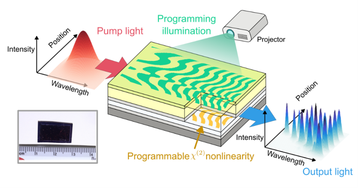
The newly developed programmable nonlinear waveguide, however, aims to push past that problem, employing a silicon nitride core which can be dynamically modified using structured light patterns.
“When a structured, programming light is projected onto the device, it creates specific patterns of optical nonlinearity that determine the device’s function,” the company explained in a statement. “Different light patterns enable different nonlinear-optical functions, all on the same physical chip, in a rapidly reconfigurable manner.”
NTT suggested the breakthrough can help photonic chip developers manufacture a single programmable chip capable of performing a multitude of functions, thereby reducing development costs and improving yields.
Beyond boosting traditional high-performance computing infrastructure, NTT suggests the technology can be applied to quantum computing, with programmable quantum frequency converters and quantum light sources providing more flexible computational architectures and improved quantum networking capabilities.
For telecoms, meanwhile, the vendor said it could help to enhance 5G and 6G infrastructure and optical communication systems.




Comments