


Researchers at the University of British Columbia have developed a “universal translator” for quantum computers, allowing different systems to communicate over a network with virtually no noise.
The UBC Blusson Quantum Matter Institute (UBC Blusson QMI) team sought to overcome the hurdle of preserving information processed by quantum computers when transmitted – which, given their fragility, can be destroyed by even the tiniest of disturbances during translation.
The researchers created a system that’s capable of “translating” microwaves to optical signals and vice versa, enabling quantum computers to interact over long distances.
Their innovation is a microwave-optical photon converter that runs at just millionths of a watt. It uses specially engineered defects in silicon to convert between microwave and optical signals while preserving the delicate quantum information.
Think of it as a kind of specialized interpreter who can perfectly translate between two completely different languages (in this instance, microwave and optical) while preserving not just the words, but the subtle nuances that would be lost with a regular translator. Except in this case, losing those 'nuances' (quantum entanglement) would make the entire conversation meaningless.
The translator solution fits onto a single silicon chip and can convert up to 95 percent of a signal with minimal disturbance.
Mohammad Khalifa, author of the UBC Blusson QMI study, said: “It’s like finding a translator that gets nearly every word right, keeps the message intact, and adds no background chatter.
“Most importantly, this device preserves the quantum connections between distant particles and works in both directions. Without that, you’d just have expensive individual computers. With it, you get a true quantum network.”
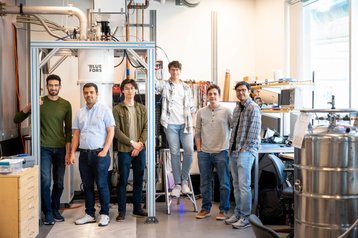


The breakthrough represents an important step in quantum networking, and while it theoretically works, the team behind it tempered excitement over it.
“We’re not getting a quantum Internet tomorrow – but this clears a major roadblock,” Joseph Salfi, the study’s senior author and an investigator at UBC Blusson QMI, told the University’s news outlet.
“Currently, reliably sending quantum information between cities remains challenging,” Salfi said. “Our approach could change that: silicon-based converters could be built using existing chip fabrication technology and easily integrated into today’s communication infrastructure.”
Comments