


El Capitan retained its crown as the world's most powerful supercomputer this week. At the same time, Nvidia celebrated as its hardware helped power Jupiter to become Europe’s first system to break the exascale barrier.
But the real story behind the bi-annual bonanza wasn’t what fancy top-tier hardware was powering the world’s fastest supercomputers, but a long-running struggle for dominance over the technology protocols keeping them connected.
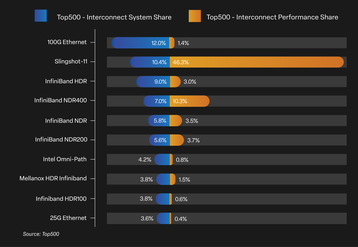
The latest Top500 list, unveiled ahead of SC25 in St. Louis, Missouri, saw 100G Ethernet take the gong for the interconnect system with the largest share among systems. But while it was the most populous interconnection technology, in terms of raw computing power, it found itself much further down the pecking order.
Instead, it was another Ethernet-based system that took the lead on this latest list: Slingshot. The high-performance interconnect from Hewlett Packard Enterprise (HPE) saw a 10.4% share of systems leveraging it, making it the most populous proprietary technology on the Top500.
Despite being utilized by fewer systems than the mid-tier 100G Ethernet, Slingshot commanded 46.3% of Top500 performance. While a slight drop from 48.1% on the previous list, it powers six of the top 10 – including the top three: El Capitan, Frontier, and Aurora. That dominance extends to the top 30, with a total of 12 systems using it.
Slingshot is designed to be Ethernet compatible, with Mike Vildibill, VP and GM for Slingshot high-performance networking at HPE, likening Slingshot to “Ethernet plus” or “Ethernet with a twist” in a recent conversation with SDxCentral.
But with some proprietary tweaks, including compute offload technologies and adaptive routing to ensure packets move at high enough efficiencies, Slingshot catapulted Ethernet to the top of the performance chart for the latest list.
Ethernet has long been second best to InfiniBand as the interconnect of choice on the data center front, though it’s making a meteoric comeback. Recent research from Dell’Oro Group projected Ethernet to dominate the data center-scale fabric space in the coming years, helping to drive nearly $80 billion in data center switch sales over the next five years. That’s a stark difference from InfiniBand holding around an 80% share of the market as recently as late 2023.
So while everyone's been watching the AI data center battle between the interconnect protocols, this latest Top500 list shows that Ethernet may have already won at exascale.
The latest results show that InfiniBand, meanwhile, is scattered across multiple variants with no real coherent leadership.
InfiniBand NDR400, for example, was employed by some 35 systems on this latest list, and saw a performance share of just 10.3%. The highest-ranked system using it was Nebius’s ISEG2 cluster, which was ranked 13.
InfiniBand NDR200, meanwhile, only recorded a 3.7% share, with the highest ranking system employing it being ABCI 3.0. Based in Kashiwa, it’s run by Japan’s National Institute of Advanced Industrial Science and Technology – but only came in at 16 on the list.
“Slingshot powers an impressive 71% of the aggregate compute capacity among the world’s top 10 most powerful supercomputers, 57% of the top 50, and more than half of the top 100,” Vildibill said. “Notably, these achievements are based on the first generation of Slingshot. With our now available second generation, which offers double the performance, we look forward to continued leadership in HPC and AI supercomputing as these solutions are adopted in the leading systems of tomorrow.”
Proliferation versus performance
With Slingshot taking the top spot for performance, 100G Ethernet leads in serving the mid-tier masses. But being the most populous interconnection technology doesn't inherently translate into the best performance.
TX-GAIN at the MIT Lincoln Laboratory Supercomputing Center was the highest-ranked system on the list using 100G Ethernet – but it came in at just position 131. It’s still the most powerful AI supercomputer at any U.S. university on the list, featuring some 99,216 cores powering the Ubuntu-based system, but that didn’t stop it from dropping down from rank 114 on the last list.
In fact, compared to interconnect stats from the June 2025 Top500 list, 100G Ethernet actually saw a reduction in the number of systems using it – 0.4%.
While that drop can be equated to just two systems, it’s not anything to be too concerned with. And compared to the November 2024 list, the needle didn’t move much either, with the exact same number of systems leveraging it to provide interconnectivity.
100G Ethernet’s popularity among the multitude of mid-tier systems stems from a sense of familiarity.
Ethernet is, of course, an open protocol, and one that’s been around for a long time, meaning it’s familiar to the vast majority of supercomputer engineers (and those working on data center clusters, for that matter). They’re also easily able to interconnect hundreds of GPUs and other hardware from multiple vendors – which further helped their proliferation across the Top500.
But while 100G Ethernet’s familiarity might have helped it to be widely employed across the vast majority of the Top500, it contributes almost nothing to actual computing power.
Looking at the higher end of the list, the three most powerful supercomputers on the planet all rely on Slingshot-11 to keep their massive GPU arrays communicating.
The trio of El Capitan, Frontier, and Aurora are at the cutting edge of exascale. Despite their underlying hardware differences – El Capitan, Frontier leverage AMD processors while Aurora features Intel Xeons – HPE's interconnect is the common thread binding them together.
So while 100G Ethernet serves the masses, Slingshot has cornered the portion of the supercomputing market where performance actually matters most.





Comments