

Scale-up. Scale-out. Scale-across. Three unique networking domains with definitions largely accepted across the industry: interconnectivity inside the rack, across cabinets, and over distances ranging from campuses to vastly disparate facilities.
There are some exceptions to the rule of three, with some vendors coming up with their own additions to the trifecta. DriveNets, for example, previously talked up the idea of hybrid scaling, where each of the three blurs together. But such alternatives are, for the most part, few and far between.
Nvidia claims to have broken the rule of three twice already in 2026, with Inference Context Management Storage (ICMS) later renamed Context Memory Storage (CMX). And the newest member of the menagerie is scale-in.
Five names. Five “pillars.” The self-proclaimed “largest” and “fastest-growing” networking company in the world has then gone beyond evangelizing the classic AI networking trifecta in a bid to pioneer distinct paradigms for its so-called AI factory stack.
It unveiled its latest iteration at Hot Chips, buried at the bottom of a list of announcements in a mess of vagueness and marketing spiel.
Upon first glance, scale-in seems to be pointed directly at north-south traffic: data flow between the compute and surrounding infrastructure services like storage, while the core trifecta is fundamentally about the east-west back-end fabric.
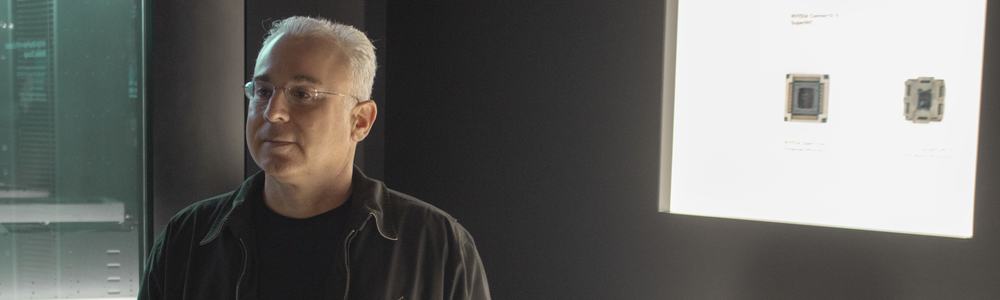
But putting the record straight, Nvidia networking chief Gilad Shainer explained in conversation with SDxCentral that the story isn’t so clear-cut.
“It was true that in previous generations like Hopper and Blackwell, there was a front-end network enabling users to access the servers and we placed BlueField-3 data processing units (DPUs) in every GPU (graphic processing unit) server, and that DPU connects to the access network. And that's it," Shainer said.
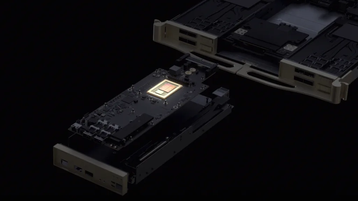
That separation collapses with the anticipated Vera Rubin generation, with the next-generation BlueField-4 DPU extending security and orchestration control directly into the scale-out and scale-across fabrics, north-south traffic, connections to central processing units (CPUs), and the fancy new LPX racks, and not simply guarding the access point.
“You cannot call it front-end anymore. … It's not just the access network or management network anymore. It needs to scale-in not just users, it needs to scale-in models. It needs to scale-in storage into the AI factory and run security across the entire AI factory, including supporting confidential computing, managing all the isolations between users across the entire AI factory and security around models and all the stuff around that,” Shainer added.
Hard numbers and secret sauces
The initial blog that revealed scale-in networking to the world was accompanied by a more detailed technical post. Where vague marketing was in the former, the latter counters the shaky ground scale-in was framed on.
Nvidia suggests the concept provides up to 1.45-times more storage throughput than off-the-shelf Ethernet. Host CPU overhead is reduced as BlueField-4 accelerates data movement, while Spectrum-X Ethernet provides the AI-optimized Ethernet fabric across the storage path to reduce congestion.
In his sit-down with SDxCentral, Shainer went deeper into the details, contending that a BlueField-3 secured only its own 400 Gb/s access link. The addition of BlueField-4, though, secures traffic across every other network interface card (NIC) it orchestrates to 7.2 Tb/s, which he called an 18-times increase in secured traffic managed – a reach claim, not a raw bandwidth one; the blog does separately list BlueField-4's network bandwidth at two-times its predecessor.
Shainer noted that scale-in was built on a multitude of technologies that form the exact stack enabling this performance.
Shainer explained that Advanced Secure Trusted Resource Architecture (ASTRA) is the secret sauce bringing the “huge change” to Vera Rubin. ASTRA was detailed in January as a means to provide out‑of‑band management and policy enforcement across traffic.
For scale-in networking, Shainer said it allows BlueField-4 to orchestrate NICs, enforcing security domains across the entire stack, and ties directly into his view that traditional north–south (front-end) versus east–west (back-end) delineation no longer holds true.
“So we provide the BlueField-4, we provide the technology to connect to everything, we provide the design guidelines on how BlueField-4 connects to all the Connect-X 9s.
"There is all the software that runs on top of that, which is part of DOCA (the DPU software development kit). You have the Spectrum-X infrastructure. So all of those elements, all of that design, this is what we propose to our customers as we're moving to Vera Rubin installations.”
Coordinated roadmap or reactive marketing?
In a way, the emphasis on what’s in a name took place behind the scenes at Nvidia with regard to its fourth networking pillar.
The change from ICMS to CMX was, in Shainer’s opinion, because the original was unwieldy and not descriptive. In his view, CMX, which he routinely referred to as “context scale,“ better describes an infrastructure that scales context storage out of the GPU server for a whole pod.
“It wasn't a great name. It kind of described what it is, but you know, from a naming perspective, it wasn't that great,” Shainer said. “It's renamed to context scale. It's actually better representative of what it does.”
That renaming around the change of perspective as a product evolves, sums up Nvidia’s reactive approach to networking rather than some grandiose plan.
It's also indicative of scale-in networking. As the constant evolution of Nvidia’s networking stack might seem to some like a company churning out announcements to keep the money train rolling, the reality is that the emergence of this completely different beast is driven by the changing ways customers ultimately want to use that stack.
“Four, five years ago, when we introduced Spectrum-X on scale-out. We said, ‘hey, the most important thing for us is limiting jitter. We don't really care about the north-south network; put whatever you want there, buy any switches you want. Put it on the north side. We don't really care. The reason was [that] it was just focused on training. That's the only thing that happened five years ago," Shanier explained.
“Now the world is completely different. In the AI factory today, language processing unit (LPU) racks, CPU racks, storage racks, compute trays, all the security. It’s a dramatic change. … It's no more north-south," Shanier added. "The front-end is no more front-end. It's important what you build there and that's why Spectrum-X has evolved and actually provides what you need on that scale-in infrastructure.”




Comments