


In late February, Nvidia published yet another blockbuster quarter, allowing for the world to exhale in relief as one of the few companies keeping the weight of the "AI bubble" – and perhaps the entirety of U.S. economic growth – afloat.
But while our eyes poured over some pretty sizable figures, including $68.1 billion in revenue for its fourth quarter of 2025 – $11 billion of which was just for networking – one innocuous comment may just have slipped through the cracks.
“I think that we’re probably the largest Ethernet networking company in the world today,” uttered by none other than Nvidia CEO Jensen Huang himself during that earnings call.
Quite a bold claim, especially since Nvidia only really began its Ethernet journey with its Spectrum-4 line back in 2022, having long touted its love for InfiniBand. But in just a couple of years, intense demand for its Ethernet-related networking technologies has sales levels “roughly on par” with InfiniBand.
During a press conference at the recent GTC 2026 event, Huang went one step further: “We're now the largest networking company in the world.”
“Spectrum-4 was our first Ethernet switch. And everybody thought that it would be difficult for us to break into the world of Ethernet," Huang said. "However, we focused completely on AI Ethernet, and we reinvented Ethernet to support the type of traffic and the type of computation of artificial intelligence. Spectrum-4, 5, and 6, huge success.”
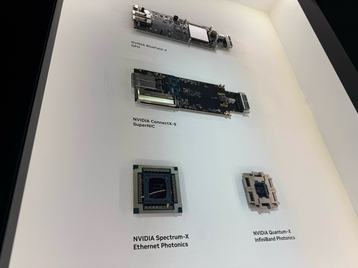
This wasn’t your typical Huang hyperbole; this was a small but bullish part of a wider strategy to break Nvidia’s perceived image of being a "chip company." That positioning was widespread at the GTC event.
No longer do Huang and company want to be seen as purely a GPU company or a chip designer, but a full-stack platform player. Nay, the full-stack platform player.
Evidence of this was on display during the CEO’s more than two-hour-long keynote, during which he proudly proclaimed Nvidia to be “the world's first vertically integrated, but horizontally open company.”
“We'll work and integrate Nvidia's technology into whatever platform you would like us to integrate into,” Huang said. “We offer you the software, we offer you libraries, we integrate with your technology so that we can bring accelerated computing to everybody in the world.”
That integration part has, in a way, helped its meteoric rise in the realm of networking.
Take Cisco. The great behemoth of the networking world might once have had a say or two on Huang’s viewpoint of Nvidia’s place in the market. But Cisco enlisted Nvidia’s Spectrum-X silicon application-specific integrated circuit (ASOC) to power its line of Nexus the N9100 that were officially unveiled last October.
“I don't think there is many examples out there that a networking company bought equipment from another networking company in order to do that,” Gilad Shainer, Nvidia’s SVP of networking, said in a conversation with SDxCentral. “[That] just shows the advantage of that. And that actually shows why it's growing. But everything is growing. Spectrum-X is growing.”
Shainer repeated Huang’s line on Nvidia’s place in the market, though worded slightly differently: “We are probably the No. 1 networking company in the world today.”
Referencing the company’s $11 billion in networking revenue alone last quarter, Shainer went as far as to claim that its related revenues are “probably more than Cisco and Arista combined.”
For the record, Cisco’s most recent earnings – for the second quarter of its fiscal 2026 – saw total revenues of $15.35 billion, of which networking revenues were $8.29 billion. For Arista, meanwhile, its most recent earnings reported total revenues of $2.4 billion.
The “growth in all dimensions” that Shainer and his networking team have seen and are continuing to see across both Ethernet and InfiniBand lines and NVLink shows that Nvidia’s meteoric rise to snatch the market crown from Cisco shows no signs of slowing.
Dell’Oro Group states that sales of Ethernet switches alone more than tripled in 2025, with all types of data center switches for AI back-end networks projected to surpass $100 billion by 2030.
Alongside Celestica, Nvidia contributed a combined 50% share of the Ethernet market last year. If demand continues in this sharp upward trend across all protocol types, Nvidia may just find itself so far ahead in the networking space that it’ll be tough to catch, even for market stalwarts.
Nvidia is set to launch more networking lines through co-packed optics (CPO) versions of its popular networking switches set to drop later this year, giving customers a choice between traditional copper and light-based interconnects.
Though despite its newfound networking crown – to add to all the other crowns and wrestling title belts Nvidia finds itself wearing – it’s still playing ball with market rivals on standards. This includes the Ultra Ethernet Consortium, Ethernet for Scale-Up Networking (ESUN), and now the recently formed Optical Compute Interconnect’s Multi-Source Agreement group (OCI-MSA), which looks to create open specifications for optical interconnects for scale up.
“We're not fighting with anyone. We like the ecosystem. And the ecosystem is great. No one can win just one by himself, especially on the capacities that exist,” Shainer added.





Comments