


SAN JOSE, California – Nvidia confirmed its next generation of networking technologies for scale-up and scale-out will support both copper and co-packed optics (CPO).
Industry concerns over speeds, costs, and a supply deficit projected to kick in by 2040 have seen copper’s industry relevance routinely questioned of late.
But during his keynote address at GTC 2026, Nvidia founder and CEO Jensen Huang reiterated comments he made about copper last August, saying copper still has its place as part of the company’s interconnect solutions, including for its next-generation Feynman architecture.
“For everybody who is in our ecosystem, we need a lot more capacity, and that's really the key," Huang said. "We need a lot more capacity for copper; we need a lot more capacity for optics. We need a lot more capacity for CPU, and that's the reason why we're working with all of you to lay the foundation for this level of growth.”
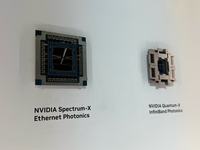
Nvidia is set to launch its first-ever CPO switches, with iterations of its Spectrum-X Ethernet and InfiniBand-based Quantum-X networking switches set to launch this year.
Huang told the audience that its CPO hardware was in “full production.” The process technology behind it was developed by Nvidia alongside its manufacturing partner Taiwan Semiconductor Manufacturing Company (TSMC).
Nvidia’s networking SVP on why copper stays
Nvidia’s Feynman architecture is expected around 2028, and is part of the company’s annual rhythm product roadmap, Nvidia networking SVP Gilad Shainer told SDxCentral that using both technologies was about “doing the right design.”
“There is nothing better than copper," Shainer said. "Copper is zero power. Copper is passive. There's no active component. … If you can use copper, use copper. And if we can use copper, we want to use copper.”
Shainer said that the real limitation with copper was not supply chain concerns, but distance.
“If I’m doing NVLink72 or NVLink 144, for example, and that fits copper dimensions, I’m going to take copper," Shainer explained. "But when I want to do 1152, it’s beyond cooperage. It’s multiple racks [so] copper cannot be used, and that's why I'd going co-packaged optics. So that's why we're having both options. It all depends on dimensions and what the NVLink domain is.”
When asked whether he foresees a time when copper is eventually phased out, the networking SVP said the material will still have its place, stating: “Copper is easy. There's a lot of copper. The thing is, with copper, [it] depends on two things, the distance of copper and the speed of the network.
“If you continue to increase speeds, then the copper reach will go shorter and shorter and shorter," Shainer continued. "At some point, it's probably going to be not enough anymore, so optics is definitely the future. [It] is being used now for scale-up, because the reach is now beyond, and we're increasing the speed. So that's why there is a huge investment in optics. That's why we make a lot of investment in the ecosystem, either investing [in] them to make sure that they have the right technology to our specification, they build the capacities and so forth.”





Comments