


There was a time when CES catered solely to fancy consumer-grade gadgets. But in 2026, the annual tech curtain raiser has morphed into a B2B show, providing Nvidia yet another platform to tout its wares as it looks to further cement itself as the top dog in AI.
Naturally, Nvidia offered a host of consumer-focused updates at the show – alongside reports that it was reviving almost five-year-old graphics cards amid shortages of memory units and its latest RTX 50-series GPUs, which are apparently being snapped up by data center customers.
But for the wonderful world of networking, Nvidia revealed a slew of updates, including a powerful edge-focused graphics card, more details on the BlueField-4, and news that its Vera Rubin chips are in “full production.”
Starting with the newest of these updates, the Nvidia Jetson T4000 was first revealed last August but was center stage in Las Vegas as a means to provide high-performance AI and real-time reasoning to edge applications.

Capable of delivering up to 200 FP4 TFLOPs of AI compute along with 64 GB of memory, the T4000 module aims to bring Nvidia’s Blackwell innovations to edge applications, with the vendor firmly eying the nascent but growing robotics segment. CEO Jensen Huang has repeatedly proclaimed that the next era of AI will be “physical” and used his 2026 CES keynote to tout that the “ChatGPT moment for physical AI is almost here.”
Offered as an upgrade to its prior Orin module, the T4000 is built on the three-nanometer (3nm) process and shares form factor and pin compatibility with the Jetson T5000, meaning developers and engineers can easily swap out common carrier boards for either unit.
In terms of its networking capabilities, the Jetson T4000 features three 25-gigabit Ethernet (GbE) ports, allowing it to support the ingestion of massive data volumes from sensors in applications often used in edge and robotic applications.
“With its energy-efficient design and production-ready form factor, T4000 makes advanced AI accessible for the next generation of intelligent machines, from autonomous robots to smart infrastructure and industrial automation,” a company blog post reads.
Elsewhere in Nvidia’s CES updates, we got a bit more information on the firm’s next-generation data processing unit. Having been initially teased way back in 2021, the BlueField-4 DPU was confirmed to join Nvidia’s growing product cadence in October 2025. And at CES 2026, we got an even clearer picture, with BlueField-4 set to play a central role in a new Nvidia-touted use case: the Inference Context Memory Storage Platform.
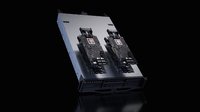
The CES announcement sees Nvidia positioning BlueField-4 as the backbone of AI-native storage infrastructure, a segment that’s becoming increasingly hot amid AI systems generating massive amounts of context data that can't feasibly be stored on GPUs long-term without creating inference bottlenecks.
Nvidia is instead pitching BlueField-4 with its 800 Gb/s throughput and tight integration with the DOCA framework and Spectrum-X Ethernet to effectively extend GPU memory capacity while enabling high-speed sharing of context across clusters of rack-scale systems – an approach the company claims delivers up to five-times improvements in both tokens per second and power efficiency compared to traditional storage architectures.
“AI is revolutionizing the entire computing stack and now, storage,” Huang said. “AI is no longer about one-shot chatbots but intelligent collaborators that understand the physical world, reason over long horizons, stay grounded in facts, use tools to do real work, and retain both short- and long-term memory. With BlueField-4, Nvidia and our software and hardware partners are reinventing the storage stack for the next frontier of AI.”
Finally, there was confirmation from Huang himself that Vera Rubin, the next sashay in its annual rhythm of GPUs, is expected to be available in the second half of 2026.
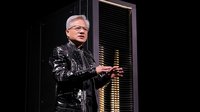
The Rubin platform, which encompasses its GPU namesake, along with the NVLink 6 Switch, ConnectX-9 SuperNIC, the Spectrum-6 Ethernet Switch, BlueField-4, and the Vera CPU line.
There were murmurings that the ongoing memory shortage – particularly SK Hynix’s decision to shift the ramp-up of its HBM4 chip capacity from Q2 2026 to Q3 could hamper Rubin. The South Korean giant’s latest generation high-bandwidth memory chip is a key part of Nvidia’s Rubin architecture, though the company quickly moved to deny that any such impact on production would take place as a result of the change.
But it was all smiles at CES as Huang told the audience that its Rubin line will “arrive at exactly the right moment, as AI computing demand for both training and inference is going through the roof.”
“With our annual cadence of delivering a new generation of AI supercomputers, and extreme codesign across six new chips, Rubin takes a giant leap toward the next frontier of AI,” the CEO added.






Comments