


Nvidia has given an inside look at its new reference architecture in support of AI-centric 6G networks.
In a blog published on Nvidia’s developer site, the chip giant laid out its distributed User Plane Function (dUPF), a framework that pushes data-plane intelligence from centralized data centers to the network edge.
The initiative forms part of the 6G AI-Wireless Intelligent Network (AI-WIN), where Nvidia and partners such as T-Mobile, Cisco, and MITRE are developing an AI-native network stack for 6G technology. The platform of choice is Nvidia AI Aerial, which combines accelerated computing platforms, software, and services for the management of wireless networks, and which is currently being piloted by SoftBank in Japan on various ventures.
Traditional UPFs explained
The UPF within a 5G core handles user data packets by handling forwarding rules, meters usage, quality-of-service (QoS), and authorized interception when required. It props up the user plane of the core, which carries application data between devices and external networks, while the control plane handles signaling and session management.
In terms of today’s enhanced mobile broadband and cloud services, UPFs are centralized and often run as virtualized or containerized network functions (VNFs, CNFs) in regional or national data centers.
But with AI models such as agents needing instantaneous response times, this framework doesn’t suffice, presenting a problem as agentic AI grows its foothold in the network space. Recent months have seen O2 Telefónica Germany launch an agentic AI solution in partnership with Tech Mahindra and Nvidia, echoing a Nokia AI agent solution from this summer designed to help telecom operators manage their networks, and an artificial intelligence for IT operations (AIOps) suite from Ribbon Communications.
With agentic AI acting autonomously and making decisions locally, any delay of transporting data between radio sites and distant core locations becomes an impediment. Nvidia’s distributed UPF model, underpinned by AI Aerial, aims to resolve this by relocating packet processing to distributed edge nodes.
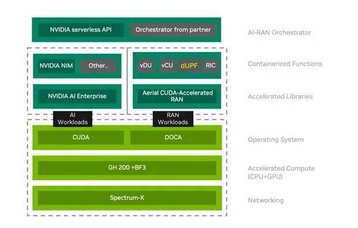
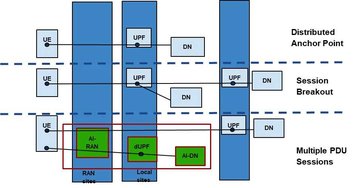
Each dUPF performs local breakout, meaning it can direct traffic to nearby application servers or AI data networks instead of sending it back to a centralized core. This local breakout capability allows operators to treat the edge of the network as an active computing layer rather than a simple forwarding domain, with packets processed consistently and predictably.
Nvidia’s reference design for the dUPF uses a combination of its Grace CPU and BlueField-3 DPU. The Nvidia Grace CPU Superchip, based on Arm’s Neoverse V2 cores, provides general-purpose compute capability for control and AI workloads. Nvidia BlueField-3 (BF3) SuperNIC, meanwhile, handles packet processing through DOCA Flow, based on Nvidia’s Data-Center On-a-Chip Architecture (DOCA) that allows developers to create and manage data-path pipelines that run directly on the DPU hardware.
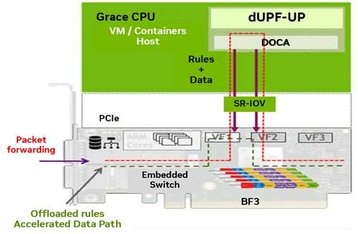
User and control planes in distributed form
In this setup, the distributed UPF is divided into two components. The dUPF-CP, or control plane, communicates with the session management function (SMF) over the standard 3GPP N4 interface to enable user plane packet processing.
Under its control is the dUPF-UP (user plane), which executes instructions through the DOCA Flow pipeline and is deployed on the Supermicro 1U Grace Hopper MGX System server platform with Grace CPU and BF3 DPU.
The dUPF-UP handles AI-specific local data networks (AI-DN) traffic at the network edge, while other traffic is sent to centralized UPF through the transport network.
The two planes communicate over a container networking interface using gRPC, a protocol that enables a client application to call methods on a server application as if it were a local object.
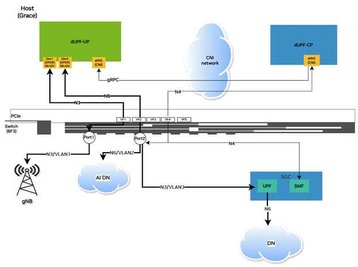
According to Nvidia, the DOCA Flow pipelines carry out the same actions as a traditional UPF but through a deployment at hardware speed. With pipeline operations happening directly in the DPU, the system can avoid any CPU bottlenecks.
Specifically, the N3 interface in this DOCA Flow setup handles uplink traffic by performing GPRS Tunneling Protocol (GTP) decapsulation, counting packets, enforcing metering and policing for both individual flows and entire sessions. It then marks packets for QoS management, and forwards them to the N6 interface, which represents the downlink pipeline, carrying out the previous operations in reverse.
Putting dUPF to the test
According to tests carried out on a Supermicro 1U server, the reference dUPF achieved 100 Gb/s of sustained throughput with zero packet loss, handling 60,000 user sessions generated by a simulated SMF at 1,000 sessions per second. Control processing reportedly consumed less than 7% of a CPU core.
Nvidia added that after setup, user plane packets were transmitted over dual 100 Gb/s links from a Cisco TRex traffic generator.
“This demonstrates full hardware acceleration of user plane packet processing for AI traffic using an IP subnet SDF-based pipeline design. This was accomplished using only two Grace CPU cores,” Nvidia’s researchers noted.
The dUPF architecture was given approval by Cisco as a foundation of 6G AI-centric networks, with Darin Kaufman, head of product for Cisco Mobility, stating the firms are “building intelligent, secure, and energy-efficient edge networks that power the next generation of wireless connectivity.”
Is dUPF dUnique?
Whether Nvidia has the edge on AI-native networks is debatable. Back in 2021, Mavenir got the jump in a collaboration with MobiledgeX and Deutsche Telekom, which demoed a similar architecture for deploying cloud-native 5G UPF to support multi-access edge computing (MEC) applications.
More recently, NEC announced a UPF product positioned for 5G-Advanced and 6G, similar to an Intel collaboration with mobile core provider IPlook.
This week's HPE, Ericsson, and Red Hat partnership meanwhile will explore scalable core infrastructure to power operators' 5G network deployments, including at the edge.
Real-world validation remains as nebulous as 6G deployment. Nvidia's framework, while good on paper, has no external validation. Its claims of zero packet loss don't explain how that success varies should the system overload or during unusual bursts of traffic, nor how it would work on older hardware or in a multitenant setup.
Likewise there is no discussion of the portability of its architecture, either on rival DPUs or future versions of Nvidia hardware.
Question marks remain on the cost model and service level agreement front as well. Nvidia's blog pushes new telecom revenue models enabled by 6G, including video search and summarization, XR, autonomous vehicle and robot communications, remote surgery, and industrial automation.
For now, though, these remain as far out there as 6G itself. But by the time it comes around, Nvidia's work with dUPF and AI-WIN may have come of age to provide a suitable infrastructure.
More in The Silicon & Supercomputing Channel




More in The Distributed Infrastructure Channel
-

-
-

Episode Is data AI’s biggest bottleneck?
Comments