

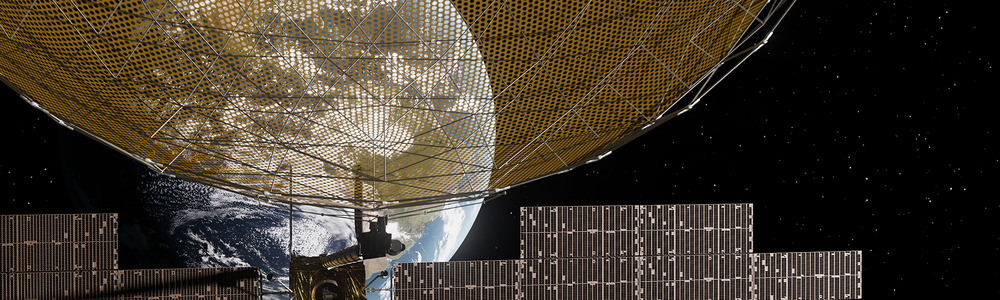
Satellite firm SpaceX submitted a petition to the Federal Communications Commission (FCC) citing fears of interference from an upcoming ViaSat satellite.
Elon Musk's space company is seeking either a blockage or strict operational restrictions on Viasat’s ViaSat-3 F2 satellite, which are poised to enter service in September, claiming the F2’s radio frequency allocation and orbital configuration could create electromagnetic interference with SpaceX's Starlink constellation.
"Viasat continues to operate in the NGSO Ka-bands without making any meaningful attempt to coordinate," SpaceX VP of Satellite Policy David Goldman wrote in the 25-page petition, claiming Viasat’s own analysis, submitted to attest the F2 could coexist with Starlink, revealed the F2 was capable of causing interference approximately one-third of the time when using the 18.8-19.3 GHz and 28.6-29.1 GHz bands for downlink. "Despite SpaceX's good faith efforts, Viasat has failed and even refused to coordinate with SpaceX for years. … Viasat's utter disregard for commission rules, its license conditions, and the harm it is causing to millions of American consumers has gone on for far too long.”
The F2 satellite is currently not under regulatory debate, being cleared for the U.S. market by the FCC in late July, though on the condition that Viasat reach an agreement with the low-Earth orbit (LEO) players alleging radio interference while using the same spectrum bands as Viasat. The FCC’s grant specifies that Viasat “must refrain from commencing or otherwise cease operations in the United States in the 18.8-19.3 GHz and 28.6-29.1 GHz frequency bands pursuant to this grant of market access until compliance is notified."
SpaceX is joined in its concerns by Amazon Leo, which has also repeatedly flagged the coordination issues to the FCC. Part of the FCC’s purpose is to regulate the use of spectrum to explicitly prevent interference like this from happening.
A single, powerful geostationary satellite like ViaSat-3 F2 can mitigate interference with directional antennas and angular separation by better directing signals and keeping them separate from others. Given ViaSat-3's 22,236-mile-high orbit is well above Starlink’s 211 to 354 mile orbit, its beams are almost constantly capable of bombarding any one of Starlink’s 11,000-plus satellites with a high-throughput signal – a notion that LEO operators believe makes it responsible for ensuring every bit downlinked expertly swerves around the overlapping paths of their constellations.
The technological feasibility of this feat does not necessarily translate to practicality for the six-metric-ton F2, which provides more than 100 Mb/s of capacity and serves customers less sympathetic to SpaceX’s suggestion that Viasat cease service whenever one of its satellites is in the way.
Viasat has not yet responded to calls for comment from press.
It’s another bit of bad news for the ViaSat-3 program, which has managed to face an Odyssean procession of challenges. ViaSat recently launched its F3 satellite, completing the trio of ambitious geostationary satellites. The company suffered catastrophe in mid-2023 when its F1 satellite was impaired due to a reflector deployment malfunction, an event which single-handedly reshaped the satellite insurance market.
The FCC has overseen a sea of reciprocal grievances between the emerging LEO giants pouring out abject disdain over the practicality of one another’s plans.
Having recently ruled in favor of billionaire-backed business giant Amazon after the company explicitly breached its rules, the commission has even greater cause to back the company again in disciplining a legacy player like Viasat. The other outcome would be further legroom for Viasat to appease big business, which is more consistent with FCC Chairman Brendan Carr’s fair-weather pro-competition rhetoric.
Unfortunately, Carr has also demonstrated a capacity to distort the free market with ideological intervention. In early 2025, he threatened to block merger-and-acquisition activity in the telecom market over concerns about their “invidious” diversity, equity, and inclusion (DEI) machinations, endangering Verizon’s $20 billion acquisition of Frontier and T-Mobile US’ acquisition of UScellular’s wireless operations and spectrum assets.





Comments