


Here's a roundup of the key themes from across the Xcelerated Compute Show in London.
The sovereignty needle hasn’t moved an inch forward
Unsurprisingly, the Xcelerated Compute Show’s first European edition could not dodge the sovereignty question, similar to last year’s DCD Compute event, where there was some cautious excitement over a string of data center investments from giants like Google and OpenAI.
Fast forward a year, and the picture was very different: U.K. digital sovereignty remains bogged down by bureaucracy while European compute can’t shake off foreign elements.
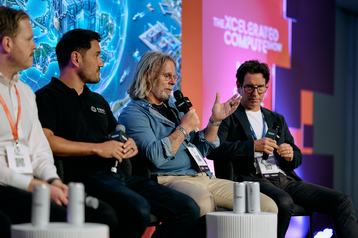
Era4 chief commercial officer Karl Havard summed it up in one panel by saying it was “virtually impossible” to have a stack sovereign to the U.K. and European Union across every layer. The only solution, he argued, was to reduce the reliance on U.S. technology at the AI infrastructure level. Havard pointed to British silicon firms like Fractile posing an opportunity with sales at home and overseas ultimately benefiting the U.K. economy. But the AI opportunity pretty much stops there, he argued, with the frontier AI model market having leveled as users move on to open-source models.
Elsewhere at Xcelerated Compute, Kao Data CEO Spencer Lamb posited that Britain was behind the rest of Europe as the compute that “we rely upon is not under our control, and if we don't get it under our control, the AI growth, if you like, of the new GPU compute that's going to support it will, in effect, create even bigger problems for the U.K. moving forward.”
Read more: Can the UK navigate toward sovereign AI nirvana?
Neoclouds versus goliaths
Of course, the sovereignty issue is part and parcel of Europe’s dependence on American hyperscalers – a dependency that won’t be going away anytime soon, according to many voices at Xcelerated Compute.
Again, it’s funny how much can change (or not change) in a year. As part of the initial AI head rush were the bright and shiny neoclouds. The argument was that they would break the hyperscale stranglehold, but across various Xcelerated panels, it seemed nobody is expecting the status quo to change any time soon.
On one panel focused on sovereign AI cloud build-outs, British firms were painted as beholden to hyperscaler services. According to Posetiv Cloud MD Mark Butcher, this is due to a tendering process favoring public cloud providers, and a risk-averse strategy from execs too timid to explore other options.

“The problem is the neoclouds can’t even get to the table in the first place for procurement,” Butcher claimed.
Only James Watson-Hall, Europe, Middle East & Africa (EMEA) field CTO for Zadara, provided some glimmer of hope, arguing that if the neoclouds solve the perennial problem of keeping compute close to data rather than vice versa, they may be onto a winner.
Read more: Don't bank on neoclouds for compute market control
Shifting beyond the GPU: Memory, CPUs, and inference economics
There was a time in the recent past when the industry would gawk at high-end GPUs, while eagerly awaiting the release of the next generation. It’s why we have annual "rhythms," to quote Nvidia CEO Jensen Huang, incremental advancements to make performance numbers go that bit higher.
But the consensus from the show floor was that it’s no longer about the GPUs. The recurring theme of inference usurping training requires a complete shift in focus within the AI stack.
Among the experts leading this line of thought was Partha Maji, Microsoft’s senior director for AI systems co-design and hardware acceleration. He argued that memory is the bottleneck facing operators today, and several hardware alternatives are trying to address it. Vendors he referenced on-stage included Cerebras with its wafer-scale technology that banks on SRAM (static random access memory), rather than supply-constrained high-bandwidth memory. But Maji argued that its ability to significantly reduce networking latency is countered by a restricted wafer limit, making it difficult to scale for models exceeding the one trillion parameter mark.
Also repeated throughout was the need to emphasize the CPU, with the processor increasingly seen as an orchestration powerhouse capable of keeping up with the complex requirements of agentic workloads that the brute-force machine that is the GPU simply can’t.
Ultimately, while hardware conversations at the show shifted beyond just the GPU, experts on stage repeatedly stressed that FLOPS were now being beaten out by tokens per dollar as the headline performance metrics. Understanding total cost of ownership and the actual economics of inference, rather than focusing solely on device-level compute or memory capabilities, was routinely touted as the more realistic validation means as to whether an accelerator makes financial sense for actual application deployment rather than relying on hardware hype.
Software stacks and the CUDA lock-in challenge
The other performance-related consideration repeatedly discussed at Xcelerated Compute London was the underlying software stack. Consensus as to the top two slots was largely agreed at the London show, with Nvidia ahead of AMD.
Michael Søndergaard, CEO of Spectral Compute, said during a fireside chat that Nvidia’s CUDA ecosystem became the default foundation for accelerated computing owing to its strong out-of-the-box performance across successive hardware generations.

“We’re no sooner getting rid of the CUDA ecosystem than we are convincing the entirety of the world to standardize around the U.K. power socket,” he said, arguing that potential ecosystem lock-in becomes apparent when organizations try to evaluate alternative hardware.
Microsoft’s Maji argued that hardware was just a quarter of what makes an accelerator company succeed, with 75% of accelerator value deriving from software capabilities. He viewed AMD as closely following Nvidia in terms of software ecosystem capabilities, but failed to place a bet on a single vendor taking the coveted third-place spot. Means for market success identified by the Microsoft exec were the ability to deploy models quickly and the capacity to achieve high-performance throughput that matches, or even exceeds, the top two’s capabilities.
Read more: Can ‘team rainbow’ loosen CUDA’s grip on AI?
Power challenges and distributed infrastructure
If there’s one thing the AI infrastructure industry is sick of talking about, it’s power. The perennial boogeyman of buildout, it’s largely the reason why several high-end facilities are built, ready to go, but stuck in limbo as grids in key data center markets become maxed out.
Panels and chats throughout the two days clashed with the desire to talk about anything but power, and the proverbial elephant in the room.
But with such a vast problem, comes the need for nifty fixes. And ideas aplenty flowed throughout the show floor. A stacked panel on day two, for example, featuring leaders from Deep Green, Radiant, Available Infrastructure, and Nutanix, argued that the shift from training to inference means the old ways of powering massive cathedrals of compute can be replaced by smaller deployments, with compute power being placed closer to where it needs to be.
Another power-centric main stage panel saw experts from Meta, Zayo, PwC, and Terakraft AI agree that the key for capacity buildout is finding lead times for large grid connections that are shorter, rather than focusing on places with abundant, and yet increasingly sought after sources of energy, like the Nordics.
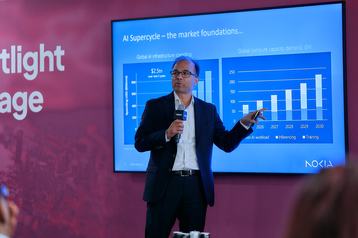
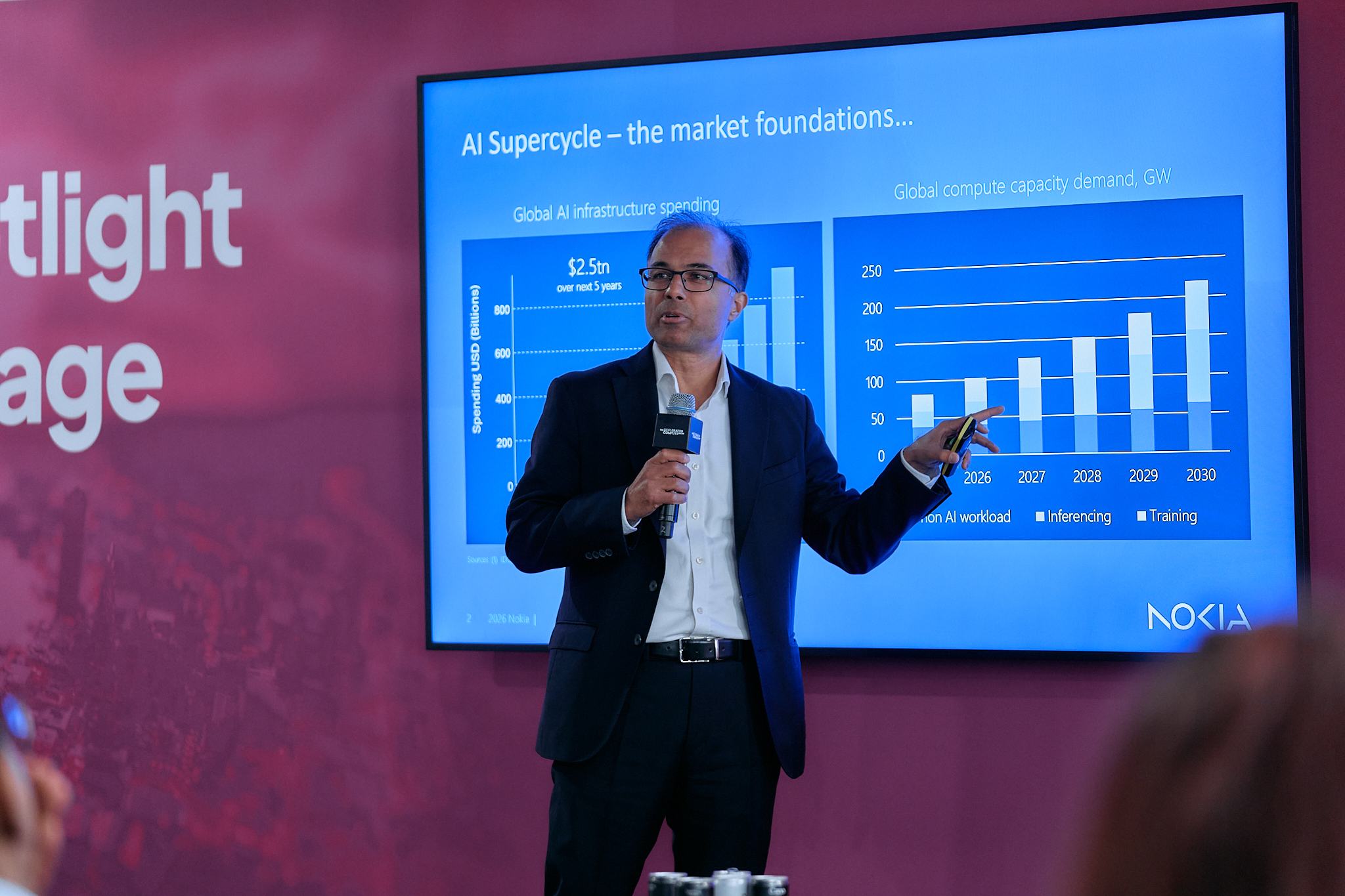
A speech from Nokia’s VP and CTO for Europe, Azfar Aslam, meanwhile, took a similar line. He argued that the rise of AI compute provides an opportunity for more distributed intelligence, with the idea of the edge cloud a potentially less constrained alternative.
“We are having to deal with the reality, so we’re distributing AI factories in smaller locations wherever we can get power in the next year or so,” Aslam said. “That distribution of data centers is effectively the way forward in Europe, but turns out the Americans are doing the same.”
Read more: Europe may lose the AI ‘bragawatt’ race, but that might not matter
Read more: Finding where the power is to fuel AI compute
The evolving state of AI networking
Networking was – as expected – a key talking point throughout the two days in London.
Among the main focuses from across the two days was how telecoms and networking infrastructure needs to evolve to support the unprecedented demand and unique routing requirements of AI workloads.
Like power, the immense AI buildout is creating scarcity. London enjoys fiber overbuild, but the same can’t be said for the rest of the world, with speakers highlighting that major data center projects in the U.S., for example, lack power and connectivity.
“I've been doing this for 30 years, and we've never seen demand like we're having today as an industry across the world, and that's creating, together with everything else in the world, scarcity,” Joe Marsella, Ciena’s VP of portfolio management, said during a panel discussion. “On one hand, we're wanting to move a thousand miles an hour. On the other hand, there's so much demand that it's difficult to meet at that pace.”

Balancing the industry's desire for rapid deployment with the actual lead times therefore requires thinking outside the box.
Among ideas proposed by speakers throughout the event to kickstart AI networking infrastructure were moving away from rigid, legacy monolithic networks toward modular, software-defined architectures like network-as-a-service to route AI services dynamically.
A strategic shift toward metro-level distribution and repurposing decommissioned central offices for inference computing may also help to support applications that require inference as close as possible, like robotics and remote surgery.
“If we start getting distributed compute, we're going to have more smaller data centers that are perhaps using, again, not GPUs but more specialized inferencing chips that are very costly and power optimized for those use cases,” Marsella said. “That means you're going to have more meshy type networks. For years, we've survived, I think, as an industry building ring-based topologies … but I think this is going to drive an even more meshy, spider-based topology than what we've got.”







Comments