

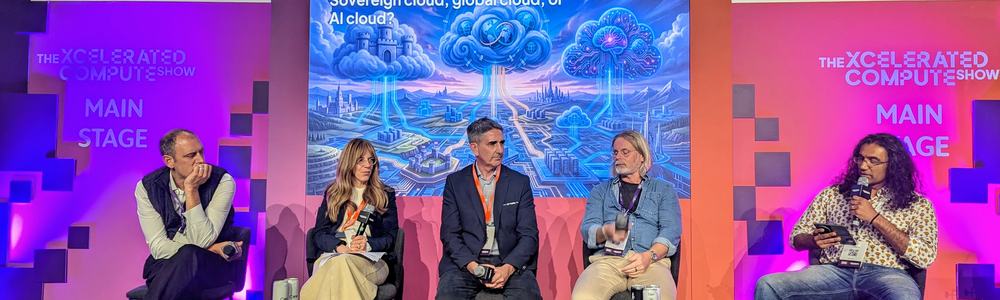
LONDON – The hyperscalers are likely to retain compute control in Europe, with neoclouds unlikely to take the reins any time soon.
Such was the unanimous verdict from a panel at this week's Xcelerated Compute Show, with little market change expected in the next five years.
The only hope for neoscalers is if they fix the perennial problem of keeping compute close to data rather than vice versa, according to James Watson-Hall, Europe, Middle East & Africa (EMEA) field CTO for edge cloud vendor Zadara.
"If the neoclouds and local in-country MSPs (managed service providers) solve the data gravity/data mobility problem, along with the trust, including security like certification and stuff like that. If they can do those things, I think they've got a fighting chance of retaining more business than they do today, and having a fighting chance to get the hyperscalers," he said.
The trust aspect was another unanimous opinion from the panelists, with Watson-Hall stressing that "control is in trust. Security is in trust" – but that British attitudes were more relaxed on the continent where the European Union's Cloud Act reigns relatively supreme.
"If you own your keys, you manage your keys, and that data is here, and it is managed by a U.S. company, and that is prone to the Cloud Act. I think that's as much as you can trust. I think the challenge is, personally, I don't think there's any actual real clarity here in the U.K. There is in Europe, but I think today anyone looking at it is looking at trust. It's a whole bunch of things, and I think whether a neocloud can tick as many of those trust boxes, I think that's all you can do today.”
Money talks. Or does it?
The Xcelerated Compute Show also revealed hyperscale dominance may persist despite the potential cost savings of shopping elsewhere.
Era4 chief commercial officer Karl Havard claimed: "neoclouds will be cheaper than the hyperscalers, but the market hasn't realized yet."
Posetiv Cloud MD Mark Butcher added it's 60% cheaper to build and operate your own platform than to buy an equivalent from public cloud, and 40% cheaper on average to buy from a British software provider than from a hyperscaler.
What's holding the U.K. back from compute mega-bargains is the tendering process, and a risk-averse strategy from execs keen to hold onto their jobs.
"The problem we actually have is the neoclouds, and the newer providers cannot even get to the table in the first place for the procurement," Butcher said. "In the UK's 'cloud standards' as such, the first line, it says 'public cloud providers.' When you read the entire document, it does define that you can look at infrastructure as a service, you can look at hosting platforms, you can look at other ones. But none of the leadership ever gets past those opening lines because they won't get fired to do that."
It seems though that some buyers are willing to pay a premium for sovereignty. This was the view from Noa Sussman, director of global solutions for TecEx, a supply chain lynchpin that provides compliant importer-of-record solutions.
According to Sussman, hyperscalers and neoclouds are placing infra in-country to satisfy customer demand for sovereignty.
"There's a big shift moving into enterprise soon to own their own GPUs, their own equipment in the different countries, and that's why we're seeing this increase in executable deployments going across the globe."





Comments