

Extreme Networks expanded its wireless portfolio with a Wi‑Fi solution designed for stadiums and large venues.
Extreme Multi‑Beam Wireless is claimed to reduce interference with defined coverage zones and controlled radio frequency (RF) patterns, while simplifying deployments by consolidating infrastructure into centralized overhead systems such as catwalks or rafters, with coverage delivered on a downward basis.
Extreme’s offering counteracts traditional stadium Wi-Fi designs which often rely on omni-directional and directional coverage as well as dense underseat deployment models to work around RF constraints. According to the vendor, adding more access points increases infrastructure mounting points, cable management requirements, and long-term operational burden.
With its solution, Extreme claimed to offer greater precision to help the network scale “without unnecessary costs or inefficiencies.” It merges AP5022FX Wi-Fi 7 access points with 16 independently serviced radio frequency (RF) sectors from MatSing. Each deployment consists of a single overhead antenna system connected to two access point chassis, with eight AP5022FX access points (APs) per chassis. This results in a total of 16 APs per antenna system, with each AP mapped to a dedicated RF sector.
With each one feeding a specific directional beam, RF energy is contained and focused, rather than spread broadly. Extreme said this reduces co-channel interference and improve signal quality, especially in dense seating areas where traditional designs often rely on less consistent coverage patterns.
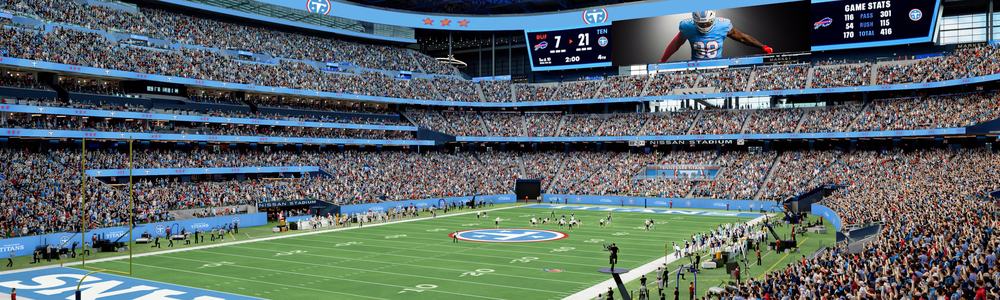
Among the first stadia to make use of Extreme's Wi-Fi-7-based Multi‑Beam Wireless tech is the New Nissan Stadium in Nashville, Tennessee. Scheduled to open in 2027, the venue will be the new home of the Tennessee Titans and will host Super Bowl LXIV in 2030 – marking the first time the sporting spectacle will be held in Nashville.
“The network will be foundational to every fan, employee and operational experience inside the stadium, and we're excited to help power a venue built to host the biggest moments in sports and entertainment," said John Brams, Extreme's SVP for the Americas.

University of Florida bring Wi-Fi 7 to ‘The Swamp’
Large, high-density outdoor venues are among the most punishing environments for wireless
Florida span
The step from Wi-Fi 6 to 7 is steadily taking shape, with the next-gen standard promising faster speeds and double the bandwidth.
Extreme has already debuted Wi-Fi 7 solutions, expanding its existing device portfolio, namely the AP5060 series outdoor and the AP5022 series indoor APs, which feature three 4x4 radios, a dedicated tri-band security sensor, and integrated IoT radios.
Both support tri-band operation on standard PoE+ (802.3at), with customers able to define the requisite balance of radio performance, scanning, and functionality according to environment.
The vendor recently worked with the University of Florida’s Wi-Fi 7 deployment at Ben Hill Griffin Stadium, also known as “The Swamp”.
Matt Vincent, assistant athletic director of IT for University of Florida Athletics, said Wi-Fi 7’s multilink operation (MLO) and expanded spectrum ensures consistency, latency, and interference management.
Noting the average 90,000-plus fans packed into the venue, Vincent explained the Swamp suffers from heavy competing RF [radio frequency].
“Having that new channel space opened up is really going to help drown out some of the noise. Not just the speed, but the cleanness of the radio space,” Vincent said, adding that with the move to Wi-Fi 7, the university is deploying the network as a fabric, enabling greater segmentation, automation, and eventual convergence.



Comments