


Enterprise networking tends to move in cycles, with long periods of incremental change followed by step-function upgrades that redefine expectations. With the University of Florida’s decision to deploy Wi-Fi 7 at Ben Hill Griffin Stadium (“The Swamp”), we’re clearly entering one of those inflection points.
Large, high-density outdoor venues are among the most punishing environments for wireless, and historically they’ve lagged a generation behind enterprise campus deployments.
I caught up with Matt Vincent, assistant athletic director of IT for University of Florida Athletics, to discuss the decision, the risks, and what IT leaders should take away from this move.
Why Wi-Fi 7 – and why now
In Florida, the timing wasn’t just about chasing the latest standard. It was driven by a familiar enterprise reality: life cycle pressure.
“Our initial stadium install was completed in 2018, so we’re at the end of life,” Vincent told me. “I’ve been putting out feelers to our administration for the past couple of years that this needed to happen. It just fell into place at the right time.”
That “right time” coincided with both the availability of Wi-Fi 7 and a shift in how the project could be funded. The school worked with Extreme Networks’, which has a network-infrastructure-as-a-service (NIaaS) model that played a critical role.
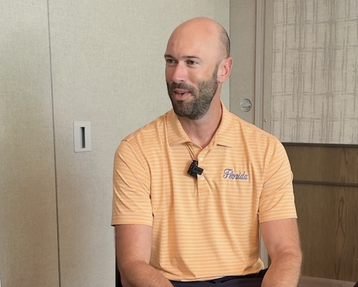
“That enabled us to take that bite without having to come up with the capital up front,” Vincent said. “You fight so hard to get approval for these big projects. Nobody wants to hear you ask for it again seven years later.”
This is a key point for IT leaders. The move to consumption-based networking isn’t just about financial engineering; it’s increasingly the enabler of modernization. In environments where infrastructure refresh cycles are scrutinized, NaaS can be the difference between staying current and falling behind.
Beyond speed: What Wi-Fi 7 really enables
It’s easy to reduce Wi-Fi 7 to a “faster Wi-Fi” story, but that undersells its impact – especially in a stadium. “Yes, speed,” Vincent said when asked to describe the difference in one word. But he quickly expanded on that.
With 90,000-plus fans packed into a confined space, performance isn’t just about peak throughput, it’s about consistency, latency, and interference management. Wi-Fi 7’s multilink operation (MLO) and expanded spectrum play a major role here.
“We have a lot of competing RF [radio frequency] – it’s right in the middle of campus,” Vincent explained. “Having that new channel space opened up is really going to help drown out some of the noise. Not just the speed, but the cleanness of the radio space.”
That “clean RF” point is often overlooked. In ultra-dense environments, reducing contention can matter more than raw bandwidth.
The shift to a converged, fabric-based network
One of the more interesting aspects of this deployment is not just the move to Wi-Fi 7, but the architectural shift happening underneath it. Florida is deploying the network as a fabric, enabling greater segmentation, automation, and ultimately convergence.
“I think that’s going to be our best opportunity to feel comfortable having a converged network,” Vincent said. “Right now, we keep things separate – Wi-Fi, concessions, different systems. With this, I’d be more comfortable bringing those together.”
Stadiums are notorious for a patchwork of networks – broadcast, concessions, ticketing, security, and IPTV – often operated independently. Converging them onto a single, secure fabric can unlock both operational efficiency and new experiences.
Vincent cited faster concessions, more flexible pop-up services, and improved fan flow as near-term benefits, noting, “making it quicker for fans to get through gates and to get concessions – those are the things that matter.”
This aligns with a broader trend: the value of network modernization is increasingly measured by business outcomes, not just technical metrics.
AI and automation: cautious optimism
Like many IT leaders, Vincent is intrigued, though cautious, about AI-driven networking.
“I’m not sure how long it will be before I allow it to start configuring itself,” Vincent said. “But the idea of predictive alerts and quickly identifying issues – that’s definitely something that would benefit us.”
Trust is the key factor. Vincent noted he’d be more comfortable letting AI handle Wi-Fi optimization before touching core network configurations.
“I’d want to see that the alerts aren’t false positives and build trust that it knows what it’s seeing,” Vincent explained.
This reflects what I’m hearing across enterprises: AI adoption in networking will start with visibility and recommendations, then gradually move toward closed-loop automation as confidence grows.
The fan experience is just the beginning
When most people think about stadium Wi-Fi, they picture fans posting on Instagram or TikTok. That’s still important. Vincent noted that Instagram currently leads in usage, with TikTok close behind, but it’s no longer the primary driver.
“The biggest improvement has been communication,” Vincent said. “Instead of radios, we can trust that a text will go through. There’s a lot of texting among staff on game day.”
Operational use cases – staff coordination, mobile point-of-sale, digital ticketing, and real-time analytics – are now as important as, if not more than, fan connectivity. Florida is also looking to expand into location-based services and analytics.
“We’re going to dive into business insights more – dwell times, things like that,” Vincent said. “Even just telling people, ‘these gates are full, go to another entrance’ – that type of thing.”
This is where modern Wi-Fi networks become data platforms, not just connectivity layers.
What IT leaders should take away
Florida’s deployment may be a “first,” but the lessons apply broadly across enterprise IT.
First, align upgrades with life cycle realities. Waiting too long creates risk but moving too early without a clear benefit wastes budget. Florida hit the window when infrastructure refresh, new technology, and funding models aligned.
Second, think beyond connectivity. The real value of Wi-Fi 7 – or any next-gen network – is what it enables: automation, analytics, and new experiences. If your use case is just “faster internet,” you’re underutilizing the investment.
Third, evaluate architecture, not just access points. The move to fabric and convergence may ultimately deliver more value than the radio upgrade itself.
Fourth, consider consumption models. NaaS isn’t right for every organization, but for many it’s becoming the most practical way to modernize at scale.
Finally, choose partners carefully. Vincent emphasized this point: “Make sure it’s a company you trust to be there after the install – not just to say hello and then disappear.”
That may be the most important takeaway. In complex environments, the success of a deployment is as much about people and support as it is about technology.
Florida is taking a calculated risk by going first with Wi-Fi 7 in a stadium, but it’s a risk grounded in clear operational needs, a modern architecture, and a strong partnership.
For IT leaders watching from the sidelines, the question isn’t whether Wi-Fi 7 will come to your environment – it’s when and whether you’ll be ready to take full advantage of it when it does.



Comments