


A “winter freeze” caused a significant dip in AI traffic before significantly rebounding later in the first quarter of 2026, according to a new report from Backblaze.
Stats from the vendor’s quarterly "Network Stats" analysis saw a dearth of activity for both neoclouds and hyperscalers, but the former camp still maintained high magnitude data transfers during the early weeks of the year, owing to their penchant for AI workloads.
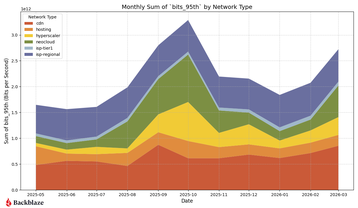
Backblaze’s report details the neocloud network loads as being high in capacity but slightly lower in volume, with a small number of graphic processing unit (GPU) clusters ultimately moving massive datasets in intense bursts. That didn’t stop those few jobs from running “hard,” the vendor highlighted.
While neocloud traffic dipped in the early months, the report showed an upward trend from February into March, with hyperscaler following suit. That initial 2026 downtime was linked to holiday season breaks, with Backblaze’s report citing it as an “indication of the human element” in the business cycle. In fact, Blackblaze’s Q1 findings found network baselines continue to rise, increasing quarter-over-quarter.
“Despite the total amount of traffic decreasing over the winter months for neocloud traffic, the magnitude of neocloud transfers still remains high,” Backblaze’s report reads. “This speaks to the nature of the traffic pattern – when a GPU/compute cluster is ingesting or producing data, it does so at a high bitrate with just a few number of unique endpoints talking to each other.”
Blackblaze’s Q1 findings found neocloud activity to remain heavily concentrated in the Ashburn-Reston corridor in Virginia, similar to previous iterations of its report. California was also found to hold a sizable percentage of neocloud activity, owing to the state being a hub for tech firms.
Beyond the U.S., Backblaze found a sizable concentration of neocloud-related network activity in Finland, Brazil, France, and Canada, with providers like Nscale, Axia Energia, and CoreWeave among the providers making strides in those respective markets.
Geographical analysis, though, sees Europe’s network posture differ greatly from that of the U.S., with local internet exchange (IX) networks preferred over larger tier-one internet service provider (ISP) networks for transit, with Backblaze placing reasoning down as politically, cost, and preference-wise.
Backblaze CEO Gleb Budman highlighted the shifting geopolitical concentration, saying, “the data tells a clear story: AI is reshaping global infrastructure investment.”
Backblaze's report follows the debut of its B2 Neo neocloud-optimized storage layer capable of handling the sizable datasets and high-throughput workloads typically seen from such players.







Comments