


Neoclouds like CoreWeave, Vultr, and Nscale are currently the talk of the town, attracting multibillion-dollar investments left and right. But it’s not just their coffers that are burgeoning, as new data suggests these emerging cloud players are causing traffic to soar.
Figures from Backblaze’s quarterly "Network Stats" analysis show that traffic from neoclouds saw a sharp increase between July and November last year, peaking in October.
The cloud storage firm contends that the vast datasets being ingested and utilized by neoclouds are largely behind the increase, suggesting that the trend is likely to continue into 2026 as part of a “new normal.”
“Few forces are reshaping network behavior faster than AI,” Blackblaze technical lead network engineer Brent Nowak explained. “This report gives the industry a clear view into how AI is driving the shift from internet-style traffic to the sustained, high-bandwidth flows required by AI-native infrastructure.”
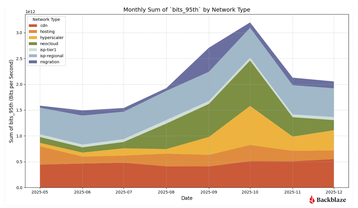
AI-driven workload inversion shifts network gravity east
The Q4 data revealed that AI-driven data transfers were largely concentrated in the "US East" region, near neocloud compute hubs like Northern Virginia, New York, and Atlanta. CoreWeave, for example, supports workloads in New Jersey, with Nebius also building a 300MW site in the state. Meanwhile, Lambda is setting up shop in Chicago and Atlanta courtesy of two facilities being built by EdgeConneX.
Backblaze’s data showed that neocloud activity in those regions skewed more toward the East Coast, where dense AI compute availability is more widespread.
“From a performance standpoint, this makes sense,” Nowak wrote. “It’s important to keep latency lower to achieve consistent high bandwidth rates for AI data transfers. For now, that gravity is pulling activity toward the East Coast.”
While traditional content delivery network (CDN) and ISP traffic stood firm along usual performance levels, the findings suggest that neocloud traffic is proving to be fundamentally different from general internet or cloud traffic.
Where traditional internet traffic has a “uniqueness” to it, with a larger number of data centers and a mix of workloads resulting in an array of outputs, the rise of the neocloud and its penchant for AI has resulted in what Backblaze suggests is fewer, more sizable datasets moving in short, sustained bursts across persistent endpoints and pipelines.
“This contrast reveals a broader trend: AI networking is less about many-to-many communication and more about sustained high-throughput relationships between specialized systems,” Nowak suggested.
As a result of the neocloud workload inversion, storage, compute, and networking look to be coming together into closer alignment, the report suggests.
We’ve already seen such alignment shifts at an operational such as via CoreWeave’s Mission Control, which, following a December update, gives enterprises using its GPU-as-a-service offerings improved visibility into GPU, network, and storage performance.
Such design approaches are even going from the neocloud to the hyperscale level, what with Vast Data’s Nvidia-based AI architecture, which embeds storage and database processing services directly into AI servers, finding itself used by CoreWeave, but also Microsoft and Google Cloud.
Backblaze, too, has sought to address the fundamental rethink to networking with its B2 Overdrive, a high-throughput cloud storage solution that looks to support client transfers ranging from 100 Gb/s up to 1 Tb/s.
“With B2 Overdrive, we created a direct, high-performance path between storage and the neoclouds where modeling takes place,” Nowak said, adding that its Q4 data showed customers are actively using its platform the way it was designed, to support high-intensity workloads.



Comments