


Space. The final frontier. While humanity’s fascination with outer space will never quite go away, for the first time since the 1970s, we’re looking back up at the stars to find our place. The Artemis II marked a testbed for our long-awaited return to the Moon and beyond.
Beyond the pinnacle of mankind’s achievements, space also presents itself as the ultimate use case for local compute and storage.
When drifting hundreds or even thousands of miles above the Earth, the concept of sending information back down to the planet simply isn’t feasible. The sheer volume of bandwidth required would be astronomical, demanding a device of significant size and robustness to supply the necessary power and connectivity. For operating in space, weights and measures (and even space itself on modules) represent perhaps the greatest challenge.

Memory & Storage Supplement 2026
How Meta, Weka, Vast, and Red Hat are rethinking storage as AI inference outpaces memory supply
In the early days of space exploration, storage was a lot humbler than what we use today.
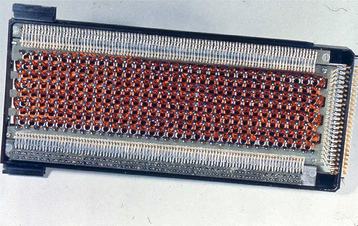
The Apollo missions made use of core rope memory, a form of permanent, physical read-only memory (ROM) that literally stored data through wires woven into ferrite cores. These looked like donuts, with each wire passing through a core representing a binary 1, while a wire bypassing it meant 0. Raytheon engineers physically hand-wove it, earning it the nickname "little old lady" (LOL) memory, yet another example of the importance women played in our journey to the moon.
While that might sound primitive by today’s standards, it did the job. The physical data was immune to damage from cosmic rays and was pretty much incorruptible. Plus, core rope allowed for around 72 kilobytes per cubic foot, so it was far denser than the memory offerings available at the time. But this was the era of tapes. And what’s more, it was stored in compact metal boxes, only taking up one or two cubic feet, making it easier for NASA to store an awful lot of the stuff without taking too much room on the considerably cramped module.
After core rope memory came plated wire memory. Developed by Bell Labs, it replaced ferrite cores with a grid of beryllium-copper wires electroplated with a thin magnetic film, which, to the delight of those who had previously spent countless hours weaving Apollo’s initial cores, could be machine-assembled while still being non-volatile and highly resistant to radiation.
In fact, Viking – NASA’s program that sent probes to Mars in the mid-70s – made use of plated wire memory, while their orbiters’ command computer subsystem made use of 18-bit processors.
But as the '70s wore on and the decade of decadence that was the '80s began, the era of silicon came to the fore. Integrated circuits completely usurped the highly rope-laden days of the '60s and mid-70s, through the invention of things like flash memory, erasable programmable read-only memory (EPROM), and electrically erasable programmable read-only memory (EEPROM).
Fast forward to today, and the miniaturization revolution that transformed consumer storage has also transformed what’s possible in orbit. Enterprise solid-state drives (SSDs) like Phison’s Pascari line were used as part of Lonestar’s Freedom mission to the moon in which a prototype lunar data center – which housed an eight-terabyte SSD – landed on the lunar surface in early 2025. On board that drive was an article from SDxCentral's sister title Data Center Dynamics (DCD).
But even today, the realities storage in space has to deal with are constraints no enterprise drive would even dream of dealing with: radiation, extreme temperature swings, being able to function in a vacuum, and, arguably most important of all, zero tolerance for failure.
This can be seen in the DCD-related expedition. While the mission was a success, the lander housing the lunar data center fell on its side and could only operate for six days. In space, operational certainty is a fallacy. Something will go wrong. Take the Artemis II: Astronauts suffered a faulty urine venting system and Microsoft Outlook issues that sounded straight out of a scene from Netflix’s "Space Force."
In modern space expeditions, NASA and the European Space Agency (ESA) are increasingly turning to commercial off-the-shelf solutions in order to not only bring mission costs down but to shorten development times for traditional, slow-to-develop space-grade hardware.
Having worked on missions such as Lonestar’s Freedom, Phison is now putting its enterprise and industrial SSDs through radiation characterization, not to build classic “rad‑hard” parts, but to harden its existing commercial product lines so they can be used more confidently in space and other harsh environments.
“The industry understands that if they keep making rad-hard devices, they're using eight-year-old technology and that won’t pass enterprise requirements,” Phison CTO Sebastien Jean explained to SDxCentral. “[The space industry] wants more certainty than when they launch something that works. So we said, 'sure… we're doing radiation characterization to understand how … they know, okay, we have to keep the drive within this temperature range, but how much shielding do we need?'”
In addition to the lunar service, Phison’s SSDs have been on the external payload module of the International Space Station (ISS), and another has been on board the rover quietly making its way across the surface of Mars for more than a decade.
The conversation about storage in space hasn’t solely been accelerated by Artemis II, as quickly brushed over during the keynote at GTC 2026 was news that Nvidia was developing a space-specific module of its Vera Rubin platform.
Having already sent an H100 graphic processing unit (GPU) into orbit aboard a test satellite, Nvidia has now set its sights on the stars, as the idea of data centers in space moves from science fiction closer to science fact.


Talk of space data centers is nothing new. IBM previously explored the idea of processing data directly in orbit in a partnership with the ESA and aerospace company KP Labs. But Phison’s CTO envisions the SSD specialist as one of the unsung enablers behind the renewed push to build this AI‑focused infrastructure in space.
“Nvidia and others are going to bring the cash to the table, but it's all these little companies that are doing the work,” Jean explained. “We’re working with them, taking their feedback, hardening our products for that environment, and then giving them more visibility into the drive.
“One of the things that's important, for example, is making sure that the drive, if something catastrophic happens, they need the ability to run remanufacturing software in space as a fail-safe recovery system," Jean continued. "So we're working very collaboratively with them, and hopefully ... those companies, they win the bids, they bring us on board with them, and we plan to very much be part of the space ecosystem.”
As we begin to re-find our footing out among the stars, things are incredibly different in the space race of today than when we first set out. And not solely around storage. Where a kilogram cost millions of dollars 50 years ago, today, it’s just a few thousand dollars. Where space is now affordable, at least in relative terms, the economics can now finally match the ambition without the need for carefully woven rope or compact storage boxes to house drives.
Storage has followed that very same arc. Things have gotten smaller, cheaper, and more accessible – the three pillars are not only seen as a necessity for space travel, but for effective use in enterprise. Where the final frontier was once science fiction, we find ourselves in a place where we can watch actual entertainment or hold vast amounts of scientific information in orbit without the cost or complexity of beaming that from home.
“It is inevitable that there will be local processing in space, because there's not enough bandwidth to do everything on Earth,” Jean added.
This article first appeared in the SDxCentral Memory & Storage Supplement.
Comments