

Hewlett Packard Enterprise (HPE)’s Slingshot fabric has dethroned 100G Ethernet as the most common interconnect on the TOP500 for the first time, while a mysterious Chinese system running an unknown “LingQi” fabric entered the list, packing more raw compute to knock El Capitan off the top spot.
Slingshot 11 – an Ethernet-based proprietary technology – overtook 100 Gb/s (100G) Ethernet as the most populous interconnection option compared to the previous list published last November.
The ultra-high-speed network fabric was developed by Cray, with HPE gaining control of the technology following its 2019 acquisition. Since that takeover, HPE has repeatedly iterated upon Slingshot, billing it as ‘Ethernet plus’ by packing it with some proprietary tweaks, including compute offload technologies and adaptive routing to ensure packets move at high enough efficiencies akin to those found in InfiniBand.
While Slingshot no longer powers the world’s top supercomputing system, El Capitan’s reign at the top was ended by the mysterious all-Chinese LineShine. the fabric features in 57 (11.4%) of the 500 systems on the list. 100G Ethernet, meanwhile, was just one system off, at 56 (11.2%).
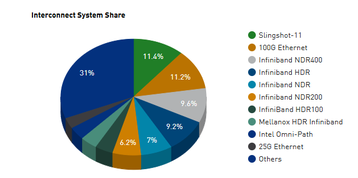
Slingshot also makes up the majority of the top 10, featuring in six systems, and 16 of the top 30. It’s found in four of the top five, including Frontier and Aurora, along with the former list topper.
While 100G Ethernet slides down the pecking order, making way for an ultra-fast fabric, its continued abundance among mid-tier systems means it retains its position. In performance comparisons, though, it lags far behind its more prevalent cousin. The MIT Lincoln Laboratory Supercomputing Center’s TX-GAIN continues to be the highest-ranking 100G-based system, though the Nvidia H100-based unit fell yet again to 150, having been at rank 131 and 114 on lists prior.
InfiniBand, long the dominant fabric in the days of high-performance computing gone by, echoes its current enterprise positioning with it continuing to evolve rather than retreat.
The biggest mover on the June list was InfiniBand NDR400, which jumped from 35 to 48 systems, the largest single gain of any interconnect. ISEG2, the Netherlands-based supercomputer operated by neocloud firm Nebius, was the highest-ranking NDR400 system, coming in at 15. It was closely followed by a supercomputer from another neocloud, Core42’s Maximus-02 in 18.
Combined with NDR's own growth from 29 to 35, the NDR family now collectively accounts for around 16% of all systems, making it the third-largest interconnect grouping on the list.
Despite Ethernet’s unabated resurgence, InfiniBand continues to find a way, with the transition from the previous HDR generation showing signs of acceleration.
But it’s another Ethernet-based fabric that’s starting to slowly eke out its own Top500 niche. Having debuted in the November 2024 list via the Israel-1 supercomputer, Nvidia’s Spectrum-X networking offering increased its presence on this latest outing. While it’s up to three, the fabric makes a similar play to that of HPE’s Slingshot: A proprietary sprinkling of improvements to a protocol firmly familiar among industry engineers.
Just three supercomputers make use of Spectrum-X on this latest list. While that’s the same as Gigabit Ethernet and InfiniBand HDR200, the fabric’s proliferation in the enterprise and hyperscale space – with IDC recently labeling Spectrum-X “the preferred network interconnect for large-scale AI training” – shows its influence in high-performance networking is greater than its current Top500 footprint suggests.
That said, hyperscalers tend to shy away from taking part in the Top500, barring outliers like Microsoft’s Eagle system, which sits in seventh place.
China back at the table
June 2026’s iteration of the Top500 is arguably the most interesting in terms of significance, as for the first time in a long time, China appears to be playing ball.
In days gone by, the Top500 was a slog-fight between China and the U.S. for who could build the world’s most powerful supercomputers. But China gave up reporting to the Top500 in 2023 out of protest over U.S. chip export controls, despite the industry recognizing its ability to produce competitive exascale systems.
The unexpected rise of LineShine (or Lingsheng) marks the first time that a Chinese system has topped the list since Sunway TaihuLight in 2017. That achieved 93 petaflops using the Linpack Benchmark – which Top500 uses to measure system performance.
LineShine dethroned El Capitan with 2.198 exaflops of performance – roughly 23 times the computing power it took for Sunway TaihuLight to top the list.
Built by the Shenzhen Cloud Computing Center, it’s also the first CPU-only supercomputer to top the list since Fujitsu’s Fugaku and its eight million cores in 2020. LineShine, meanwhile, has more than 13 million cores, spread across some 40,000 semi-custom LX2 processors believed to have been co-designed by China's National Supercomputing Center and Huawei.
A research paper published in April shines a light on LingQi, the little-known interconnect keeping those processors working in tandem. The proprietary technology is a Chinese-designed high-speed fabric running a dual-plane fat-tree topology.
China’s surprising return to the world of supercomputing benchmarking sees it field an interconnect forming part of a vertically integrated sovereign exascale stack.






Comments