

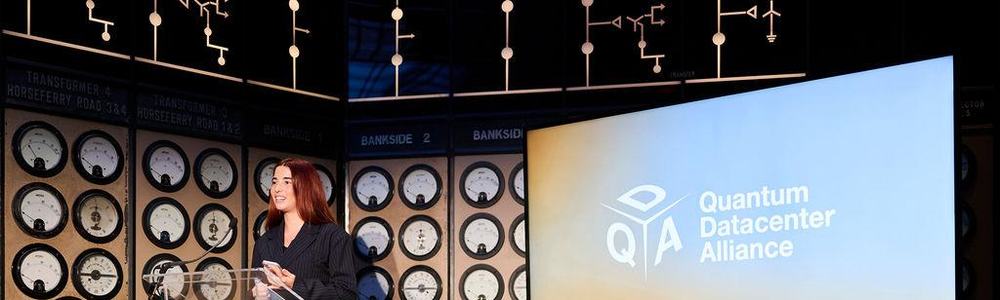
LONDON – Nu Quantum CEO Carmen Palacios-Berraquero laid out the quantum network market proposition, discussing the possibility of going public and hinting at new partnerships in the field.
In an exclusive interview, Palacios-Berraquero discussed Nu Quantum’s progress since securing a $60 million Series A investment round in December, which she described as “the largest funding round ever raised for a quantum networking company anywhere in the world at any stage.”
Palacios-Berraquero revealed Nu Quantum's workforce has doubled in size in one year, as it transitions from being an research and development firm to a product vendor.
“Nu Quantum's been looking at the problem of networking quantum computers right since the beginning," she explained. "We were the first company to identify that there was a missing layer of the stack, which is the connectivity or the entanglement layer, and started to solve it. It’s a really difficult challenge to solve because it's so multidisciplinary. What you're trying to entangle is two qubits in different processors via photonics.
"We started by tackling low-loss switching, high-performance optical resonators, and low latency control, all of these components which quantum computing companies will actually need in a few years,” she added, hinting at Q-day’s long-awaited arrival around the corner.
According to McKinsey research, the quantum communications market will be worth $15 billion by 2035, by which point quantum will likely have arrived with a bang.
McKinsey's researchers broke down their figures to predict regional quantum networks will be worth $2 billion by the same date; modular quantum interconnects just shy of $3 billion, and the quantum global internet at $2.2 billion.
Quantum partnerships
Nu Quantum recently partnered with Atom Computing, whose neutral-atom quantum computers were intertwined with Nu Quantum's photonic networking hardware. The company already works with heavy-hitters like Cisco, with whom it founded the Quantum Datacenter Alliance (QDA) last year as a way to bring the British quantum ecosystem out of Cambridge for a more global kind of get-together.
Speakers at QDA Forum 2026 included Nvidia, which touted for the London audience its quantum-based NVQLink interconnection, leading to the question over whether Nvidia is on the potential partner list for Nu Quantum.
“We’re adapting our networking stack to create solutions for all of these different players, so that's really exciting," Palacios-Berraquero said. "We announced our partnership with Atom Computing … and we've got a couple more coming up.”
“Nvidia is important in that they've been working with many players in the industry and trying to understand how GPUs and QPUs (quantum processing units) talk to each other. Watch this space,” she added.
Palacios-Berraquero elaborated on Nvidia’s status as AI behemoth, commenting that it was often thought that AI would “steal a lot of the limelight from quantum,” taking away funding opportunities with it.
“But actually, I think it's been the opposite. It's actually reminded the world what happens when you have new computing hardware,” she said.
“I feel like people had forgotten that because there hasn't been new hardware for so long. Everything has been software-based for so long, and now AI has reminded us what it means when you have a new compute architecture," Palacios-Berraquero contiued. "Most people are thinking about the future of supercomputing as heterogeneous and integrated between quantum and GPUs, CPUs, QPUs, and everything in between.”
Zero crossover with classical networking
Despite this convergence, Palacios-Berraquero reminded this title that no classical networking technology can be ported over to quantum networking.
“It's all new technology. There's some analogies, for example there needs to be an interface between the computer and the network. There needs to be a protocol, and there needs to be different layers with a control plane and data plane," Palacios-Berraquero said. "It enables modularity. … But what it's doing is entirely different. Classical networking is sending data packets from one place to another. Quantum networking is about creating quantum entanglement between two qubits in different processors. Nothing is sent from one place to another in quantum. You're creating a shared state.”
On the protocol side, Palacios-Berraquero noted that with quantum’s otherworldly differences, standards for quantum computing have been slow coming. Not that this has stopped Nu Quantum from looking ahead.
“We can already see where networking standards will come. For example, we'll have a computing chip and then a networking chip, and they will communicate via a link that will be standardized. So we are starting to design this link with QPU companies. Another standard will come in the shape and wave packet of photons for networking. There might be the wavelengths that you network at, which are not telecom-based," Palacios-Berraquero said.
"Neutral atoms have a different wavelength, the trap diameters, and some of the superconducting qubit technologies, some of the photonic technologies. There will be similar for quantum, perhaps four or five bands for each kind of qubit, and maybe it will start coalescing around like a few of them," she added.
Palacios-Berraquero, though, warned against setting standards soon in case it limits innovation.
Elsewhere in the future, the CEO expects quantum to have a flashpoint moment like AI did “that will make the world realize why we're developing this technology.”
By that point, Nu Quantum may well be considering going public. When asked what Nu Quantum’s company plans are down the road, Palacios-Berraquero commented “you have to choose these things well.”
“Going public comes with its own sort of things. For now, I think we have been able to raise the capital that we needed to. We’ll raise our Series B in 2027; this will be an order of magnitude more, and then we’ll see," Palacios-Berraquero said.


Comments