


Nvidia claims to have kicked off the “quantum-GPU computing era,” unveiling a way for quantum computers to interconnect with classical systems.
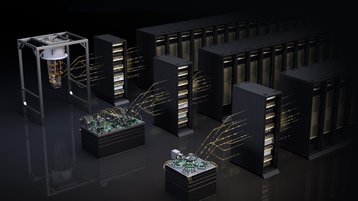
Revealed at the chip giant’s GTC event in Washington, D.C., NVQLink is a supposed world-first system capable of interconnecting quantum systems with classical CPU and GPU-based systems.
Effectively, the interconnection makes it possible for engineers and scientists to call GPU computations directly from a quantum processor with latency as low as four microseconds.
Tim Costa, GM for Nvidia’s engineering, semiconductor, and quantum business units, explained in a press briefing: “There's a symbiotic relationship between these two types of computing. On the one hand, quantum processors will unlock the ability to solve problems that classical systems cannot solve on their own. On the other hand, to make a quantum computer useful, there’s a very large computational problem in terms of error correction, calibration, and optimal control that needs to be addressed.
“This problem requires delivering large amounts of AI compute at low latency and with high bandwidth as the size of the quantum processors grows. This is why we announced NVQLink today.”
Quantum’s CUDA moment
A major roadblock in quantum development has been the networking component: getting quantum systems to communicate with another computing system.
Due to the sheer complexity of quantum signals, interconnecting the two disparate systems, let alone a quantum system with a classical computer, has proved a stumbling block.
While there have been several breakthroughs attempting to bridge the gap, such as the University of British Columbia’s “universal translator” for quantum computers, little progress has been made to bridge these worlds efficiently.
Nvidia’s NVQLink architecture therefore aims to enable tight integration between quantum processors and GPUs, forming the basis of the chip giant’s “mutualistic vision” of both hybrid, accelerated quantum-GPU systems, and accelerated quantum supercomputers.
To further boost systems, connected GPU systems can be scaled to “an arbitrarily large amount of compute if needed” using Ethernet connectivity.
The interconnect offering supports all major quantum processing unit (QPU) modalities, from superconducting systems and trapped-ion to photonic and neutral atoms, while also providing real-time access to an API of Nvidia’s CUDA-Q software library to support computations across GPUs, CPUs, and QPUs.
“[NVQLink] represents the most powerful classical resource ever to have quantum processors connected with connections at lowest latency, demonstrated for complete, scalable quantum error correction,” Costa added.

Inside Spectrum-X: Nvidia’s Ethernet networking platform
How Nvidia re-engineered Ethernet to power the world’s largest AI clusters
A symbiotic relationship
In a conversation with SDxCentral prior to GTC, Costa said the chip giant views classical GPU-based computers applying AI to quantum devices as “an absolutely essential step milestone on the road to useful quantum computing.”
He said Nvidia doesn’t think a useful quantum computer would exist without the application of a large-scale AI supercomputer to address issues like simulation, calibration, and overall control of quantum devices.
“Today, error correction is nascent,” Costa said. “Calibration is hand-tuned by physicists, and you simply can't scale that to the size of systems that will be needed for solving real problems of significance.”
To further fuel NVQLink, Costa told SDxCentral that the CUDA-Q “allows domain scientists to couple together all the best of accelerated computing and the infrastructure they're using today with the capabilities of a quantum processor.”
“We want to provide a fundamental instrument of science and engineering for those who are building quantum technologies, and then also we want to work with all of the people who are building quantum technologies, both software and hardware, to integrate that in to the system that will be the future of computing, including quantum acceleration, and provide the horsepower to do the important workloads of error correction, calibration and control,” he added.
Built on an 'open architecture'
Nvidia is billing NVQLink as an open architecture system.
During the press briefing, Costa explained that Nvidia developed NVQLink “in collaboration” with some 17 organizations working on quantum processor technologies.
The likes of IonQ, Quantunuum, and QuEra were among those listed at GTC as having partnered with Nvidia on NVQLink, alongside several leading labs including Fermilab, Los Alamos National Laboratories, and Oak Ridge National Laboratories.
“Nvidia’s mission is to build the best classical computing technology to integrate quantum processors so the world can solve problems that aren't solvable with classical systems alone,” Costa said. “If you look at the announcement, you see 17 QPU partners, five quantum control systems, and a slew of US national labs. The definition of the architecture, the adoption of the architecture, were all done openly with the ecosystem.”



Comments