

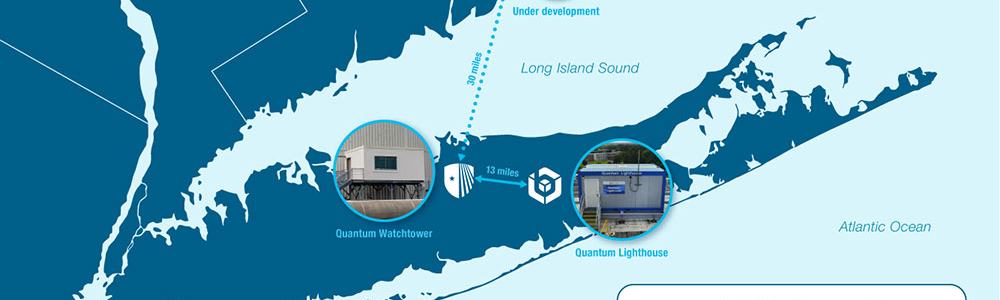
Brookhaven National Laboratory and Stony Brook University transmitted entangled photons over a 13-mile free-space optical link, adding a wireless connection to an existing 161-mile, eight-node quantum network.
The demonstration is the first free-space optical (FSO) quantum link of its kind in the U.S., according to the institutions. It adds wireless capability to a metropolitan-area network spanning Long Island and the New York area, where commercial fiber distributes entangled photon pairs between eight nodes.
During a daytime event, researchers generated low-intensity quantum states of light at Stony Brook’s rooftop Quantum Watchtower and sent them across open air to Brookhaven’s Quantum Lighthouse 13 miles away. That test demonstrated the precision of the optical link but did not use entangled photons.
The entanglement work took place separately during nighttime testing when lower background light made the faint quantum signals easier to detect. Entangled photons generated in a Stony Brook physics laboratory traveled by fiber to the Quantum Watchtower, then crossed the free-space link to the Quantum Lighthouse, where they were received and measured.
The institutions did not report figures for fidelity, photon loss, or transmission rate, but said the results marked progress toward sustained wireless exchange of quantum information between the sites.
Borrowing from astronomy
Sending quantum states through open air required expertise borrowed from astronomy. Radio frequencies used by conventional wireless technologies are too noisy to preserve quantum information, so the teams used optical light and adaptive optics techniques normally employed to correct for atmospheric turbulence in telescopes.
Because the entire route passes through the turbulent atmosphere close to the ground, Brookhaven’s team had to adapt those techniques to correct distortions in the light during its 13-mile journey.
Justine Haupt, Brookhaven’s lead scientist on the cross-institutional FSO link project, explained that building the link meant integrating “the optics, controls, communications, quantum sources, and detectors” so equipment 13 miles apart could function as a single experiment.
Free-space links are intended to complement fiber rather than replace it. Commercial fiber is optimized for telecom wavelengths, while an open-air path can carry other wavelengths, including some at which quantum technologies natively operate. That could enable connections between quantum devices without converting their signals to telecom wavelengths.
The approach is also a step toward linking terrestrial networks with orbiting satellites, potentially extending quantum communications to areas with little fiber infrastructure.
The next stage is intended to extend the network beyond Long Island to Yale University in New Haven, Connecticut, where a third facility has already been completed. Researchers are now working to establish a roughly 30-mile connection between Stony Brook and Yale across Long Island Sound. Longer-term plans include connecting quantum computers across the network and transmitting quantum information to satellites.




Comments