

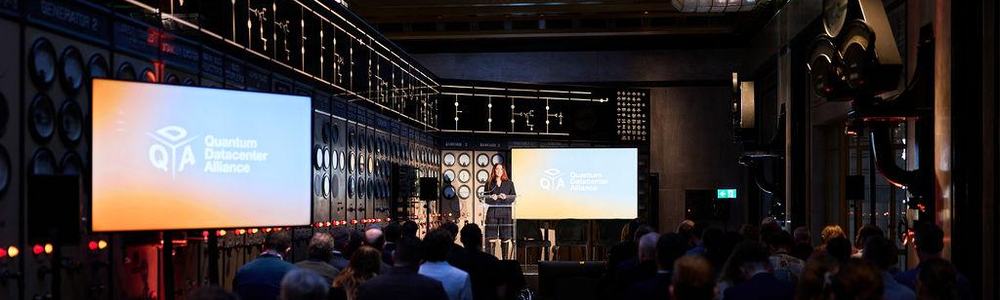
LONDON – Networking leaders Cisco and Nvidia argued tomorrow’s quantum systems will still need to rely on classical network systems and open architecture.
Speaking at QDA Forum 2026, Cisco engineer Luca Della Chiesa mentioned the “elephant in the room,” being quantum interfaces that link various quantum systems together, or quantum and classical systems to form hybrid setups. Della Chiesa said such interconnections form a bottleneck that prevent quantum components from working together at scale.
“The winner will not be who will build the best qubits, the best entanglement rate. The winner, and this I think Nvidia knows very well, is who builds the best system,” Della Chiesa said, referring to the chip giant.
The ideal interface should be open and integrated, and designed for real data-center integration. As Della Chiesa put it, “You will not get a greenfield (to work with). You will need to enter into a data center and integrate with what is there.”
Cisco’s presentation illustrated a classical backend network powering quantum processing units, as linked with an as yet undefined protocol or standard.
Nvidia makes the AI and quantum case
Andy Grant, EMEA director for supercomputing and AI at Nvidia, in another QDA session detailed the firm's hybrid vision for QPUs to be plugged into existing supercomputers to act as extra accelerators, courtesy of Nvidia’s NVQLink interconnection.
Software-wise, an AI-based predecoder compresses error information before it gets transferred to the decoder, so the latter “doesn't have to do as much work,” thus helping keep quantum information from environmental noise and decoherence, which lead to errors en transit.
Grant said Nvidia’s approach, unveiled in July, sees 2.5-times faster decode speedup and three-fold improvement in logical errors rates (LER).
Nvidia’s open quantum platform is comprised of a supercomputer running CUDA-Q algorithms to solve and compile, and a quantum system processor running Cudaq-realtime and CUDA-Q quantum error correction (QEC), which is "NVQlinked" to a quantum system controller and a physical quantum device.
Grant described the setup as based on “AI supercomputing.” Unsurprisingly, the AI giant believes AI can accelerate quantum computing at multiple stages, not just for analyzing results afterward. In a collaboration between Quantinuum, Pfizer, and Nvidia, transformer-based generative AI was used to synthesize quantum circuits for molecular ground-state modeling. Nvidia's quantum platform was used to generate training data and simulate circuits during reinforcement learning, with Quantinuum reporting a 234-times increase in in training-data generation speed.
Like Cisco, Nvidia argued only open interoperability would bring quantum networking into the mainstream.
“If we can get to the point where we've got more open tools and open formats and shared benchmarks, that'll let the entire ecosystem compound in the same way that it did for machine learning a few years ago,” Grant argued.

Comments