


Researchers from the University of Chicago (UChicago) claim to have pushed the barriers of communication between quantum computers: enabling systems to potentially connect across thousands of miles just by altering how components are put together.
Instead of developing new tools or materials to boost connectivity between quantum computers, the researchers sought to boost quantum entanglement using a slightly different technique.
Detailed in a paper published in Nature Communications, the researchers employed molecular-beam epitaxy (MBE), a process wherein thin layers of single-crystal materials are created in a vacuum.
The traditional Czochralski method sees single crystals for integrated circuits created by having the raw materials melted in a crucible above 3,000 degrees Fahrenheit, and then slowly cooled to form a material crystal before being chemically carved into the required form. With MBE, it allows chip designers to be more precise, almost akin to 3D printing, as complex structures are built slowly by adding layer upon layer of material (in this case, rare-earth crystals) one at a time. The team at UChicago applied this method as a means to better lay out components to ultimately boost quantum coherence.
“The traditional way of making this material is by essentially a melting pot,” explained Tian Zhong, an assistant professor at UChicago’s Pritzker School of Molecular Engineering. “You throw in the right ratio of ingredients and then melt everything. It goes above 2,000 degrees Celsius and is slowly cooled down to form a material crystal.”
“[With MBE], we start with nothing and then assemble this device atom by atom. The quality or purity of this material is so high that the quantum coherence properties of these atoms become superb.”
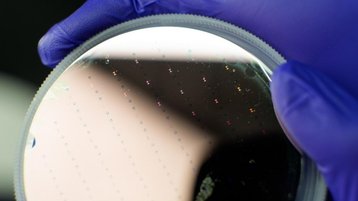
The researchers contended that a controlled nanofabrication approach resulted in quantum coherence of individual atoms on components from 0.1 milliseconds to longer than 10 milliseconds.
In one test, the researchers' nanofabrication method yielded quantum coherence of up to 24 milliseconds, which would theoretically allow for quantum computers to connect at a distance of 2,485 miles, or the UChicago PME to Ocaña, Colombia.
Commenting on the results, Dr. Hugues de Riedmatten from the Institute of Photonic Sciences, said: The approach demonstrated in this paper is highly innovative. It shows that a bottom-up, well-controlled nanofabrication approach can lead to the realization of single rare-earth ion qubits with excellent optical and spin coherence properties, leading to a long-lived spin photon interface with emission at telecom wavelength, all in a fiber-compatible device architecture.”
The team at the University of Chicago are now looking to test whether the increased coherence time enables quantum computers to connect over even longer distances.
Interconnecting quantum computers is becoming an increasing possibility, with recent breakthroughs looking to bring the concept to reality.
Recent breakthroughs saw researchers at the University of Sheffield exploring the idea of applying single-photon switches to support routing future quantum networks. Engineers at the University of Pennsylvania in Philadelphia, meanwhile, are looking to integrate quantum technology into traditional fiber-optic cable systems. And arguably the biggest advancement saw University of British Columbia researchers create a “universal translator” for quantum computers, allowing them to communicate over a network with virtually no noise.
Nvidia is getting in the game too with NVQLink, which is designed to enable quantum hardware to communicate with classical systems – all part of what Tim Costa, the chip giant’s GM for quantum, described to SDxCentral as the start of the “quantum-GPU computing era.”





Comments