


Researchers from the University of Pennsylvania in Philadelphia have developed a method to integrate quantum technology into traditional networking systems.
In a paper published in the Science journal, the engineers created what they describe as a “Q-chip” which allows quantum information to be transmitted over regular fiber-optic cables alongside classical internet traffic.
Effectively acting as a sophisticated traffic controller, the hardware uses a hybrid networking protocol – where different network technologies are brought together to boost performance – to manage two signal types.
Study author Yichi Zhang likened the breakthrough to a train engine that can be observed and controlled: “The classical ‘header’ acts like the train’s engine, while the quantum information rides behind in sealed containers.
“You can’t open the containers without destroying what’s inside, but the engine ensures the whole train gets where it needs to go.”
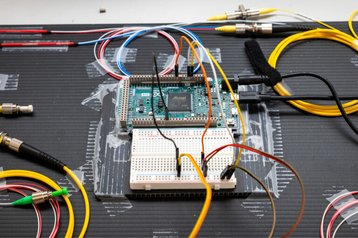
The breakthrough represents a step toward making quantum networking potentially commercially viable, as the team successfully demonstrated their system working on live commercial Verizon fiber-optic infrastructure rather than in controlled laboratory conditions.
Tests saw the Q-chip maintaining over 97% accuracy despite real-world challenges like temperature fluctuations, vibrations from construction, and seismic activity that affect commercial cables.
To counter these real-world challenges, the researchers developed an error-correction method designed to help mitigate interference while working in tandem with protocols that manage existing networks.
“Because we can measure the classical signal without damaging the quantum one,” Professor Liang Feng, the paper’s senior author, explained, “we can infer what corrections need to be made to the quantum signal without ever measuring it, preserving the quantum state.”
The Q-chip has the potential to be mass-produced, too, as it was made of silicon and fabricated using existing techniques, with the researchers aiming for a new approach that’s easy to scale.
“This feels like the early days of the classical internet in the 1990s, when universities first connected their networks,” said Robert Broberg, a doctoral student in electrical and systems engineering. “That opened the door to transformations no one could have predicted. A quantum internet has the same potential."
The University of Pennsylvania's research is the latest in a string of breakthroughs slowly bringing quantum networks that little bit closer to reality.
In the past month, a group of engineers from Canada and Italy developed an algorithm to shore up quantum key distribution (QKD) networks, preventing them from being disrupted by threat actors.
Meanwhile, Defense Advanced Research Projects Agency (DARPA) engineers came up with a method to integrate quantum links into classical network infrastructure. A similar project was completed by researchers at the University of British Columbia earlier this summer, who created a “universal translator” for quantum computers, allowing disparate systems to communicate over a network with virtually no noise.




Comments