


LAS VEGAS – Google’s recent “Q-day” deadline proclamation may have tripped alarm bells across the cybersecurity ecosystem, but for those working deep on developing quantum computing systems, the news was “more noise” than actual impact.
Google earlier this year set a 2029 deadline for post-quantum cryptography (PQC) migration, pushing forward by several years the time in which most predicted a quantum breakthrough that would render non-quantum-based cybersecurity systems obsolete. While that proclamation has caused many to accelerate their quantum-based work, others continue their efforts at pace.
“For me, what really matters is, can I come up with something that is reliable, that is robust, and that my users can have a decent experience of doing science with,” Bruno Abreu, deputy scientific director at the Pittsburgh Supercomputing Center, said during a quantum panel discussion at this week’s HPE Discover event. “Those types of claims of … when it's coming, when it's not, that doesn't impact me much. It helps me plan, it helps me understand where the technology might be in the near future, but ... it's more noise for me that it actually impacts my work.”
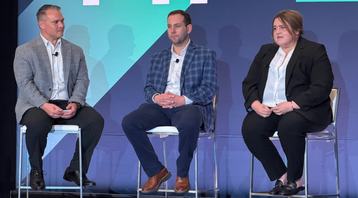
Abreu’s notion was echoed by fellow panel member Laura Schulz, lead for quantum innovation at Argonne National Laboratory, who said the community is definitely aware of these “technological thresholds,” but that “we still have this whole infrastructure to build up and all of this consideration.”
“That's kind of the stuff that frankly lies behind the big press releases and the big announcements, because we have to build this entire network. … These systems are fairly limited in number right now, so there's only going to be so many of them,” Schulz said. “There's a groundswell here of understanding the infrastructure, understanding the operation models, understanding all the components while that technology itself is continuing to advance and while we're also trying to figure out on the application side how we're going to use it once it gets to that point threshold, but hopefully the infrastructure is going to be there so when the technology hits, everything is wonderful.”
Work toward wonderful
HPE threw its efforts toward that wonderful future, announcing this week an expanded relationships with eight companies to integrate high-performance computing (HPC) and quantum computing systems to pave the way for practical and scalable hybrid classical-quantum applications in the future.
HPE’s specific work is in collaboration with Intel, IQM, Qblox, Quantinuum, QuEra Computing, Quantum Machines, Rigetti, and Riverlane, and is targeted at advancing full-stack hybrid quantum supercomputing across multiple modalities. This includes development of integrated testbeds for hybrid algorithm co-design, software interoperability, and system-level performance benchmarking across HPC and AI environments.
This team is also working toward bringing together multiple quantum modalities – including neutral atom, ion trap, superconducting, and silicon spin quantum bits (qubits) – along with quantum error correction and quantum control systems to determine architectural trade-offs, validation of hybrid workflows, and the development and benchmarking of quantum application workloads and workflows running on HPC systems and AI factories.
HPE’s position within this collaboration is based on its Cray supercomputing operations, which gained some momentum this week and were a repeated talking point by HPE executives, and are also efforts lauded by the quantum community.
Schulz noted that there has been considerable work with individual quantum-focused companies, but that there needed to be a more focused effort in order to integrate with national laboratories.
“One of the conversations that we had very early on was like, ‘hey, guys, you're doing great work, we're supportive of you, but in the future it's going to be very hard for us to do a procurement directly with you because you have to come into our ecosystem and we're buying from an integrator and that solution, and with having a one-off here, that's too much work for the center itself. You need to fold in because there are all of these tools and infrastructure that the integrators have strategy with. The networking HPC systems are very balanced, bespoke solutions in and of themselves that are also evolving, and having to bring all of this together, this is not something that a center would try to do on their own because integrators have to lead in this respect,’” Schulz explained. “So that's why HPE and integrators are really fundamental to this endeavor."
This greater collaboration is also important as the quantum space works through still basic infrastructure challenges like generating the qubits essential to operating a quantum computer. These efforts are currently spread across those different modalities, with Schulz explaining that each have their own advantages.
“They have their different benefits in the topology with how they're laid out, with the fidelity that they're able to keep, with their reactivity to the environment that they're in,” Schulz explained. “Some of them have to be deeply cooled, some of them don't need that. … They have their different behaviors, they're different personalities. … So we definitely have to think about a multimodality ecosystem where we can use that to our advantage, but at the same time we have to implement and integrate those into an overall cohesive stable ecosystem framework that we can actually work with them.”
This work is expanding at a rapid pace, including recent work between Amazon Web Services (AWS) and QuEra Computing that they claim will produce a fault-tolerant quantum computer available through Amazon Braket in 2028.
Despite timelines being bandied about, this week’s panel was averse to naming any ecosystem “winners" that might emerge.
“There isn't going to be a winner. It's going to be something that different applications, different use cases are going to take advantage of different technologies,” Abreu said. “You have to really think about how to combine that, and then how you orchestrate and distributed your workloads across these different platforms. … So I really don't think there's going to be a clear winner anytime soon. Maybe in the future when all this is wrapped into a much more stabilized, like a GPU or a CPU, maybe we'll get there and there would be a clear winner, but I think we're pretty far from that.”



Comments