


BARCELONA – Robots were hard to miss on the ground at this year’s Mobile World Congress (MWC), inferring that telecom operators are in prime position to profit from the inference needed to power future robotic action.
Even rivals Cisco and Hewlett Packard Enterprise (HPE) were on the same page when touting the telco opportunity in our briefings, with operators building out the infrastructure for AI tokenomics to become a reality. Fiber routes, metro data centers, edge facilities, mobile core deployments, private 5G networks – all make up the highway for AI inferencing to power robots, chatbots, and agentic bots, with telcos becoming token tollsters or even token turnpike trusts, to upgrade some olde Industrial Revolution terminology.
As such, it was hard for SDxCentral to overlook that MWC became robotics central this year. A lot of the robots looked the same, built as they were on inexpensive Chinese kit, and a fair few were not at their full potential for reasons of space and health and safety. The most interesting included one showcased by Dassault Systemes, Themis, a standalone system designed by Westwood Robotics that doesn’t require the edge for the robot itself is the edge, carrying its entire AI OS and compute stack internally.

In probably the only example of a telecom operator dabbling in robotics through R&D, Japan’s NTT DoCoMo had some intriguing physical AI in the form of a mushroom-cosplaying robot using computer vision to track visitors, as well as a robot in the form of a snail designed to infiltrate animal environments.
But it wasn’t all about robots at MWC26, as our on-the-ground takeaways will illuminate for those who weren’t able to attend the event this year (and, sadly, many were not due to travel disruption stemming from events in the Middle East).
AI and autonomous networks
All the physical AI at MWC 2026 casts some shadow on the digital AI that telcos are using either now or in the short-term, instead of the AI they’re forecast to facilitate in the possible age of Transformers and Terminators. With announcements from Samsung, MSI, and more, virtual radio access network (vRAN) software was abundant with claims of AI infusions, to the point where it was no longer clear what was AI-RAN and what was more like vRAN with a twist.
As revealed at Barcelona, Samsung announced vRAN collaborations with both Vodafone and Rakuten Symphony. But visiting the Samsung space at MWC26 gave a good chance for SDxCentral to understand how its U.S. networks division is positioning its autonomous networks solutions. Deepak Bajaj, senior manager for RAN systems engineering in its networks business, recently told me that the company’s immediate focus as part of its 2027 roadmap for actualizing fully autonomous, level-five networks is expansion of its vRAN offerings, with an overall purview spanning planning, deployment, operation, troubleshooting, optimization, as well as customer experience management.
This was confirmed in Spain by Kali Pickens, senior director and head of marketing for Samsung Electronics America's Networks Business, who described the firm’s network operations suite as the management and orchestration layer for an operator’s virtualized network, giving a single glass pane view of network operations.
Agents and the hyperscaler halfway home
Are you keeping up? Good, because then there’s the agentic element to contend with, as Pickens highlighted an agentic fabric working the management layer, which can deploy rApps to orchestrate between radio frequency performance, root cause analysis, and user equipment.
Agents were also widespread at MWC, as various keynotes and product launches showed. For example, Nvidia and Viavi showcased "scenario-generation" agents that synthesize realistic traffic, mobility, and radio conditions for Nvidia AI Aerial/AI-RAN-based digital twins.
“An average network engineer is not going to trust an agent, and that is where digital twins are extremely important,” Kanika Atri, senior director for telco marketing at Nvidia, told me. “So what the agent does is, after it's come to a recommendation, it's going to simulate it in the digital twin for you and show you what is the impact of that change to the network engineer. It gives them confidence about the agent.”
Atri was also confident that while autonomous networks can be deployed here and now for a telco “slam dunk,” AI-RAN is a “much bigger shift” in Nvidia’s view, needing more time to mature for the market.
Elsewhere, IBM showed off a suite of telco-focused agents as a follow-up to an autonomous network solution it launched last year. Upon that launch, Benjamin Hickey, director for product management and M&A at IBM Software Networking, told me any autonomous system needs what he called a dual intelligence, layering generative, agentic AI with analytical AI, as powered by the firm’s Watsonx platform, with agents working in the same vein as Samsung's. Hickey also pointed to IBM’s time series foundation models (TSFMs), compact, open-source AI models designed for high-performance, zero-shot forecasting, classification, and anomaly detection.
“Users don't need task-specific machine learning algorithms; they need a one-time series foundation model instead,” Hickey argued.
With more clients onboarded since the launch, Rahul Kumar, global industry leader for telco and media at IBM, claimed another advantage in its AI offering regarding telecom customers needing standardized agent frameworks to “apply security and access policies centrally within their systems for cross-AI platform use.”
The Telecoms Supplement
Uncover telecom trends beyond AI
“Then, they federate these policies/security postures to be applied at the agent level, since agents may be running on different hyperscaler platforms, or in on-premises or on a private cloud,” Kumar said. “The other client expectation is often related to guardrails, such as governance and observability.”
This may give IBM a market advantage. As explored in our recent Telecom supplement, some operators have been left wanting by hyperscalers’ agentic offerings with regard to telecom security regulation, requiring compliant architectures baked into agents rather than left for operators to figure them out alone.
It’s worth remembering that models from the hyperscalers, tech giants like IBM, or trendier developers like Anthropic are where the real token value lies, capturing a large portion of the value while operators, as token tollsters (aka token-tolls/tel-tokes), instead monetize where inference happens.
In fact, looking closely at hyperscaler partnerships on the ground at MWC, it often felt more like developers at telecom firms simply used models and agents from hyperscale platforms as opposed to any strategic collaboration or deals.
As a journalist, I am privy to embargoed announcements, and the U.S. cloud giants had little to share with SDxCentral in advance of Mobile World Congress. Some seemed somewhat unprepared with their news, or even conflated generic announcements with an alternate release that were peppered with the term "telecom" at random. And while Microsoft had a stand at Barcelona, its main MWC-related announcement – an ontology-driven agentic AI partnership with Tech Mahindra to galvanize telecom data modernization – was actually unveiled after the event came to a close.
Curious incidents like these made MWC26 feel somewhat like a halfway home for the hyperscalers. Perhaps they have other things on their mind at the moment?
Korea Central, and Europe, the poor man of telco
Where hyperscalers didn’t dominate MWC 2026, hallyu did, to use the hangul term for the Korean Wave.
KT had one of the most bustling, boisterous, and blockbuster pavilions in Barcelona, complete with K-pop and Korean beverages, while SK Telecom laid out its AI pitch so well that they were one of the few operators to embody the token tollster/tel-toke vision (more on that coming soon to SDxCentral). There were also Seoul-centric pavilions on the ground, and, rather curiously, one dedicated to Gyeongsangbuk-do, a tourist region of South Korea that’s more known for its cultural heritage rather than anything tech-specific.
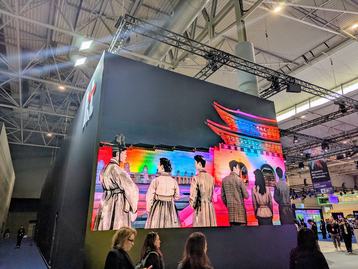
With South Korea and Japanese operators like DoCoMo making a splash with their AI and robotic wares, it was worth considering how Europe was faring in all things cutting-edge, such as 5G-Advanced and 6G.
The answer was best summed up in a chat I had with Cellnex U.K. CEO Gianluca Landolina:
“It’s useless to even mention 6G today.”
The chief exec argued that with the U.K. only on 15% 5G standalone deployment, Britain needs to first finish its 5G rollout and improve network quality within cities instead of focusing on basic coverage footprint and pie-in-the-sky 6G deployments.
“The U.K. decided to go to 5G. Once you take a decision, you need to be consistent. Consistency is key for each and every strategy,” he added.
Landolina’s comments tie in with the Cellnex group claiming it has a key role in helping Europe overcome its significant telecom infrastructure shortcomings, particularly through mobile network operator consolidation, which it believes will facilitate network investments and market repair.
As a British journalist more used to 4G dead zones than 5G signals on my handset, one couldn’t help see Europe as the poor man of telco from the crow’s nest of Barcelona.
And on that note: this was SDxCentral’s first visit to MWC since its acquisition by Europe’s InfraXmedia last year. We covered the event this year alongside sister site DCD, in a team effort to cover the most relevant news coming out of Barcelona (no small feat). We’d like to pass a message of thanks to Paul from DCD, as well as personal thanks to our executive editor Dan Meyer for his sage wisdom on all things MWC. I’m sure Dan was broken up to hand over the reins to us in Europe after many years of traveling to Barcelona from the States and trekking the cavernous halls of the Fira Gran Via. He really misses all those fun and games.
But remember: Mr Meyer is still at SDx, representing the U.S. side of our operations as ever, and we continue to keep a global purview on all things telecom and networking. Here's to MWC 2027!





Comments