

BARCELONA – European telecom infrastructure giant Cellnex said Elon Musk is its “best defender” when it comes to telecom chatter regarding the potential of low-Earth orbit (LEO) satellites.
The remarks were made by Cellnex Chief Strategy Officer Vincent Cuvillier at a press briefing held at Cellnex’s Barcelona headquarters during Mobile World Congress (MWC). There, the tower giant explained it manages more than 114,000 sites across Europe under a neutral-host model, while maintaining 85% fiber, connectivity, and housing coverage for France, Spain, and Poland.
Cellnex sees itself as helping Europe overcome its significant telecom infrastructure gap through mobile network operator (MNO) consolidation, which it believes will facilitate market repair and network investments. CEO Marco Patuano commented that, "we have a common interest with MNOs to be more pro-investment," and also argued for lower spectral renewal fees to free up capital for such investments.
Talk of LEO coverage from the likes of Musk’s Starlink was repeated in conversations throughout the cavernous halls of MWC 2026. Regarding said elephant in the room, Cuvillier noted satellite data connectivity solutions as solely complementary to terrestrial networks when it comes to providing basic coverage to “dead zones.”
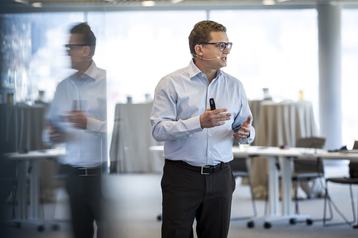
“The best defender of our business has been Elon Musk himself. He said satellite will not replace ground-cell stations,” Cuvillier said. “In Europe, we're pretty well covered. There is national, regulated spectrum, so when you have satellite, it makes it very complex to keep your frequencies or your spectrum with sovereign borders.”
Cuvillier reminded the room that Cellnex was once the main shareholder of Eutelstat until it divested in 2014 due to its satellite apprehensions. The company, though, is not 100% terrestrial, having what the CSO called a “small participation” in a Spanish layout constellation, and continues to provide television and radio signal distribution via satellite, alongside data distribution through very small aperture terminals (VSAT) stations and private satellite data communication networks.
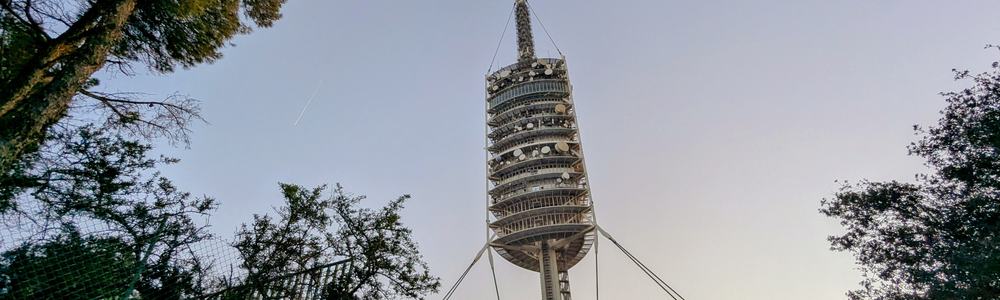
Another extraterrestrial link was found in a visit to Torre de Collserola (Collserola Tower). Barcelona’s tallest structure, the tower houses Cellnex’s main network operations center, alongside an optical free-space link over a 12 miles (20km) distance to the headquarters of the ICFO research center on photonics. The luminescent green beam in effect turns the tower into an optical ground station to download secure quantum keys directly from satellites.
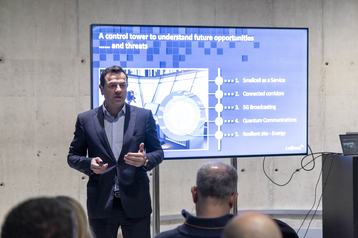
“From the terrestrial perspective, we foresee encryption on information as completely crucial, and that's going to be quantum communications,” Cellnex Chief Commercial Officer Oscar Pallarols, said. “Our sites could become trusted nodes. … So we could have another type of customer, in the form of encryption entities.”
Cellnex is also proud of its role in mission-critical networks for Catalonia’s Emergency Coordination Center (CECAT). During a visit to the center, a representative confirmed services such as those from Starlink would remain complementary to the private network it provides for the RESCAT Network, giving coverage for security and emergency services across Catalonia.
“It could only be a backup network for emergency services. The kind of deployments we use for voice services are not as expensive as deployments for broadband," Antoni Liria, global sales excellence and marketing director at Cellnex, explained. "That’s one reason broadband rollout can be slow. If you need more and higher frequencies for broadband, you also need more base stations. The cost doesn’t grow linearly; it grows exponentially. So from a cost perspective, perhaps the best decision for a government is to invest in satellite as a complement: in an emergency, you need all responders using the technology.
“I don’t see it becoming the main network; rather, it would be part of a balanced approach,” Liria added, echoing the message from Cellnex HQ.





Comments