

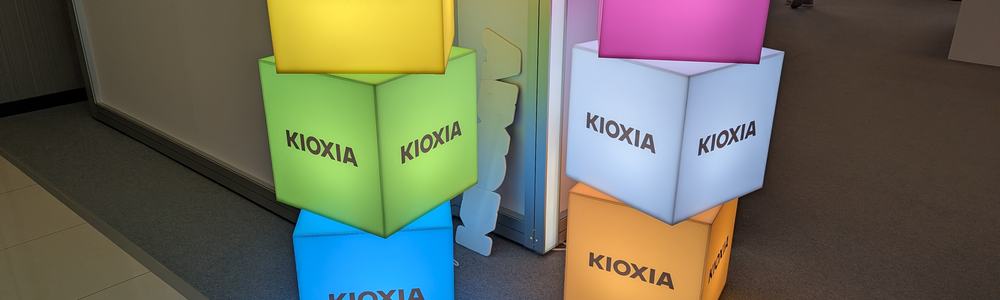
Flash vendor Kioxia is pivoting into a full-stack ecosystem player with the likes of Nvidia, helping it become Japan's most valuable company this summer.
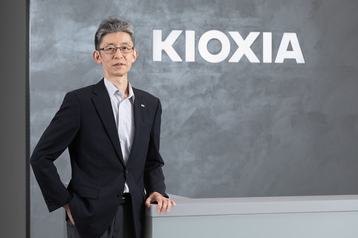
In an interview held at Computex 2026, technology executive for applied SSD technologies, Koichi Fukuda, revealed the AI boom was evolving Kioxia’s focus on regular solid-state drive (SSD) wares.
“SSD needs to adapt to AI, but Kioxia can’t do it alone, so we realized and are focusing on not just being an SSD supplier to become a trusted ecosystem partner instead,” Fukuda said.
As part of this effort, Kioxia is a major partner on Nvidia’s 'Storage-Next' concept, which works on turning flash storage into system memory by leaning on GPUs instead of CPUs to initiate storage operations.
Kioxia is also leading on the venture’s Context Memory Extension (CMX) pillar, previously known as Inference Context Memory Storage (ICMS), which utilizes SSDs as a memory layer to store key-value (KV) cache for improved AI inference. As explored in SDxCentral’s recent Storage Supplement, KV cache is a memory-intensive process that speeds up inference by reusing tokens used in previous generations by an AI model.
“As the scale of AI increases, especially for agentic AI … storage or memory becomes a kind of bottleneck,” Fukuda said. “One goal for Kioxia is to mitigate the bottleneck of DRAM (dynamic random access memory) capacity or HBM (high bandwidth memory) capacity. How can SSD help mitigate the limitation of data to scale the total data handled by AI?”
March saw Kioxia release Super High IOPS SSDs, which enable GPU access to high-speed flash memory as an expansion to HBM use in AI systems. But the Kioxia stack also includes software remediation, in the form of the open-source AiSAQ (all-in-storage approximate nearest neighbour search - ANNS - with product quantization).
Fukuda explained that retrieval-augmented generation (RAG), which enables large language models (LLMs) to expand upon pre-trained memory, depends on vector databases, traditionally run in DRAM. When scaling these databases to billions of vectors, DRAM no longer becomes a viable option.
The exec said AiSAQ addresses the limitation of DRAM for inference by using “very minimal DRAM.” This is done by putting all data, including the vector index, onto SSD, while still guaranteeing the latency and performance associated with DRAM-based systems. Fukuda added that Kioxia is working with the chip giant’s Spectrum-X database team in this regard.
Memory & Storage Supplement 2026
How Meta, Weka, Vast, and Red Hat are rethinking storage as AI inference outpaces memory supply
From Toshiba to trillions
Following the interview, June saw Kioxia at one point leapfrog Toyota to become Japan’s most valuable firm. That’s pretty good going for a company that saw an initial public offering (IPO) only in late 2024.
But the firm has a long history. Credited with inventing flash memory in the 1980s, it started as Toshiba’s flash memory unit, which went on to acquire SSD vendor OCZ Storage Solutions in 2014.
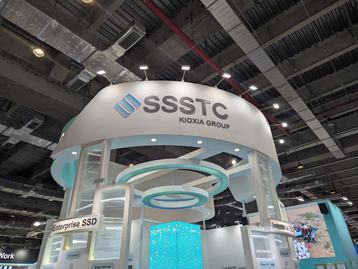
Toshiba’s entire memory unit would then be sold off in 2017 to become the independent Toshiba Memory Corporation. Two years later, it acquired the SSD business of Taiwan’s Lite-On Technology to form Solid State Storage Technology Corp (SSSTC). Fukuda described SSSTC as an engineering resource integral to the parent firm.
“We allocate Kioxia’s Japan engineering results and SSSTC’s results optimally, because the speed of change due to AI means we need to introduce new products quickly. That's why Kioxia purchased SSSTC.”
Kioxia was meant to make its IPO a year later, but the pandemic delayed it to 2024, where it debuted on the Tokyo Stock Exchange at ¥104.7 billion (around $698 million).
Today, it is valued at ¥50.44 trillion (approximately $315 billion), echoing AI-driven mega-boons for fellow Asian memory vendors Samsung and SK Hynix.
As expected, hyperscalers make up a large segment in the Kioxia client base, which is only increasing due to AI demand. In comparison, local telecom operators are comparatively small, despite efforts in AI that seem to progress beyond those of operators outside of Asia.
According to an investor day held by Kioxia around the time of Computex, the firm believes it is in a supercycle in terms of future growth, with its expanded stack making it less vulnerable to the cycles that regularly define the fortunes of memory vendors.
Speaking with Fukuda, it is clear Kioxia is confident yet not cocky over its future, preferring not to overhype flashier concepts such as artificial general intelligence (AGI) and embodied AI powering the robotics realm.
As Fukuda said, “If physical AI arrives, it will be a huge change. But still, we need technology innovations to realize it. For high-quality AI, we need huge calculation power, computational power, huge datasets. So, we’re still relying on cloud services … [whereas] physical AI needs to be done on edge.
In other words, despite Japan being a world leader in robotics, Kioxia is not putting the cart before the horse, hence its work under the hood with SSDs and vector databases.
“There are so many sophisticated problems we need to overcome first,” he said.



Comments