


VMware found itself firmly nestled among the Leaders in Gartner’s latest Magic Quadrant for distributed hybrid infrastructure. But the firm found itself surrounded by rivals on all sides as the analyst firm suggested that more than half of enterprises (55%) will initiate proofs of concept to shift away from the Broadcom-owned business by 2029.
Gartner’s report suggests that Broadcom’s acquisition of the virtualization giant has proved a “massive catalyst,” accelerating migration and modernization considerations up from just 25% in 2026. Surveyed customers said they were looking at a range of options that “treat virtual machines as first-class citizens, alongside modern Kubernetes and cloud-native workloads.”
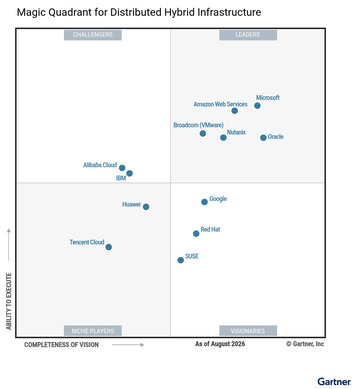
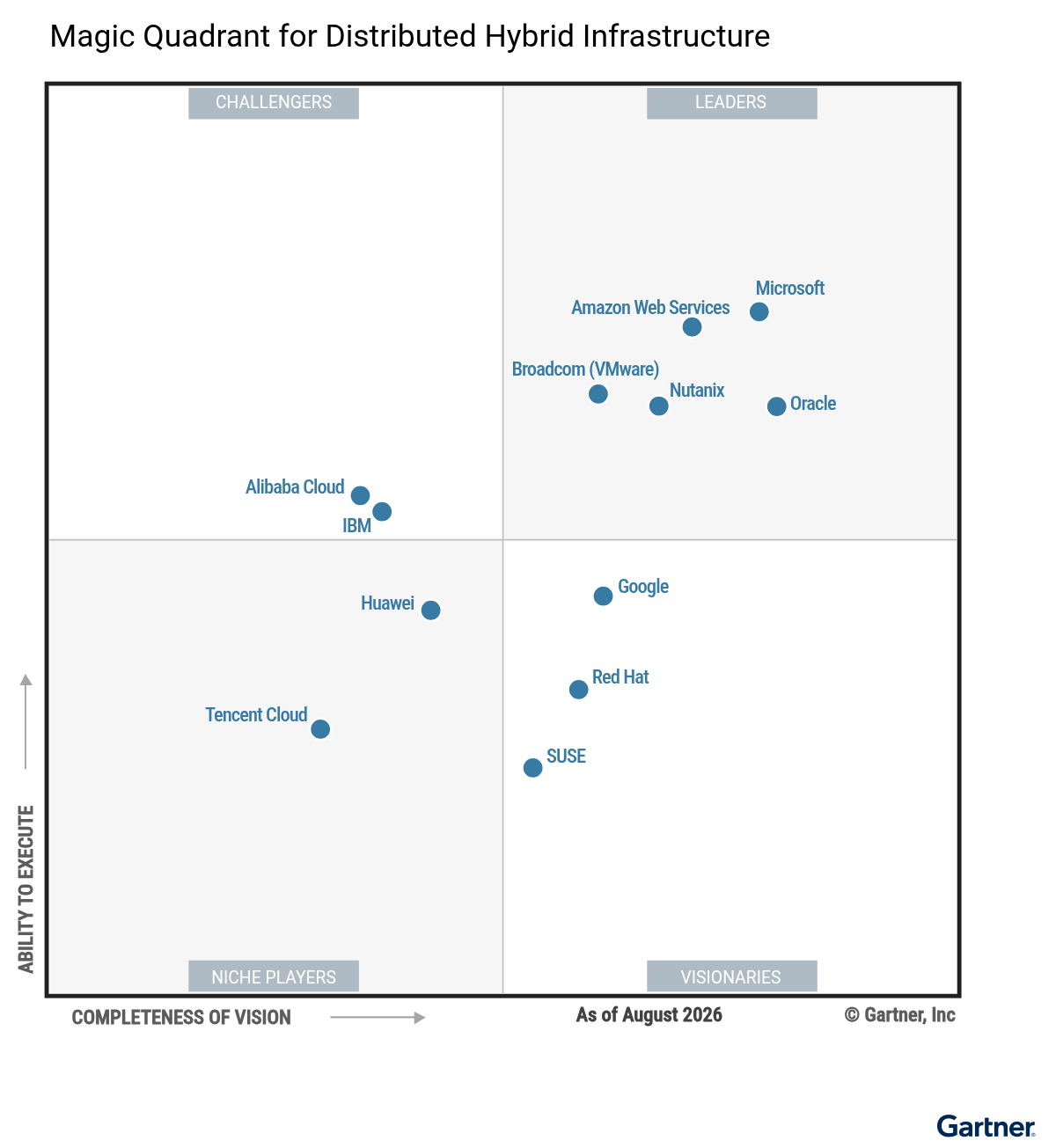
VMware was one of five pips plonked in the Leader quadrant. Placed furthest to the left, Gartner said it had received an “increased level of negative sentiment” toward the brand from customers on everything from communication and commercial business practices to support delays.
Beyond well-documented consternation, however, Gartner cautioned that VMware’s flagship Cloud Foundation (VCF) platform “does not have mature advanced data services for unstructured file and object storage capabilities,” while strict commercial limits for edge deployments were also cited against the vendor.
The findings from its latest Magic Quadrant come a little over a year after Gartner suggested some 35% of workloads could shift from VMware to hyperscalers. An apt finding for the 2026 report as three of its fellow Leaders fit that category: Amazon Web Services (AWS), Microsoft, and Oracle.
Microsoft drew praise for its streamlined hybrid cloud with Azure Local, while AWS’s fully managed model was highlighted for limiting customer responsibilities when it comes to physical provisioning and hypervisor maintenance. Oracle, meanwhile, was touted for its broad portfolio, with offerings ranging from the tactical edge (e.g. warfighters) to rack-scale database.
Despite Gartner’s predictions, it wasn’t all bad for VMware. Analysts described VCF as “comprehensive,” consisting of a stack that natively consolidates compute, storage, and networking into a “single, time-tested platform.”
VMware also earned acclaim for its offering’s sovereignty-focused approach. Gartner said VCF allows customers to “build and run sovereign AI natively on familiar infrastructure,” while for highly regulated industries, its VMware Cloud Provider program spans some 50 independent, local providers globally.
The fifth and final Magic Quadrant Leader was Nutanix, the perennial rival that continues to try to snap clients away from the Broadcom-owned business.
Other vendors that made it to Gartner’s Magic Quadrant for distributed hybrid infrastructure include Google, Red Hat and SUSE in the Visionaries segment, Alibaba Cloud and IBM in Challengers, while Huawei and Tencent Cloud were listed as Niche Players.
More in Cloud-Native Networking


More in The Cloud & Storage Channel
-

-

-

Episode Is data AI’s biggest bottleneck?
Comments