


Nokia and Nvidia deepened their relationship with a $1 billion investment from the chip giant in the European vendor, as well as partnering upon an AI-augmented radio access network (AI-RAN) solution.
Nvidia’s GTC event saw the chip giant debut its Aerial RAN Computer Pro (ARC-Pro), a 6G-native accelerated computing platform aimed at enabling telecom operators to shift from 5G-Advanced to 6G.
The announcement came alongside news that Nvidia has made a $1 billion equity investment in Nokia, becoming a 2.9% shareholder of the firm.
Nokia said the investment will helps its development of 5G and 6G RAN technologies. This includes a new AI-RAN solution centered around ARC-Pro, with an expansion of its 5G and 6G RAN availability on Nvidia’s CUDA platform.
The tie up expands on Nokia’s AnyRAN approach for both cloud RAN, custom-built RAN, and now AI-RAN. This is achieved with vendor-agnostic cloud and server infrastructure software grouped together with Nokia’s modular AirScale base stations and AirFrame servers, which allow new cards to integrate with previously deployed ones.
T-Mobile US is expected to trial the new platform next year as part of its 6G development efforts, while Dell Technologies is providing PowerEdge servers as the compute platform for operators deploying AI-RAN services.
In its announcement of the Nvidia backing, Nokia said that aside from general corporate purposes it would use the investment "to accelerate its strategic plans to advance trusted connectivity for the AI supercycle.”
The firm also aims to increases its presence in the AI and cloud sectors with "data center-aligned networking solutions within its Network Infrastructure business.”
In addition, Nokia and Nvidia will work together on Nokia’s SR Linux network operating system on data center switching for Spectrum-X, Nvidia’s Ethernet-based networking fabric specifically designed for AI.
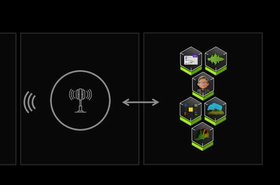
Nvidia 6G reveal brings AI agents to the edge
Chip giant unveils next-generation telecom framework
The two firms will also explore Nokia’s optical capabilities as part of Nvidia’s future AI infrastructure.
The AI-RAN release from the pair comes after Nvidia recently expanded on its reference architecture in support of AI-native 6G networks, laying out its distributed user plane function (dUPF), a framework that pushes data-plane intelligence from centralized data centers to the network edge.
Nvidia and AI-RAN
The AI-RAN initiative was positioned as a base for a 6G-centric future featuring drones, cars, robots, and extended-reality (XR) wearables, with Nvidia’s SVP of telecom Ronnie Vasishta calling AI a “critical factor” in the formation of new 5G and 6G standards during an Nvidia press briefing.
In the near-term, Nokia and Nvidia are addressing the rise of generative AI and agentic AI traffic on the same sites as RAN functions by deploying edge AI to improve spectral and energy efficiency, alongside network performance.
It also expands on Nvidia’s AI Aerial wireless network solution, which has been extensively used by Japan’s SoftBank to apply AI to 5G networks. Earlier this year, Nvidia and SoftBank field-tested an AI-RAN solution dubbed AITRAS at the former’s headquarters in Santa Clara, California.
“Telecommunications is a critical national infrastructure – the digital nervous system of our economy and security,” Nvidia CEO Jensen Huang stated. “Built on Nvidia CUDA and AI, AI-RAN will revolutionize telecommunications – a generational platform shift that empowers the United States to regain global leadership in this vital infrastructure technology. Together with Nokia and America’s telecom ecosystem, we’re igniting this revolution, equipping operators to build intelligent, adaptive networks that will define the next generation of global connectivity.”
“The next leap in telecom isn’t just from 5G to 6G – it’s a fundamental redesign of the network to deliver AI-powered connectivity, capable of processing intelligence from the data center all the way to the edge," Nokia CEO Justin Hotard added. "Our partnership with Nvidia will accelerate AI-RAN innovation to put an AI data center into everyone’s pocket. Our first AI-RAN deployments in T-Mobile’s network will ensure America leads in the advanced connectivity that AI needs.”


Comments