


T-Mobile US has been one of the more vocal and visible proponents of linking AI to telecom network operations in an effort to drive efficiencies, backing that the carrier is refining as it looks to support AI-based services and enter new revenue-generating market segments, and also take advantage of telecom’s inherent positional advantage over hyperscalers in the AI ecosystem.
Ankur Kapoor, chief network officer at T-Mobile US, told SDxCentral in an interview that the carrier today views the use of AI across a trio of pillars – network control, service creation, and customer experience differentiation. The latter two have shown through the carrier’s various service offerings and often-touted T-Life application, with the first described pillar being the most fluid.
Kapoor first took a step back, explaining that T-Mobile US’ current AI efforts build on the carrier’s long-standing network automation work. These were described as self-organization network (SON) principles that were used to support “running scripts, making changes, humans sitting in there doing automated scripting so that at night they don't have to go and type commands.”
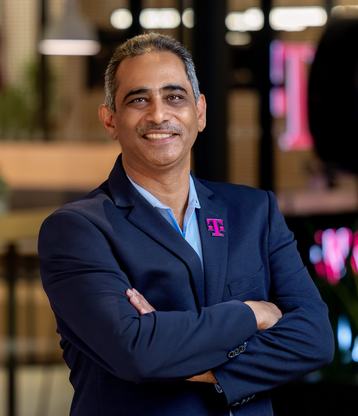
Kapoor noted that these efforts have proven “phenomenal … because less errors, people can just do the scripts once in the middle of the day, don't have to be waiting middle of night to do the scripts and run the scripts at night.”
But with AI, that network control process has been accelerated. Kapoor pointed specifically at recent storms that have impacted parts of the U.S. and how the carrier was able to use AI to help control its radio access network (RAN).
“When you get hit by storms, obviously it's not good. We lose connectivity. Most of the times we lose connectivity because we lose power, we lose transport, and these networks get impacted,” Kapoor said. “And things change pretty dramatically hour by hour in those areas.”
“One part that we always struggled with in the pre-AI era was how do we adapt to these changing conditions that are changing so rapidly?” Kapoor said of connectivity damage from storms. “What we have done on AI and especially in the disaster recovery as well as the events is the network actually adapts based on actual usage of people, phones, and signals that we get from the phones. We get real-time information back from the handsets where people are, where population is. We get real-time demand for the capacity and we automatically adjust the network … and that all happens completely autonomous. No humans involved. We made thousands of changes … and we were able to connect over 95% of the customers back within the first six hours.”
Building an AI ecosystem for telecom
Those potentially life-saving use cases come from T-Mobile US’ work in shepherding the use of AI in the telecom space. An example of this is the carrier’s work in spearheading efforts with fellow members of the AI-RAN Alliance to build a test facility in Bellevue, Washington.
Kapoor described this approach as being about “trying to build an ecosystem.”
“The reality is that anyone who sits there and thinks that they can build an ecosystem all by themselves, it's possible. I mean, it's possible that someday you could have cars actually fly. That is also possible. But an ecosystem doesn't get built by a single thing. We actually partner with a lot of people,” Kapoor said, before adding, “but we keep all the controls … and really kind of be the orchestrator for the industry.”
Kapoor explained that this approach is about letting those partners do “what they do best,” while also having T-Mobile US do what it does best.
“What we know best, and we think we know it way better than most of the other companies, is the customer experiences and how do we bring these things, join them together, and bring them to real life,” Kapoor said, though he later admitted that this area remains a work in progress.
“We're rallying very big companies, some of them bigger than T-Mobile, to come behind us, and they're coming happily,” Kapoor said. “But that really is like, how do we bring this ecosystem together? And anybody that, at least from my perspective, anybody that says that they can do it by themselves are setting themselves up for failure because it is an ecosystem.”
Where telecom is best positioned
That ecosystem approach has been core to shaping early AI and RAN efforts. Kapoor explained this idea by first delineating between AI and RAN, or as he said: “AI in RAN” and “AI for RAN.”
The first is where AI is used to help control RAN functions, with Kapoor specifically pointing to T-Mobile US’ work with Ericsson in deploying link adaptation into the network. This basically has the network ingesting performance insight every two milliseconds and adjusting radio performance based on a changing environment.
“It's real AI in the radio network that's operational nationwide today,” Kapoor said, later adding that the carrier plans to have AI-RAN commercial field trials live by the end of this year.
AI for RAN, on the other hand, is in “early days.” This is the move to “run the radio workloads and the non-radio workloads – so AI workloads – on the same compute.”
Kapoor noted that this model is coming to market alongside physical AI use cases, “which is not coming in a decade, it’s almost here now.” But with that comes the decision on where to run the network layer of these physical AI deployments.
That decision underpins the current push around distributed network models, which is where telecom players see themselves as having an advantage over more centralized hyperscale operations.
“We're not competing with hyperscalers,” Kapoor said. “They have massive data centers. I can never meet and match the capacity they can generate. But I'm not trying to serve every single person in the country. I'm not trying to have compute available for Starbucks, compute available for grocery stores, we're going to go for those niche products that actually cannot wait for decision making all the way to the hyperscaler and then come back.”
That latency challenge, or as Kapoor more succinctly put it a “consistent jitter” challenge is where operators see their advantage compared with hyperscalers, an advantage and opportunity that grows with physical AI.
Kapoor explained that this advantage stems from carriers like T-Mobile US having a significantly denser network topology than hyperscalers.
“If I think of the T-Mobile network, I'm about four- to five-times more distributed than any of the hyperscalers,” Kapoor said. “If I think of Azure as an example, they're in like 22, 25 different locations. We are approaching 100-plus locations.”
Contextualizing for the physical AI world
Kapoor did admit that hyperscalers are able to counter that lack of distribution with denser compute resources but added that this does not mean a lot for many specific use cases. Instead, Kapoor said that hyperscalers lack operator connectivity expertise, “and that gives us the right to win in this area.”
Kapoor said backing for that “right” comes from hyperscalers lacking “context,” and that this context is important for the physical AI opportunity where “it’s all going to be context based.”
“Nothing in the physical AI space is going to work without context. If you are looking at humanoids or robotics in the factory, you need to understand the context they have,” Kapoor said. “If you're thinking of traffic lights in a city, you need to understand what the context is. You need to understand what is this, what is the city trying to do, what is the government trying to achieve, and you need context to really understand if you should have a speed bump here. Is it really to understand how many cars drive through that, and that is the context that telcos have.”
“We understand what the context is,” Kapoor explained. “So when I'm using my phone and I'm driving, I know what the context is. I know where you're going to head next. I know the things you're doing on your handset that hyperscale can never know.”
T-Mobile US CEO Srini Gopalan recently touted physical AI as a future driver of mobile network traffic. Those systems are designed to bring together different AI platforms to help in the development of physical items like autonomous vehicles and robots, which Gopalan noted sets the stage for the next iteration of AI in the real world and a specific reliance on 6G network technology.
“I think there's a piece of moving away from ChatGPT as the fundamental form of AI to actually automation and robotics,” Gopolan said during an investor conference late last year. “Now, to make that happen, you need low-latency connections between the robot or the device and the network. Only 6G can give you that.”
Kapoor added that T-Mobile US is “making big bets” on driving this opportunity, and “we think we are going to be super successful in that space.”



Comments