


Nutanix posted strong quarterly earnings that managed to ride continued traction in gaining disenchanted VMware customers against some tightening due to ongoing supply chain challenges.
Nutanix’s results for the third quarter (Q3) of its fiscal 2026 came in ahead of expectations, with revenues increasing 10% year over year to $703 million for the quarter. That growth was backed by more than 700 “new logo” wins, with CEO Rajiv Ramaswami telling investors “most of our customers are coming from and migrating away from” VMware and Broadcom.
That route bolsters Nutanix’s long-standing enchantment of VMware customers. Ramaswami had previously claimed that VMware’s overall customer sentiment remains dour following its acquisition by Broadcom and subsequent changes to VMware’s go-to-market approach.
“I think there's no doubt that the customer sentiment continues to be negative about Broadcom,” Ramaswami said during a press briefing at the vendor’s recent .NEXT event. “There's no doubt about it, and increasingly negative.”
That sentiment has allowed Nutanix to bolster its customer base. Ramaswami at that time said the vendor has “about 30,000 customers," numbers bolstered by the hundreds of disgruntled VMware customers Nutanix has been attracting each quarter, “and we expect that to continue,” Ramaswami added.
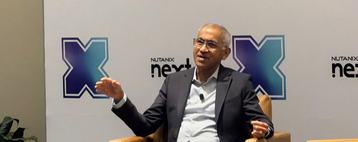
Ramaswami during the .NEXT event said that Broadcom has an “installed base of probably 300,000 customers or so,” and “we are targeting about 165,000 of those customers … and we have a segmented approach to going after those customers.”
Those numbers align with analyst estimates that more than 100,000 VMware customers could eventually leave that vendor.
“Nutanix continues to be a top alternative to VMware in the wake of the Broadcom acquisition,” equity research firm William Blair wrote in a note earlier this year tied to Nutanix’s Q2 earnings. “Adoption remains strongest in the mid-market where migration friction is lower, but Nutanix is increasingly gaining footholds within larger enterprises, often starting with partial deployments that can expand over time.”
Migration trajectory and routes
Ramaswami during the latest earnings call added further color to that migration trajectory, something that analysts noted could see increased velocity as customers that initially signed up for VMware’s Cloud Foundation (VCF) 9 platform come up on renewals.
“Most customers who have purchased VCF today have not fully adopted VCF. They're buying VCF, but they're deploying what they were deploying before, which is vSphere with external storage, and now the same thing will happen with VCF 9,” Ramaswami said. “It's going to force these customers to go deploy and just go buy VCF 9, but it's not clear to me that they're going to all deploy fully. It's going to take time, and they may still deploy portions of it.”
Ramaswami added that those wanting to fully deploy VCF 9 will “require a substantial hardware refresh, including their embedded storage solution.”
“VCF 9 is going to be quite a significant upgrade for you all in terms of the effort that you're going to have to put in,” Ramaswami said. “You may still not benefit from all of its capabilities. It is complex, and we have these options of external storage, public cloud, and then we have also the automated migration tools behind that, and of course the commercial incentives, all of those put together to provide a good proposition for customers to migrate, and like I said, we're seeing this with customers coming and migrating every quarter.”
Ramaswami’s thesis was backed by Broadcom CEO Hock Tan, who during an earnings call late last year that while more than 90% of VMware’s 10,000 largest customers had signed up for the VCF 9 platform that conversion rate was only in terms of license sold and not actual VCF deployments.
“I'm careful about [my] choice of words,” Tan added. “Because we have sold them on it, and they bought licenses to deploy, doesn't mean they are fully deployed.”
Tan explained that this deployment will be “the hard work over the next two years that we see happening,” but that’s the part where customers will be able to garner value from those deployments. It will also allow Broadcom to then sell more advanced services into those deployments.
“First phase is convincing people to convert from perpetual subscriptions [to] purchasing VCF,” Tan said. “Second phase is make that purchase they made on VCF create the value they look for in private cloud, on their premise, on their IT data center. That's what's happening and that will sustain for quite a while, because on top of that, we will start selling advanced services, security, disaster recovery, even AI running AI workloads. All that is very exciting.”
Ramaswami during the latest earnings call did note a handful of general directions for VMware customer migrations.
“They go to Nutanix, they go to Red Hat, they go to Microsoft – small number, and then some of them go to the public cloud directly,” Ramaswami said. “It hasn't really changed much in the last several quarters … and we tend to do very well when it comes to mission-critical VMware workloads running in production because we have a very solid platform for doing that with the public cloud. Sometimes customers do make strategic decisions to go to the public cloud, but what they find is it's much easier for them to go to the public cloud on the Nutanix platform itself, and we've seen that part of our business continuing to grow very nicely.”
Red Hat has indeed been one of the more vocal barkers for VMware opportunities, enough so that Nutanix executives have been pointed in differentiating the two options.
Supply chain gymnastics
Nutanix remains watchful of ongoing memory related supply chain challenges, with Ramaswami noting “supply chain challenges continue to drive higher prices and generally longer lead times for server hardware from our partners, which are pressuring customer budgets and timelines.”
“They're looking for more flexibility on software licensing terms,” Ramaswami said of these moves. “There are some instances of customers delaying projects, but those are not very common, but that does happen once in a while.”
This uncertainty has some customers leveraging Nutanix’s more flexible hybrid-multicloud architecture where they can tap public cloud resources in the near term.
“We have a number of tools to help them offset these issues, and they're actually also making use of this. They have choice of several vendors. We have external storage platforms now available where they can do migration without requiring new hardware purchases. They can use our solutions in the public cloud, and we've seen some customers do that directly, where your servers are more easily available and sometimes cheaper than buying enterprise servers,” Ramaswami explained. “So our customers are certainly getting used to this, and we are also providing them the options to help them adapt to this supply chain environment.”
Ramaswami did add that Nutanix expects this supply chain challenge to extended into next year.




Comments