

Nutanix views the recent updates to its Kubernetes-based containerization platform as positioning the vendor uniquely in the market, specifically between rivals VMware and Red Hat in how it can support diverse container deployment models.
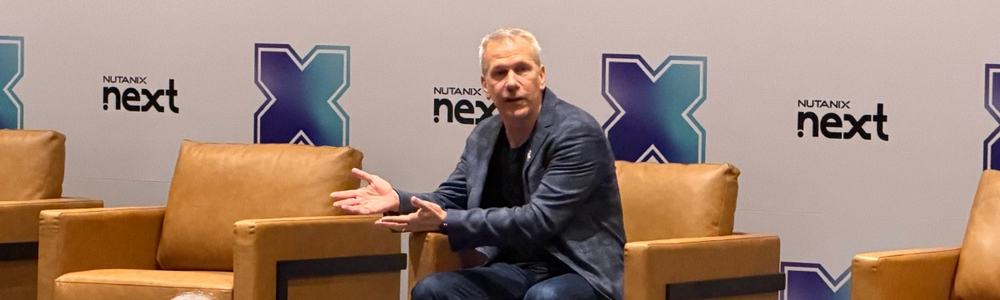
Dan Ciruli, VP and GM for cloud native at Nutanix, explained during the vendor’s recent .NEXT event that its latest Nutanix Kubernetes Platform (NKP) Metal updates uniquely allow it to provide a dual-support path for containers. The first is the ability to run Kubernetes-managed containers in a virtual machine (VM) environment, which takes advantage of virtualized environments, with the other path in running those containers in a bare-metal environment.
“Some vendors have a way to do one and not the other. Some vendors have a way to deploy on bare metal, but they don't have an inherent way to do it in virtual machines. And with NKP Metal, we're now giving our customers the ability from it from a single control plane when provisioning nodes, decide, ‘hey, do I want to provision this with a hypervisor and run a full Nutanix stack and all the goodness that comes with that: enterprise storage with [Acropolis Operating System]; management of VMs, and running in those VMs, by the way, virtualized workloads or containerized workloads, because, of course, we can run containers there, but from that same set of management tools also deploy and manage nodes that are bare metal Kubernetes, where we're running NKP, so that, in itself, is distinguishing features no one else has.”
Ciruli argued this dual-path approach is what separates Nutanix from rivals VMware and Red Hat, a separation emphasized by not naming either of those rivals.
“From some vendor’s perspective, everything should be run in a virtual machine. It's the only way to run. … They like virtual machines so much they put it in the name,” Ciruli said of VMware’s approach without naming VMware.
“And then we have a vendor who is very much trying to eliminate the hypervisor from the stack, … and not necessarily because the industry is clamoring to get rid of the hypervisor, but … they see an opportunity right now because people are unhappy with Broadcom and they could ‘hey, our product can be an alternative,” Ciruli added of Red Hat, again without naming Red Hat.
Is Red Hat making enterprise adoption difficult?
Red Hat has indeed been one of the more vocal rivals in attempting to convert unhappy VMware users looking for a virtualized alternative to the now Broadcom-controlled rival.
Perhaps acknowledging that angle, Ciruli further delineated how Nutanix stood apart from Red Hat, noting that the rival’s use of the KubeVirt open-source project to underpin Red Hat’s OpenShift platform place more stress on enterprise IT teams.
KubeVirt – or the Kubernetes virtualization API – provides a unified approach for developers to support containerized workloads and also VM-based workloads that cannot be easily integrated into a containerized environment.
“KubeVirt is an interesting technology. It's also a fairly new technology. It is not widely adopted. It hasn't had a decade in the industry of people running entire enterprises,” Ciruli said. “It's very good for slight use cases when you are running bare metal for Kubernetes and you have the odd, the end need to deploy, but I think that having a real, proven hypervisor that has tooling built for the users who are traditionally deploying virtualized workloads is an advantage.”
Ciruli, who previously worked at Google as part of its Istio service mesh program and later came to Nutanix as part of its D2iQ acquisition, said this familiarity is important.
“I've been attending Kubernetes conferences for nearly a decade, and at every single one, when they talk about what are the barriers to adoption, skills gap is always the thing that comes up. And this is from companies who are running maybe 10% of their workloads in Kubernetes, and 90% are still in VMs, and they're saying we can't hire enough people who know about Kubernetes,” Ciruli said. “When you adopt something like KubeVirt, you're now saying you need to use Kubernetes to deploy 100% of your workloads. You want to deploy a VM? It's KubeVirt. Write some YAML, learn how to use that tool. … It's a really steep adoption, and that's why I think our ability to give a VM-based tool for those people who are have people trained on VMs, and are running mostly VMs, and have a tool that can run Kubernetes, and have those side-by-side is really, I think, a distinction.”
Nutanix’s containerization efforts have been noted.
Forrester last year ranked the vendor alongside Red Hat and SUSE as top “multicloud container platforms.” That ranking touted Nutanix for its emboldened market approach following its D2iQ purchase. Nutanix’s management has touted recent success of its Kubernetes-based platforms in stealing customers away from rivals, including Red Hat and VMware, but Forrester pointed to customers still wanting a more robust alternative.
While VMware was often targeted in the Forrester report as a platform enterprise might want to move away from, it was notable that the vendor’s own offerings were not included. Forrester explained this omission was due to VMware’s then positioning of its multicloud container platform as part of its broader VMware Cloud Foundation (VCF) platform and not a “separate SKU” that prevented it from being included on this list.
VMware does indeed have a bifurcated approach to container management. This includes its VMware Kubernetes Service (VKS), which is a Kubernetes runtime and orchestration service that is included in the vendor’s halo VMware Cloud Foundation (VCF) offering; and Tanzu, which is Broadcom’s platform-as-a-service (PaaS) offering.
Kubernetes angling for AI
Ciruli more broadly explained that Nutanix’s recent Kubernetes updates also align with a growing need from enterprises looking at AI to help develop applications.
“AI is making it easier than ever to write applications, and it is increasing the number of people who can write applications. And what that means is we've seen a steady increase in the rate of new applications in my entire lifetime … and AI is going to make that increase fast,” Ciruli said. “For the last five years, container has been kind of the de facto way you develop any new application, is to be deployed into the container. All the new applications are ready to go into containers, and all the AI applications, and are going to be new applications, they're going to be running in containers. All the new things are running in containers, and all the things that run in containers are running in Kubernetes.”
The Cloud Native Computing Foundation’s (CNCF) most recent Annual Cloud Native Survey showed 66% of respondents reported their organization was using Kubernetes to host generative AI workloads. This was deemed as illustrating “how Kubernetes has become the common denominator for cloud native scale, stability, and innovation, especially as organizations bring AI workloads into production environments.”
“Over the past decade, Kubernetes has become the foundation of modern infrastructure," CNCF executive director Jonathan Bryce noted in a statement. “Now, as AI and cloud native converge, we're entering a new chapter. Kubernetes isn't just scaling applications; it's becoming the platform for intelligent systems. This community has the expertise to shape how AI runs at scale, and we have a massive opportunity to build something open, powerful, and impactful for the next 10 years.”
However, the survey also clarified that only 7% of organizations were deploying AI models “daily” and 47% deploying “occasionally,” with 44% of respondents stating they did not yet run AI or machine learning workloads on Kubernetes, “underscoring the early stage of AI production maturity.”
Ciruli agreed, noting that this AI angle remains nascent, but interest is surging.
“We are in a state right now that 95% of the conversations we have involve AI at some point, but I would say probably fewer than 5% of the workloads that are running today are actually using AI,” Ciruli said. “It is a place where we talk about it a lot, but most of these deployments are still in the future.”



Comments