

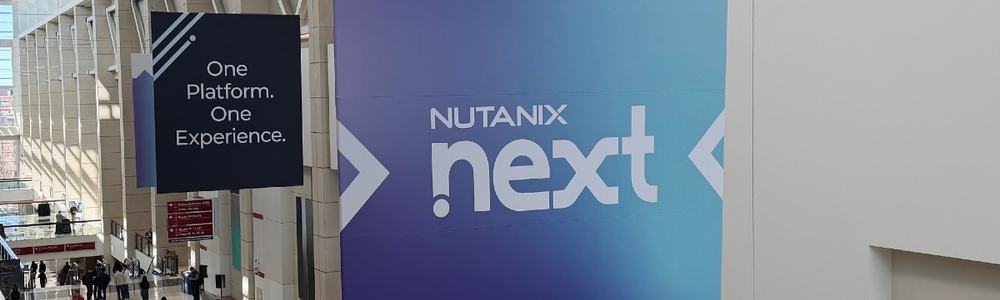
CHICAGO – Nutanix rolled out a handful of updates to its halo Cloud Platform (NCP), including new AI, Kubernetes, and storage services designed to bolster itself as a stronger offering for enterprises looking at alternatives to rivals like VMware and Red Hat.
The broadest view of the update is the integration of Nutanix’s recently unveiled Agentic AI stack into NCP. That Agentic AI stack was launched at the recent Nvidia GTC event, tapping into Nvidia’s AI Enterprise at the “agent builder” layer, allowing customers to build and run agentic AI applications across multi-user environments.
Nutanix plans to bolster that platform later this year with a multitenancy framework through its Service Provider Central offering designed to support neoclouds in operating shared AI infrastructure. This includes support for GPU-as-a-service, Kubernetes-as-a-service, “and an enterprise-ready AI platform service powered by Nutanix Agentic AI.”
Nutanix Chief AI Officer Debo Dutta during a press briefing this week at the vendor’s .NEXT event explained that this work is geared toward making it easier for enterprises to deploy and manage AI-led infrastructure, or as he put it, an “easy button.”
The Service Provider Central offering is also gaining refined management and services that Nutanix explained are designed to further lure “recently disenfranchised VMware Cloud Service Provider partners to continue offering profitable services to their customers.” These updates include a “single pane of glass” to run and manage multiple tenants and new program offerings with best practices and service badges.
Nutanix CEO Rajiv Ramaswami told investors during the vendor’s most recent earnings call that it added more than 1,000 new customers, which the executive said was “our strongest quarterly new logo additions in eight years.” Ramaswami later noted that “most of the logos came from our typical VMware migrations on to the HCI (hyperconverged infrastructure) platform.”
Despite that solid growth, Ramaswami did note that overall VMware conquests remained paced, but that those recent deals with hyperscalers and storage vendors make VMware “migrations easier.”
“We don't think anything has changed from an opportunity perspective,” Ramaswami added. “I've always said that this is a multi-year journey, and it will continue to be a multi-year journey for us.”
Kubernetes differentiation
Tangentially, Nutanix’s Kubernetes Platform (NKP) Metal offering is now generally available, extending support for Kubernetes deployments onto bare-metal infrastructure. This includes support for edge environments and AI training workloads that might rely on dense general processing unit (GPU) infrastructure deployments.
This integration provides for a common orchestration, management, and security layer for containers running in virtualized and bare metal environment.
Lee Caswell, SVP for product and solutions marketing, explained during a press briefing that Nutanix was the “only company that offers a dual-native approach. What I mean by that is containers can run with a virtualization layer as the native underlying substrate, and so that's one way to go and run containers in [virtual machines]. … But we're also then giving you a native approach, so you can run on bare metal directly.”
Nutanix also sees this as a significant differentiator against rivals like VMware and Red Hat.
“This helps customers with choice, and it's actually quite differentiated from VMware, where vSphere is always required for any container environments; or, correspondingly, from Red Hat, where every environment is a container substrate,” Caswell said. “So giving that choice, we think, is really important as you start thinking about how the edge evolves. Particularly our view is that the edge will evolve with having more cost sensitive, more power sensitive, or footprint sensitive environments. Less about scale, more about agility, power, cost at the edge. And so the ability to have applications that run at the edge, particularly AI where we see a lot of AI container driven edge deployments on the horizon.”
Dutta this week explained that the NKP update also includes a catalog of curated AI-related services that allows more advanced customers to tackle ownership and management of their AI infrastructure. The vendor also offers a managed service for customers needing more support.
“Customers obviously have different [needs] based on how far they are along the agent journey,” Dutta said. “Some of them want to do it themselves. They want to run models themselves. They want to run all the data services and memory and agentic memory themselves, but they want really validated, open source, and they want a good, easy button to start off with.”
More partners and more to come
Nutanix also rolled out new partner agreements, specifically highlighting work with NetApp and MongoDB.
The NetApp work will see Nutanix integrate NetApp’s Intelligent Data Infrastructure built on NetApp enterprise storage systems with NCP and Nutanix’s Acropolis Hypervisor (AHV). This is targeted at helping enterprises manage data strategies across on-premises, cloud, and containerized environments.
MongoDB’s Ops Manager has been certified to work with Nutanix’s Database Service platform in a move to make it easier for enterprises to manage MongoDB-deployed data.
Nutanix also expanded integration of its offerings into new platform environments. This includes a Foundation Central appliance designed to ease deployment of Nutanix Cloud Infrastructure and the AHV hypervisor on servers from Cisco, Dell Technologies, Fujitsu, Hewlett Packard Enterprise (HPE), and Lenovo.
There is also new support for synchronous disaster recovery for Dell PowerFlex; and more integration support for Everpure (formerly Pure Storage). These two build on past storage work with both Dell and Everpure that were linked to combating VMware.
Nutanix also teased more integration work later this year with Cisco’s Unified Edge, Secure AI Factory, and AI Pod; general availability of Dell PowerStore support, and more work with Dell Private Cloud automation and PowerFlex environments; full-stack work with Lenovo; and more work with NetApp.
AMD’s recent “strategic investment” into Nutanix is also set to gain momentum with expanded availability of AMD CPUs across major server vendors and plans for Nutanix to add support for AMD GPU-accelerated compute servers targeting AI workloads.



Comments