

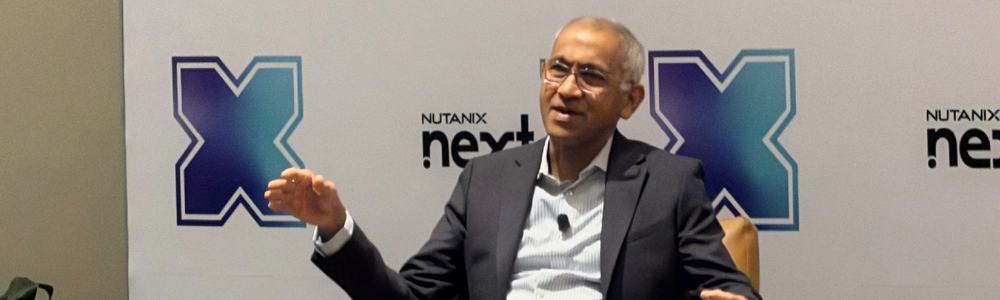
CHICAGO – Nutanix CEO Rajiv Ramaswami touted the vendor’s ability to lure disgruntled VMware customers, with plans to target more than half of its rival’s remaining base.
Ramaswami during a press briefing at the vendor’s .NEXT event this week said that VMware’s overall customer sentiment remains dour following its acquisition by Broadcom and subsequent changes to VMware’s go-to-market approach.
“I think there's no doubt that the customer sentiment continues to be negative about Broadcom,” Ramaswami said. “There's no doubt about it, and increasingly negative.”
That sentiment has allowed Nutanix to bolster its customer base. Ramaswami said the vendor has “about 30,000 customers," numbers bolstered by the hundreds of disgruntled VMware customers Nutanix has been attracting each quarter – and an amount that topped more than 1,000 customers added during Nutanix’s most recent fiscal quater – “and we expect that to continue,” Ramaswami added.
Ramaswami noted during that most recent earnings call that those most recent VMware churners represented “our strongest quarterly new logo additions in eight years.” Ramaswami later noted that “most of the logos came from our typical VMware migrations on to the HCI (hyperconverged infrastructure) platform.”
VMware migration waves
Ramaswami during this week's event explained that Nutanix’s ability to turn VMware customers so far has “come in waves.”
“We had a first wave of customers that started their migrations right after the deal closed, because they knew what was coming and they wanted to get out before their next renewal came, and we successfully migrated many of them,” Ramaswami said, noting this included “many large ones” that completed “migrations within a year.”
That second wave is ongoing and involves customers that are waiting out the VMware upheaval.
“There's a set of customers that didn't migrate, and they just wanted to see what was going to happen. And they had to do another renewal with Broadcom. And that happened,” Ramaswami said. “Now there's some subset of them looking to migrate … and they start the migration. They said, ‘I did this renewal. I want to get out before my next,’ so that's happening.”
The third expected wave is to come, driven by Ramaswami’s view on the “increasingly negative” sentiment among VMware customers and what the executive called “trigger points,” including VMware’s ongoing focus on its Cloud Platform 9 (VCF 9) offering.
“There'll be multiple trigger points, and we expect this to come gradually. It's not all going to happen overnight,” it’s going to happen “over the years,” Ramaswami added.
That third wave is expected to be driven by both cost and trust issues. Ramaswami noted that the former “calculus for customers” is changing, “because now they know what the cost is going to be, so they know the cost side of the equation,” while the latter is the evolving dynamic.
“There's cost and there is trust, and there is like … can they depend on Broadcom for their future needs?” Ramaswami stated. “Almost in all cases, I think customers think about this as, OK, I'm here. … I'm running my workloads currently at VMware, and yeah, it may take some time for me to get out, especially the larger I am, the more difficult it may be for getting out, but this is not the platform I'm going to bet on for the long term.”
Nutanix is betting that a lot of VMware customers will be working through those concerns.
Ramaswami said that Broadcom has an “installed base of probably 300,000 customers or so,” and “we are targeting about 165,000 of those customers … and we have a segmented approach to going after those customers.”
Those numbers align with analyst estimates that more than 100,000 VMware customers could eventually leave that vendor.
“Nutanix continues to be a top alternative to VMware in the wake of the Broadcom acquisition,” equity research firm William Blair wrote in a note on Nutanix’s latest earnings. “Adoption remains strongest in the mid-market where migration friction is lower, but Nutanix is increasingly gaining footholds within larger enterprises, often starting with partial deployments that can expand over time.”
Should Broadcom be concerned?
Broadcom, for its part, has remained confident of its VMware stewardship, with CEO Hock Tan repeatedly touting the firm’s ability to get more than 90% of VMware’s 10,000 largest customers resigned to new contracts.
However, the vendor’s most recent earnings showed muted growth from its VMware-housed software business. That division posted just 1% year-over-year growth during the quarter, an amount that was down significantly from the 19% growth posted during the final fiscal quarter of last year and the 47% growth reported for the first quarter of fiscal 2025.
Despite the slowed growth, Tan touted that VMware-specific revenues increased 13% year-over-year during the most recent quarter, with total bookings during the quarter in excess of $9.2 billion, and the executive also dismissed any notion that AI-type services have impacted this business.
“Let me reinforce that this growth in our infrastructure software business reflects our focus and investments in foundational infrastructure, and our infrastructure software is not disrupted by AI,” Tan said. “In fact … VCF is the essential software layer in data centers, integrating CPUs, GPUs, storage, and networking into a common, high-performance private cloud environment as the permanent abstraction layer between AI software and physical chips. … VCF cannot be dis-intermediated or replaced.”
Tan added that enterprises will come to rely more on VCF to help “scale complex, generative AI workloads effectively with agility that hardware alone cannot provide. We are confident that the growth in generative and agentic AI will create the need for more VMware, not less.”
CORRECTION: This story has been corrected to note Nutanix CEO Rajiv Ramaswami said the vendor had more than 30,000 total customers and not that it had attracted 30,000 customers from VMware.



Comments