


NEC launched a “Composable Disaggregated Infrastructure Solution” aimed at improving the flexibility of distributed computing resources.
Debuted in Japan, the offering is designed to help data center operators reduce capital investment and operating costs by using NEC's ExpEther virtualization technology to separate CPUs and GPUs from their physical enclosures, enabling them to be distributed over data center-scale networks.
By disaggregating compute components, NEC argues that data center resources can be more flexibly allocated as needed, preventing shortages during peak times and avoiding excessive idle times.
“[The Disaggregated Infrastructure Solution] facilitates flexible and efficient operation of various resources within data centers and enterprises, maximizing the overall utilization efficiency of systems,” the company said in a statement.
Data center disaggregation is far from a new thing, with early research efforts leading to the creation of concepts like Meta’s Facebook Open Switching System (FBOSS) for managing and controlling network switches across massive data centers.
Hyper-converged infrastructures (HCI) has held the crown in terms of how cluster operators manage compute resources, opting instead for a single, integrated stack. However, amid the rise of AI and its subsequent upending of traditional demands of high-performance computing, industry data projects the disaggregated infrastructure market will more than double by 2033, as operators will look for more ways to better manage their resources.
NEC’s offering looks to take advantage of that potential demand. Its offering sees ExpEther boards equipped with a 100 Gb/s (100G) version of the ExpEther IP core for Ethernet optical fiber connectivity to provide low-latency transmissions between disparate equipment.
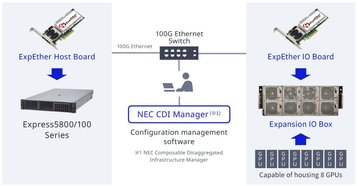
Further, an expansion IO box capable of housing eight GPUs and NEC’s infrastructure management software allows operators to configure their resources across different floors or buildings within data centers or enterprises, maintaining high scalability while ensuring adequate power supply and cooling capabilities across their entire stack.
NEC said it tested the offering with Osaka University as well as in its data center located in Inzai City, Japan, though the tech giant offered little in the way of details, saying “its effectiveness has been confirmed through joint verification,” with results being progressively published on the vendor’s website.
“The Composable Disaggregated Infrastructure Solution represents a significant step forward in optimizing computing resource management,” the company said. “By enabling flexible, distributed deployment and efficient utilization of resources, NEC aims to address critical challenges faced by data centers and research institutions.”
Set for initial launch in Japan, NEC said it plans to bring the disaggregated offering to “various sectors” in the future.
The disaggregated infrastructure solution launch comes as NEC doubles down on data center offerings.
The Japanese giant unveiled a 25 Gb/s bidirectional optical transceiver last September aimed at reducing complexity in coherent deployments when compared to higher-end 100 Gb/s systems.
It also demonstrated its tech in a team up with Hewlett Packard Enterprise’s Juniper-infused networking business as they augmented data center and campus infrastructure for Brazilian banking giant Ouribank. NEC was brought in to automate Ouribank’s network, while HPE Networking’s switches were utilized to boost facility interconnectivity.





Comments