

Huawei has revealed more details on the latest generation of its UnifiedBus interconnect protocol.
Debuted last September, version 2.0 acts as the backbone for SuperPoD clusters. The 2026 edition of Huawei’s Connect event saw the vendor reveal that more than ten undefined interconnect protocols come together under UnifiedBus in order to facilitate terabit-level interconnect bandwidth.
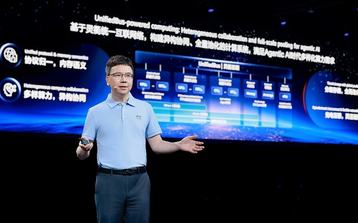
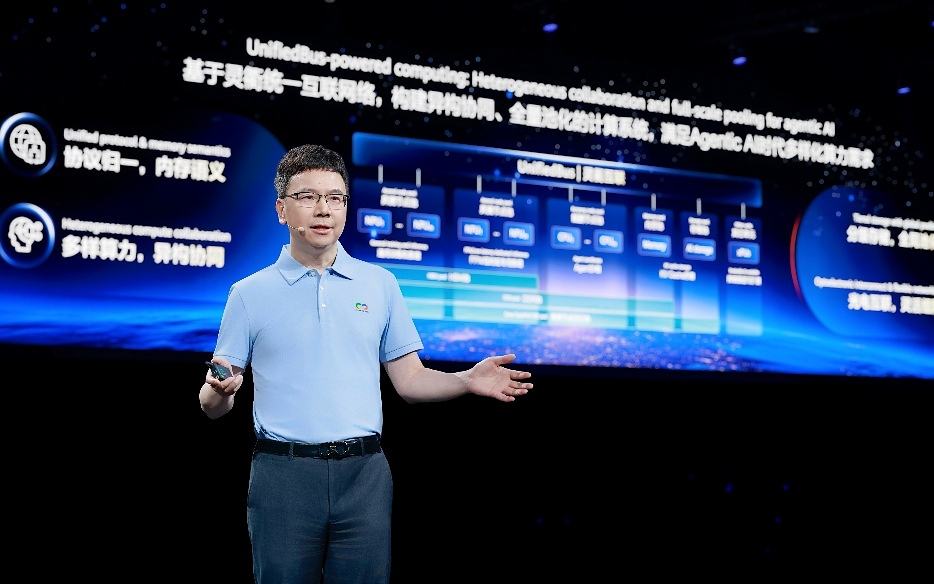
Capable of connecting CPUs with Huawei’s neural processing unit (NPU) custom silicon line, as well as memory devices, the vendor claims it breaks bottlenecks through decentralized, peer-to-peer access between memory and accelerators. Further performance enhancements come from UnifiedBus’ use of hybrid-media resource pooling – where different types of memory are used to form a single, unified pool, with data needs intuitively routed across the differing types of caches.
Describing the protocol as enabling an “ultra-high bandwidth, ultra-low latency ‘data highway,’” UnifiedBus forms the basis of a new line of high-performance Huawei products.
Top of the line is the UnifiedBus LinkBlade, which supports scale-up connections inside the cabinet. With an apparent cable-free design, Huawei claims the optics-based offering can replace some 121 miles (196 km) worth of copper cabling within a 4,096-NPU SuperPoD. At the scale-out level, UnifiedBus LinkDevice supports some 176 ports, each of which offers 1.6 terabits per second of bandwidth for a total of 280 Tb/s, which it claims is the industry’s highest-bandwidth, highest-port-count high-speed bus-protocol interconnect device
Across clusters, or scale-across networking, Huawei said its UnifiedBus UBG switch provides a radix fan-out capacity of up to 1,024, which would mean it could conceptually support a massive million-NPU SuperCluster.
In addition to going larger with its networking efforts, Huawei said it’s also looking at applying UnifiedBus on a much smaller scale. The vendor said it has developed UnifiedBus-based offerings that support between one and eight NPUs, touting it for use by small and medium-sized enterprises wanting to run trillion-parameter models locally.
Data center networking has quickly become a central play for Huawei as it looks to get billed as the home-grown AI infrastructure alternative to Nvidia. To make up for chip performance that lags slightly behind its Western contemporaries, Huawei has sought to pack as many chips in as possible to achieve on-par performance. Its CloudMatrix 384 offering, for example – which makes use of version 1.0 of UnifiedBus – packs five times more chips than Nvidia's rack-scale rival.
At Connect 2026, CEO of Huawei’s ICT Business Group and executive director of the board, Yang Chaobin, said its latest efforts culminated in collaborations with open-source efforts like DeepSeek Harness and OpenJiuwen.
“Huawei is committed to innovating at the system level, building a computing-foundation product portfolio, and going open source and open system,” Yang said. “We will continue working with customers, partners, and developers to help this ecosystem thrive and offer the world a new option for compute.”
UnifiedBus updates join to “upgrades” to Huawei’s Stellar AI Network solution spanning wireless access networks (WAN) and campus deployments.





Comments