


Huawei says it has "upgraded" its Stellar AI Network solution, improving lossless performance and adding what it described as intelligent, AI agent-based automation.
The offering, which spans AI fabrics, wireless access networks (WAN), and campus deployments, features a revamped version of its NetMaster network agent. The vendor claims the AI-based tool can perform root-cause analysis for 95% of network faults “within minutes.”
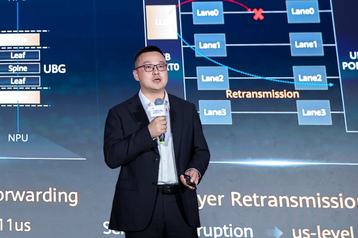
Sprinkling intelligence to ensure uptime looks to be a key theme of Huawei’s latest networking update. For example, its WAN-based offering features an algorithm dubbed “Starnet,” which it claims can eliminate long-distance packet loss, and thereby boost distributed computing efficiency to over 95%. Another algorithm is used to transmit only high-dimensional vectors over the network, ensuring raw data remains strictly on-premises.
Huawei’s intelligent algorithm push to make the network smarter extends to the campus, with the vendor claiming its Deep Causal Pruning (DCP) tech can optimize AI models to cut inference errors by more than 20% while boosting troubleshooting accuracy to 95%.
The City University of Hong Kong and Eskom, South Africa's state-owned electric public utility, are among those listed in a Huawei announcement as having carried out “joint innovation practices” for the wider Stellar AI Network solution.
Erick Zhang, president of the data center network domain for Huawei’s Data Communication product line, suggested that AI is turning traditional data centers into “compute factories,” and that in the emerging agentic era, underlying network fabrics “directly dictate token throughput and overall compute yield.”
While maligned in the U.S., Huawei was recently crowned a Leader in the data center networking space by Forrester. In an effort to stay even with its Western rivals, the vendor has doubled down on agentic AI and automation, culminating in recent updates to its Xinghe architecture and “Agentic Infra” stack.
In addition to AI automation, its latest round of “upgrades” saw the vendor showcase two switch families designed for high-density computing.
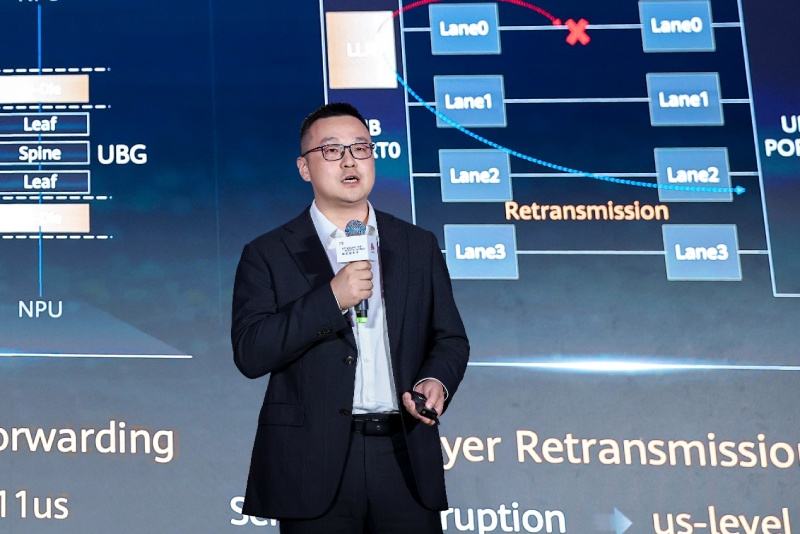
The CloudEngine SF9300 or UBG switch uses a two-layer multi-plane architecture, which reportedly provides end-to-end latency with microsecond-level recovery during cases of link flapping. The CloudEngine XH9300 uses near-packaged optics (NPO) to provide fast interconnections while using 40% less power draw.
The NPO-based switch comes just a week after Huawei publicly backed the technology over co-packaged optics (CPO), arguing it is more feasible today for large-scale deployments and more supply chain-friendly.



Comments