

Huawei upgraded its Xinghe enterprise and data center networking architecture to support deployments across Southern Africa.
Announced at the vendor’s Network Summit 2026 in South Africa, Huawei’s Intelligent Network Solution portfolio contains a slew of products like a data center network fabric and a converged wide-area network (WAN) offering. At its Africa-centric event, Huawei said its Xinghe “upgrade” provides capabilities to support AI and distributed agent workloads.
South Africa ranks as the highest nation on the continent for AI usage, per Microsoft figures, followed by neighboring Namibia. Africa as a whole severely lags behind the rest of the world in terms of AI usage among the world’s working-age population, though market penetration is still expected to soar. Mordor Intelligence projects the South African AI data center market alone to grow from $99.37 million in 2026, to $572.63 million by 2031, a 42% compound annual growth rate (CAGR).
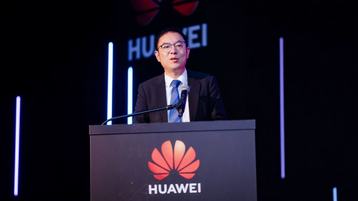
“Johannesburg is a vibrant city rich in opportunities, connecting talent, industries, and cultures across Africa,” Vincent Chen, Huawei’s VP of enterprise business for the Southern Africa Region, explained. “Today, AI is becoming a key driver of global innovation, and its adoption in Africa is transitioning from pilot exploration to real-world deployment, accelerating intelligent transformation across sectors such as finance, education, and public services."
Huawei's update is targeted at AI agent adoption, with Huawei warning that rapid usage places unprecedented technical demands on networks.
“Real-time AI interaction, multidimensional data flow, core business security, and other scenarios are driving networks to embrace an AI-centric paradigm shift,” Leon Wang, president of Huawei's data communication product line, added. “This marks a transition from ubiquitous ultra-broadband into a new journey defined by lossless computing power, integrated communication and sensing, full-scope security, and network autonomy.”
Huawei is also updating its Xinghe AI CloudCampus SaaS platform cloud-managed network operations tool in the region. This pay-as-you-go subscription model allows operators in Southern Africa to support bulk branch network configuration and deployments without upfront capital expenditure. A built-in copilot performs automated network resiliency management, with Huawei claiming it is capable of identifying and resolving around 80% of common network issues.
“In the past, intelligent operations and maintenance was a luxury exclusive to large enterprises. Now, we have deeply integrated AI into the cloud management service platform, enabling [small- and mid-sized enterprises] to easily access these capabilities as a cloud service,” Shi Lei, VP of network cloud engine (NCE) for Huawei's Data Communication product line, noted. “This is more than tech inclusion; it is about making AI network services genuinely accessible, affordable, and actionable.”
The Africa-focused updates follow the launch of an agentic AI security tool for Huawei's Xinghe platform. The aptly named Agentic Security Operations Center (SOC) aggregates data from across network switches, firewalls, and routers, with the compiled information fed into a unified knowledge graph that allows the AI to sift through logs from across multiple network layers.






Comments