


Cisco’s long-simmering integration work with Pure Storage and Nutanix hit a commercial milestone, with the trio now officially offering a converged stack of compute, storage, and software running in a modular architecture, a configurable package that could present migration opportunities for disgruntled VMware customers.
Jonathan Gorlin, director of product management at Cisco Compute, explained in a blog post that the FlashStack with Nutanix platform is a jointly validated offering that taps services from the three vendors.
Cisco offers up its UCS X-Series, C-Series, and B-Series servers; Pure Storage provides its FlashArray; and Nutanix its Cloud Platform that includes Nutanix Cloud Infrastructure (NCI) and its Acropolis Hypervisor (AHV). There is also non-volatile memory express (NVMe)/transmission control protocol (TCP) connectivity and support for Cisco Intersight, Nutanix Prism, and Pure1 unified lifecycle management platforms.
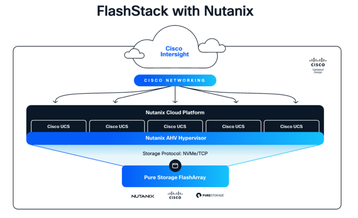
This converged stack can be run in greenfield environments or adapted to current vendor customers.
“With this architecture, organizations can design a predictable, consistent foundation for databases, enterprise applications, analytics, and cloud-native workloads – while maintaining the operational models they trust,” Gorlin wrote.
The work harkens back to last May, when Nutanix and Pure Storage struck a deal that tied the former’s AHV to the latter’s FlashArray platform. This linked Nutanix’s cloud infrastructure and its Flow virtual networking and security to the Pure Storage offering.
That link supported the deployment of Nutanix’s management layer on top of underlying servers that integrate the Pure Storage platform. Those server products are available from vendors like Cisco, Dell Technologies, Hewlett Packard Enterprise (HPE), Lenovo, and Supermicro.
Pure Storage and Cisco at that time also further extended Nutanix support to their more than 60 FlashStack validated designs.
Broadcom’s VMware in the crosshairs
Equity research firm William Blair noted at that time that the Pure Storage deal extended Nutanix’s competitive push against larger rival VMware, which the research firm said was fighting bouts of customer dissatisfaction. These issues came from Broadcom’s alterations to VMware’s pricing and licensing structure.
“Running standalone AHV on existing three-tier infrastructure provides dissatisfied VMware customers with an easier migration route off VMware as it removes the need for hardware refreshes,” William Blair noted in its report.
Nutanix has been one of the more vocal vendors in attempting to lure disgruntled VMware users. While the vendor has claimed success in getting thousands of VMware users to make the switch, Broadcom has also been successful in getting its highest-profile and profitable VMware users to stay.
Gartner’s most recent ranking of the market’s distributed hybrid infrastructure providers listed Nutanix alongside VMware, Amazon Web Services (AWS), Microsoft, and Oracle in the report’s “leaders” category.
The analyst firm did note that several clients had “expressed negative experiences” communicating with VMware sales staff and a lack of “prompt support service” – an issue that some customers previously suggested left them without security updates for weeks.
Ultimately, Gartner projects that 55% of organizations will test alternative infrastructure platforms by 2028, nearly quadruple the 15% currently exploring replacements.
Despite its woes, Broadcom received praise from Gartner for its early implementation of hybrid cloud deployments and “robust” partnerships with public cloud providers, with the analyst firm touting its VMware Cloud Foundation (VCF) platform as a “competitive offering for hybrid infrastructure management, edge computing, and sovereign workload use cases.”
Other vendors have also targeted this opportunity.
Lenovo recently unleashed a number of data storage and virtualized infrastructure systems. Stuart McRae, executive director and GM of data storage at Lenovo, at that time said “disruptions in enterprise virtualization strategies” are prompting organizations to consider making changes to their stack.
“These new offerings provide the security, flexibility, and performance to optimize enterprise applications and power enterprises to extract maximum value from data,” McRae added.
Broadcom, for its part, remains unfazed by the frenzy.
CEO Hock Tan recently touted VMware as a business driver, specifically pointing to VMware in helping Broadcom’s broader 24% year-over-year increase in full-year revenues, which hit a company record $64 billion. More specific to Broadcom’s infrastructure software business, which is where VMware sits, segment revenues increased 26% in fiscal 2025 to $27 billion for the full year.




Comments