


Broadcom’s licensing overhaul may have triggered headlines about VMware workloads defecting to hyperscalers, but Gartner’s latest Magic Quadrant for distributed hybrid infrastructure (DHI) suggests a market in flux, with disillusioned customers increasingly weighing their options while rivals jostle for position.
The customer revolt, outlined in the report, suggests a feeding frenzy among rivals competing to capture displaced VMware users frustrated by increased costs and what the research firm describes as deteriorating customer support.
Broadcom/VMware still achieved leader status in Gartner’s market analysis. However, increased costs following the shift from perpetual licensing to a subscription-based model were among the reasons Gartner clients cited for considering reducing or outright eliminating their reliance on VMware Cloud Foundation (VCF).
Compounding the vendor’s predicament were suggestions that several clients had “expressed negative experiences” communicating with VMware sales staff and a lack of “prompt support service” – an issue that some customers previously suggested left them without security updates for weeks.
Ultimately, Gartner projects that 55% of organizations will test alternative infrastructure platforms by 2028, nearly quadruple the 15% currently exploring replacements.
Despite its woes, Broadcom received praise from Gartner for its early implementation of hybrid cloud deployments and “robust” partnerships with public cloud providers, with the analyst firm touting its VCF platform as a “competitive offering for hybrid infrastructure management, edge computing, and sovereign workload use cases.”
While its rivals wait in the wings to snap up disgruntled customers, Broadcom CEO Hock Tan recently revealed that more than 90% of VMware’s 10,000 largest customers have signed up for the vendor’s revised subscription model – though questions remain over the value for Broadcom and smaller enterprises.
VMware's closest rival gains ground
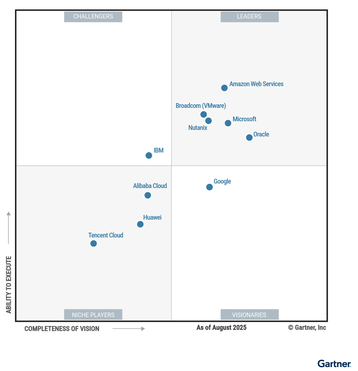
While Broadcom grapples with customer dissatisfaction, its competitors are positioning themselves to capture the displaced users. Chief among them is Nutanix, which has loudly nipped at VMware’s heels in recent months.
Nutanix was positioned closest to VMware in the "Leaders" quadrant, a spot the firm has been nurturing for some time. It has appeared in Gartner's distributed hybrid infrastructure analysis three times, achieving top status for the second time.
Now, the vendor is looking to continue taking advantage of the VMware exodus, with CFO Rukmini Sivaraman recently telling investors that Nutanix expects “mid- to high-three digits” worth of customer per quarter in fiscal year 2026.
In its Magic Quadrant analysis, Gartner praised Nutanix and its DHI offering’s single-stack approach for simple implementation, noting it avoids “the undesired complexity related to integrating multiple offerings.”
The firm also garnered praise for its identical operational model for applications and data, providing users with consistency whether applications run at the edge, in private data centers, or in public clouds.
There were some cautions, with Gartner citing a “limited cloud-first traction” and issues over price perception. Even its size was seen as a potential detractor, with some Gartner clients admitting to having passed over Nutanix because of the vendor’s size, “believing that larger-scale providers in the DHI space present less risk.”
Lee Caswell, Nutanix’s SVP for product and solutions marketing, said in a statement provided to SDxCentral: “We feel our positioning on both vision and execution in this year’s Gartner Magic Quadrant for distributed hybrid infrastructure is a direct reflection of our relentless focus on innovation and customer success.”
Hyperscalers compete for enterprise workloads
Amazon Web Services (AWS) was among the highest-positioned leaders in this Magic Quadrant, with Gartner praising the hyperscale giant for the range of use cases its broad DHI portfolio supports. Offerings like AWS Outposts, which provide fully managed on-premises infrastructure with a subset of its cloud services, drew plaudits for supporting data residency and sovereignty requirements.
According to Gartner, however, the cloud giant suffers from “low awareness” of its distributed hybrid infrastructure among non-AWS end users. Its Outposts offerings, meanwhile, were found to have limitations when operated without service link connectivity to AWS Regions.
Joining Broadcom, Nutanix, and AWS in the Leader segment were Microsoft and Oracle.
The former’s Azure Local, which replaced its Azure Stack HCI offering, drew praise for enabling centralized control, lifecycle automation, and visibility across distributed infrastructure assets. However, Microsoft’s revised offering was found to lack a “breadth of offerings that cover a significant range of DHI use cases, such as large on-premises deployments or lightweight edge.”
Oracle, meanwhile, was highlighted for its variety of sovereign options, with Oracle Cloud Infrastructure (OCI) described as being “well-suited” to handle AI applications due to being built on a high-speed, remote direct memory access (RDMA)-based network.
Despite its AI suitabilities, however, Oracle was found to lack a native generative AI model, with OCI focusing on delivering large-scale compute services for AI model builders and enterprises. Gartner said if OCI falls behind on its technical capabilities, “it risks losing these customers, who are driving large capital investments.”
Google bets big on AI and sovereign cloud
Google was the sole "Visionary" in Gartner's analysis, with the analyst firm noting the cloud giant’s decision to bank heavily on AI capabilities and sovereign cloud contracts to disrupt the distributed hybrid infrastructure market.
Described as a relatively new entrant in the hybrid cloud space, Google’s Distributed Cloud (GDC) offerings span from software-only Kubernetes deployments to air-gapped solutions designed for highly secure, isolated environments. The tech giant has aggressively moved to differentiate itself through AI, bringing its Vertex AI platform, Gemini models, and machine learning capabilities directly to on-premises and edge locations.
Its AI-first approach has already paid dividends in the public sector, with Gartner noting Google has secured “major public sector contracts” for national sovereign cloud initiatives by advancing its on-premises AI roadmap. Its zero-trust security architecture and strong identity management capabilities, meanwhile, have made it particularly attractive for government and defense customers with strict data sovereignty requirements.
However, Google's ambitious vision comes with execution challenges. Its emergence in the hybrid cloud space means its ecosystem lacks the maturity of established players. Gartner noted that Google's third-party integrations, partner support, and customer references aren't yet as extensive as market leaders.
More problematic for enterprises eyeing VMware alternatives, Google's hybrid operations remain inconsistent. GDC manages virtual machines (VMs) differently than Google's public cloud, using KubeVirt and local control planes that Gartner said “may require different tools and processes” than Google Compute Engine.
And for all its focus on AI capabilities, Google’s offerings aren't uniformly available across all GDC offerings, with many features still in preview or slated for future releases.







Comments