

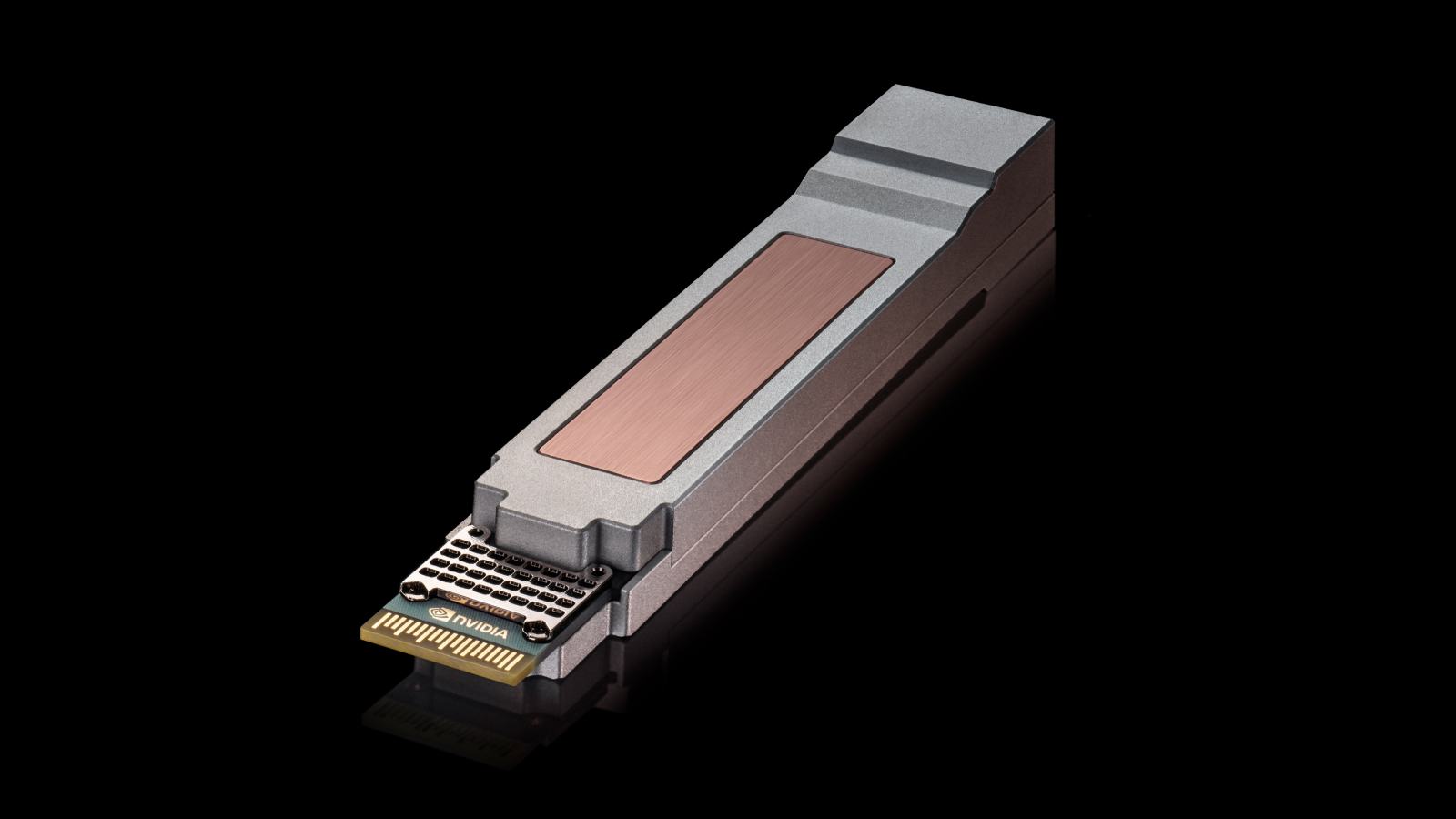
The main product launch is Cisco’s Ultra-dense Small Form-factor Pluggable (USFP) that was developed with ecosystem partners Nvidia, Amphenol, and TE Connectivity. Cisco claims the USFP is the industry’s first 400 Gb/s (400G)-per lane optics module.
The initial transceiver will include 16 full-duplex lanes in an octal small form factor-sized package that can support switches and network interface cards (NICs) with a path toward expansion to 32 lanes. This architecture can support a 6.4 Tb/s (6.4T) or 12.8T optics module, or what Cisco Silicon SVP Rakesh Chopra during a briefing on the news said is a “four-times bandwidth density increase” than anything else out in the market today with a “1.3-times improvement in terms of our efficiency as well.”
Toward that second claim, Cisco touts USFP supports power dissipation above 100 watts without the need for a separate embedded cooling circuit dedicated to the transceiver.
Chopra added that the platform was standardized as a “community-led multisource project” with “more details coming out about the USFP and its implication in the coming months.” It also builds on Cisco’s ongoing work with Nvidia to integrate the latter’s Spectrum-X Ethernet networking with the former’s Silicon One-based Ethernet networks.
Nvidia marketing director Brian Sparks during a separate press briefing, did clarify that while the two frenemies have had a “great” partnership “over the past year or so,” including a lot of work on Spectrum-X integration, the USFP move is not part of that partnership. “It's just Cisco and us and others in the ecosystem believe that USFP is the right solution moving forward,” Sparks said.
Cisco is also adding to its Silicon One G300 platform unveiled earlier this year with the G302 iteration, which is a 1.6T top-of-rack (ToR) design for front-end networks. Chopra described this as “taking all of the functions, the capabilities, the performance of G300 and shrinking it down in size to be deployable in top-of-rack switch style deployments” that drives manageability and simplification of infrastructure.
The final main product launch is the Cisco 8001 system that uses the Silicon One A100L. This platform will come in two versions: one based on 1 Gb/s and one based on 10 Gb/s support.
Chopra explained that the move to scale Silicon One into “management switches is just a natural extension” of the silicon platform’s scaling ability and that its newer architecture provides efficiency gains compared to products currently serving that market from the likes of Marvell and Broadcom.
“I think a lot of the silicon that maybe exists in this space is older in nature, and there's efficiency gains that you get by moving to newer process nodes in terms of overall performance and power,” Chopra said.
First-class SONiC
Cisco is also ratcheting up its support for software for open networking in the cloud (SONiC) specification, with the vendor set to extend that Open Compute Project (OCP)-housed OS to its Nexus 9000 hardware. Will Eatherton, SVP of engineering at Cisco, described the move as making SONiC a “first-class citizen” from Cisco, “which we believe is … unusual for Cisco in the context of our 20-, 30-year history.”
That upgraded citizenship comes with some Cisco-developed features like a focus on segment routing over IPv6 (SRv6) that it’s working to extend into the broader community; open config, programmable APIs, and to work with customers on management plane control; and integration of Cisco’s Isovalent and Cilium ecosystem into the Kubernetes layer.
This announcement had been hinted at earlier this year when Eatherton wrote in a blog post that Cisco was planning to include SONiC support on its CN9000-series data center switches. The actual support is set begin by mid-2027.
Cisco is also extending its Live Protect service to vendor-validated SONiC deployments running on its Nexus One platform, a move that extends that support from the current focus on Cisco NX-OS.
The Live Protect offering was unveiled earlier this year as a runtime cybersecurity platform tied to what Eatherton said is “all of the Glasswing-Mythos.” The Live Protect service itself is embedded directly into the operating system – NX-OS or now SONiC – that allows administrators to apply Cisco-validated compensating controls to infrastructure between regular maintenance upgrades.
Eatherton added that Cisco’s deepening SONiC support is about “working with the open systems, the open software from SONiC, adding new feature functionality, but also now adding in core infrastructure and security protection.”






Comments